


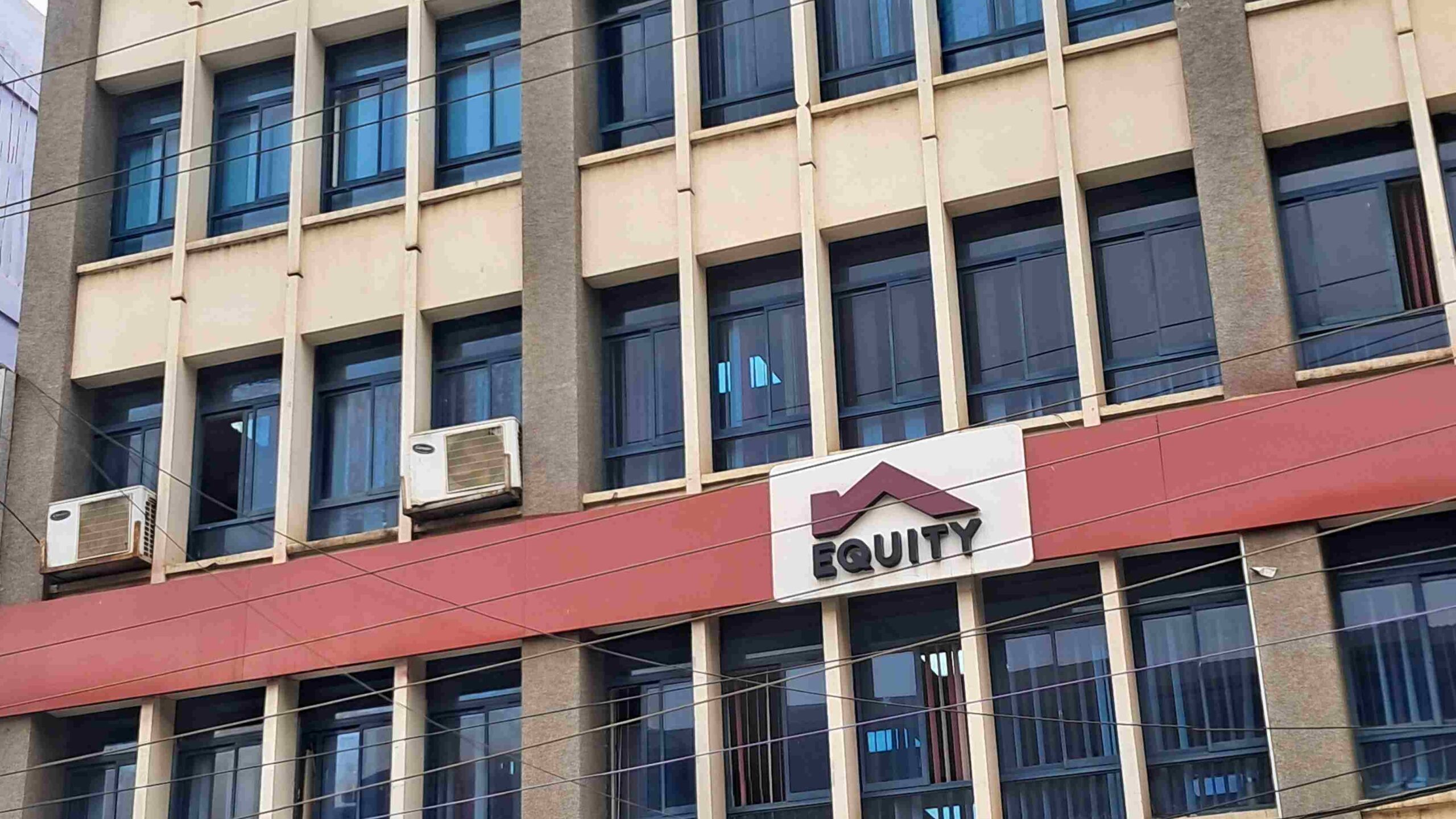
Equity Group emissions rose 19% in 2025, from 33,200 to 39,605 tonnes of carbon dioxide equivalent, while profit after tax rose 55% to KES 75.5 billion.
The group, listed on exchanges in Kenya, Uganda and Rwanda, says it has not concluded a climate transition plan and that no outside party has assured its sustainability figures.
Carbon dioxide equivalent converts every greenhouse gas into one measure. The 2025 Sustainability Report, which covers the year to 31 December 2025, lists emissions by scope and gives no group total, so Khusoko added the figures. Khusoko reported the profit result in March.
Equity Group emissions rose in all three scopes
Scope 1 covers fuel burned in generators and company vehicles. Scope 2 covers purchased electricity. Scope 3 covers the value chain, which the report lists as business travel and financed emissions, the emissions from activities Equity lends to.
| Measure | 2024 | 2025 | Change | Change % |
|---|---|---|---|---|
| Scope 1 (tonnes) | 17,474 | 20,213 | +2,739 | +15.7% |
| Scope 2 (tonnes) | 13,048 | 14,572 | +1,524 | +11.7% |
| Scope 3 (tonnes) | 2,678 | 4,820 | +2,142 | +80.0% |
| Total (tonnes) | 33,200 | 39,605 | +6,405 | +19.3% |
| Employees | 13,083 | 13,370 | +287 | +2.2% |
| Emissions per employee (tonnes) | 2.54 | 2.96 | +0.42 | +16.5% |
| Energy use (kWh) | 24,247,693 | 26,194,229 | +1,946,536 | +8.0% |
Source: Equity Group 2025 Sustainability Report, “Our GHG Emissions” section. Totals and percentages are Khusoko calculations.
Emissions outpaced both headcount and energy use. The report says the group “managed to reasonably limit the increase without compromising the sustainability of our business”.
Two banks account for 98% of the increase
Equity Bank (Kenya) Limited produced 65% of the 2025 total. The bank calls it “the source of the majority of Group revenue”.
| Subsidiary | 2024 (tonnes) | 2025 (tonnes) | Change | Change % |
|---|---|---|---|---|
| Equity Bank (Kenya) | 21,742 | 25,772 | +4,030 | +18.5% |
| Equity BCDC (DRC) | 6,626 | 8,889 | +2,263 | +34.2% |
| Equity Bank (Tanzania) | 1,014 | 1,515 | +501 | +49.4% |
| Equity Bank (South Sudan) | 469 | 527 | +58 | +12.4% |
| Equity Bank (Uganda) | 1,449 | 1,363 | Down 86 | Down 5.9% |
| Equity Bank (Rwanda) | 1,899 | 1,538 | Down 361 | Down 19.0% |
Source: subsidiary sections of the report. Khusoko added each bank’s Scope 1, 2 and 3 figures. The rows sum to 33,199 and 39,604 tonnes, one tonne below the group totals.
Equity Bank (Kenya) and Equity BCDC, the group’s Congolese bank, supplied 6,293 of the 6,405 tonne net increase. Equity BCDC’s Scope 3 emissions climbed from 1,086 to 3,353 tonnes, and the report does not explain why.
Equity blames expansion and better data collection
The report names two causes. The first is “significant business expansion during the year, including the growth of existing operations and the integration of new business units”. The second is improved data capture, which means the group now counts emissions “that may have been less precisely measured in previous reporting periods”.
The report calls the trend “seemingly counterintuitive to our sustainability ambitions”. It does not say how much of the rise comes from each cause, and its disclosure index lists restatements of earlier figures as not applicable.
The press release gives no emissions figure
The press release says the group invested a record KES 99.5 billion (US$771 million) in social impact and sustainability. It lists 9.1 million trees planted in 2025 and more than KES 26 billion in climate aligned finance.
On emissions, it says only that “the report also tracks the Group’s greenhouse gas emissions, energy and water consumption, and environmental impact”.
Equity has not concluded a climate transition plan
A climate transition plan sets out how a company will cut emissions over time. The report says “a formal climate transition plan has not yet been concluded”. It adds that a consolidated plan “is currently under development”, with foundational work in Kenya and Rwanda informed by a European Investment Bank technical assistance programme.
Moses Nyabanda, Managing Director of Equity Bank (Kenya) Limited, said in the report that “the process of setting internal GHG emissions targets remains work in progress”. GHG stands for greenhouse gas.
Dr. James Mwangi, Equity Group Managing Director and CEO, said the group is “working to establish a solid foundational baseline for operational emissions” and will advance its net zero commitments by 2030.
“Our responsibility is to continue to turn potential into productive opportunity while protecting the natural systems that make prosperity possible,” Mwangi said in the company’s statement on the report.
No outside party has assured the emissions figures
The report says “no external assurance has been provided” and that the group intends to seek it. It describes the KES 26 billion in climate finance as third party verified, which sets that figure apart from the emissions data.
IFRS S1 and S2 are the international sustainability disclosure standards. Prof. Isaac Macharia, Chairperson of Equity Group Holdings PLC, said the Board welcomes the Institute of Certified Public Accountants of Kenya (ICPAK) requirement for phased adoption and will oversee preparedness for “assurance expectations”.
The Board also cites a duty of “guarding against the risks associated with greenwashing or unsubstantiated sustainability claims”.
Khusoko’s Green Ledger has examined how independent assurance can raise confidence in sustainability reporting but cannot replace sound internal data processes.
Equity pitches climate finance while its data matures
The report makes the climate transition approach contingent on “access to concessional finance for green investments”. Concessional finance means loans on softer terms than the market. Macharia said the Green Climate Fund, an international climate funding body, accredited Equity as a Regional Direct Access Entity after the reporting period, which “positions us to mobilise global climate finance”.
H.E. Sebastian Groth, the German Ambassador to Kenya, said that “Equity Group is demonstrating that sustainability is not a luxury for the few, but the very engine of transformation for the many”. The emissions figures that sit beside that pitch carry no outside assurance.
Equity is not the only large Kenyan company reporting higher emissions. Khusoko reported on 27 October that Safaricom’s Scope 1 and 2 emissions rose 9.1% in FY26. Equity’s Scope 1 and 2 emissions combined rose 14.0% in 2025.
