


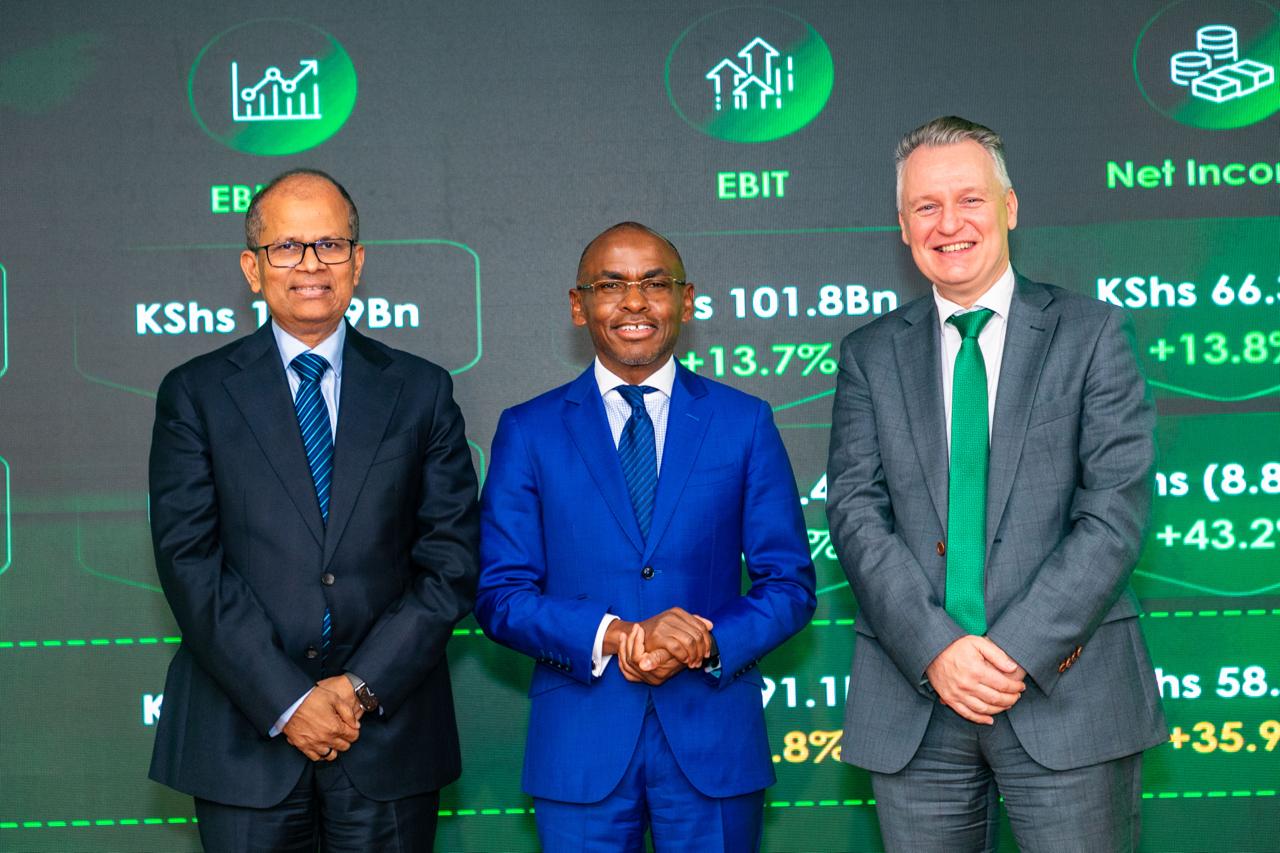
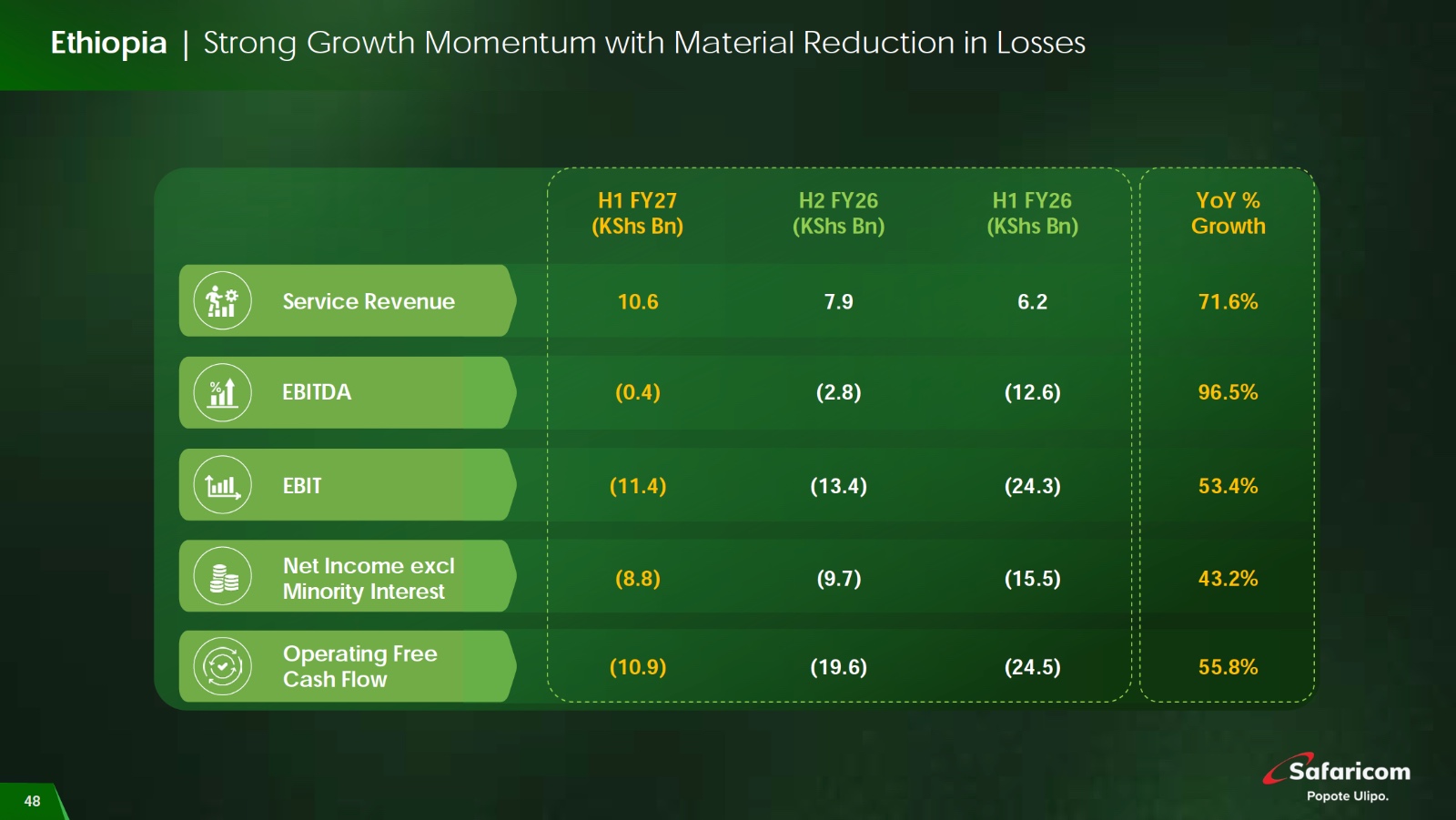
Safaricom Ethiopia break even moved closer in the six months to September 2026. Safaricom Ethiopia Telecommunications PLC cut its loss before interest, tax, depreciation and amortisation (EBITDA) by 96.5% to Sh0.4 billion, and its funding now includes US$474 million of debt.
Shareholders who financed the business mostly with equity face a smaller cash drain, but Safaricom says it needs prices that cover its costs, and the regulator controls the next price steps.
Peter Ndegwa, Safaricom’s group chief executive, said the company expects Ethiopia to break even at the EBITDA level by the end of its financial year in March 2027. The board backs the investment and set three priorities for the group at the half year briefing.
Customers rose 38.4% and data supplied 81.2% of revenue
Ethiopia service revenue rose 71.6% year on year to Sh10.6 billion, and customers rose 38.4% to 15.4 million, Safaricom said. Mobile data supplied 81.2% of service revenue and voice supplied 9.1%.
In Ethiopian birr, revenue more than doubled to 13.1 billion, Dilip Pal, Safaricom’s chief financial officer, said. Adil Khawanja, the board chair, gave the growth as 102.1%.
Wim Vanhelleputte, chief executive of Safaricom Ethiopia, said revenue grew on more users, more usage and a higher rate, with each driver contributing about equally.
Cost control and insourcing held the loss down
Vanhelleputte said keeping the cost structure under tight control was crucial to the half year result. EBITDA equals revenue minus operating costs minus cost of sales, so Safaricom had to move all three together.
He said insourcing work and localising costs as the business grew limited the foreign exchange exposure it faced in earlier reporting periods.
Safaricom Ethiopia break even covers EBITDA, not profit
Losses remain below the EBITDA line. Ethiopia posted a loss before interest and tax of Sh11.4 billion, down 53.4%, and a net loss of Sh8.8 billion, down 43.2%, according to the results Khusoko reported earlier.
Kenya’s EBITDA margin stands at 57.7%. Vanhelleputte said Ethiopia has “a very long way to go” to catch up with where the Kenya business has been.
Price floor steps depend on the regulator
A regulatory directive sets the minimum price the Ethiopian market must reach over the long term, Vanhelleputte said. Prices were adjusted a few months ago and more steps will follow. Their pace depends on the regulator and on Safaricom’s talks with it, and the change of government delayed the process.
Ndegwa said regulator led action helps build a more sustainable industry, but prices tied to minimum cost need further correction.
“We do need pricing that reflects the minimum cost of delivering service,” he said. Safaricom still needs to invest in Ethiopia, he said.
The Middle East conflict disrupted fuel supply and raised transport costs, Ndegwa said. That hit customer affordability and slowed network rollout.
Debt reaches 20% of equity as the heavy capex phase ends
Safaricom Ethiopia’s funding closed at US$2.84 billion, up US$193 million since March 2026, as Khusoko reported earlier. Debt now makes up a larger share of the mix.
| Funding at the half year | US$ |
|---|---|
| Equity | 2.37 billion |
| Local currency debt | 163.0 million |
| Foreign currency debt | 311.0 million |
| Total | 2.84 billion |
Pal said Safaricom chose to add debt to optimise the capital structure, which lifted debt to equity to 20.0% in the half. He said it was critical, and will stay critical, for the subsidiary to raise financing on the strength of its own balance sheet. “No business is sustainable that way,” he said of the earlier equity only model.
Pal said the phase of heavy capital spending in Ethiopia is behind the company and creates a tailwind. He said spending on capacity will continue for a few years. Safaricom left its capital spending guidance unchanged as Ethiopia moves to a more normal investment level, Ndegwa said.
Over the past three years, US$100 million of spending left Ethiopia with US$80 million of assets, Vanhelleputte said, because the rest ran the operation. “Now, 100% of whatever funding you can get into the business goes straight to assets,” he said.
Board backs Ethiopia and sets three priorities
Khawanja said the board remains committed to the Ethiopia investment and encouraged by progress. He said success depends on understanding the market’s needs, strengthening customer relationships and executing the strategy.
He said Safaricom supports regulation that protects consumers and promotes fair competition. Rules must also recognise the long term investment that telecoms and financial services need, he said. Khawanja did not mention Ethiopian pricing in those remarks.
The board’s first priority is to strengthen the Kenya business and protect its leadership. Its second is to accelerate growth in financial services and enterprise technology platforms. Its third is financial and operational discipline, with investments that “must generate sustainable returns”.
Khawanja said the board expects management to lead change, not respond to it. “Our responsibility is now to build on that success, not simply protect it,” he said.
Ethiopia still costs Safaricom Sh8.8 billion in net loss
Ethiopia’s Sh8.8 billion net loss sits inside group net income of Sh58.2 billion, which rose 35.9% in the half, as Khusoko reported. Safaricom kept its financial year 2027 guidance, citing lower Ethiopia losses.
Ndegwa said Safaricom won the Ethiopia licence during COVID, when interest was low, and credited the board’s support.
The next fact to watch is the end of Safaricom’s financial year in March 2027, when Ndegwa expects Ethiopia to break even at the EBITDA level. The regulator has set no dates for further price steps.
