



Safaricom will retire its M-PESA app and its MySafaricom app in the coming months and move customers to the Safaricom One app. Anyone who uses either older app will need to switch, though the company has not set dates.
The company said 7.3 million people downloaded the One app in the first half of its 2026/27 financial year.
Safaricom One app takes over from two apps
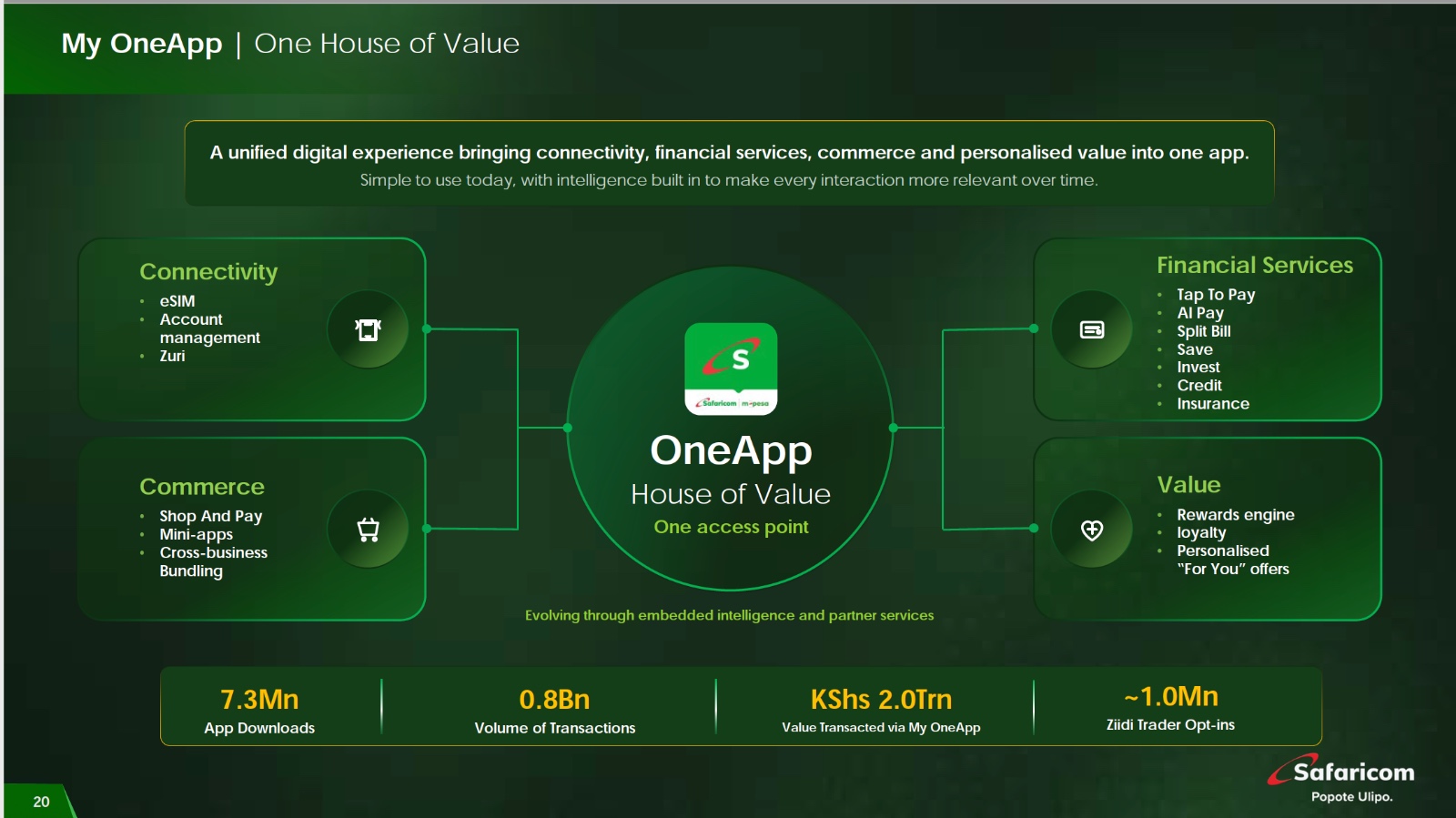
Peter Ndegwa, Safaricom’s group chief executive, called the One app “our house of value” at the results briefing. It brings connectivity, financial services, e-commerce and personalised offers into one place, and 4.5 million people use it each month.
Ndegwa said Safaricom made mistakes when it launched the app and has corrected them. He said the company now needs to scale it. Safaricom also launched a Sharia compliant money market fund, and Ndegwa said 1.5 million people engaged with it within two months.
Shared wallets, QR codes and Tap to Pay come to M-PESA
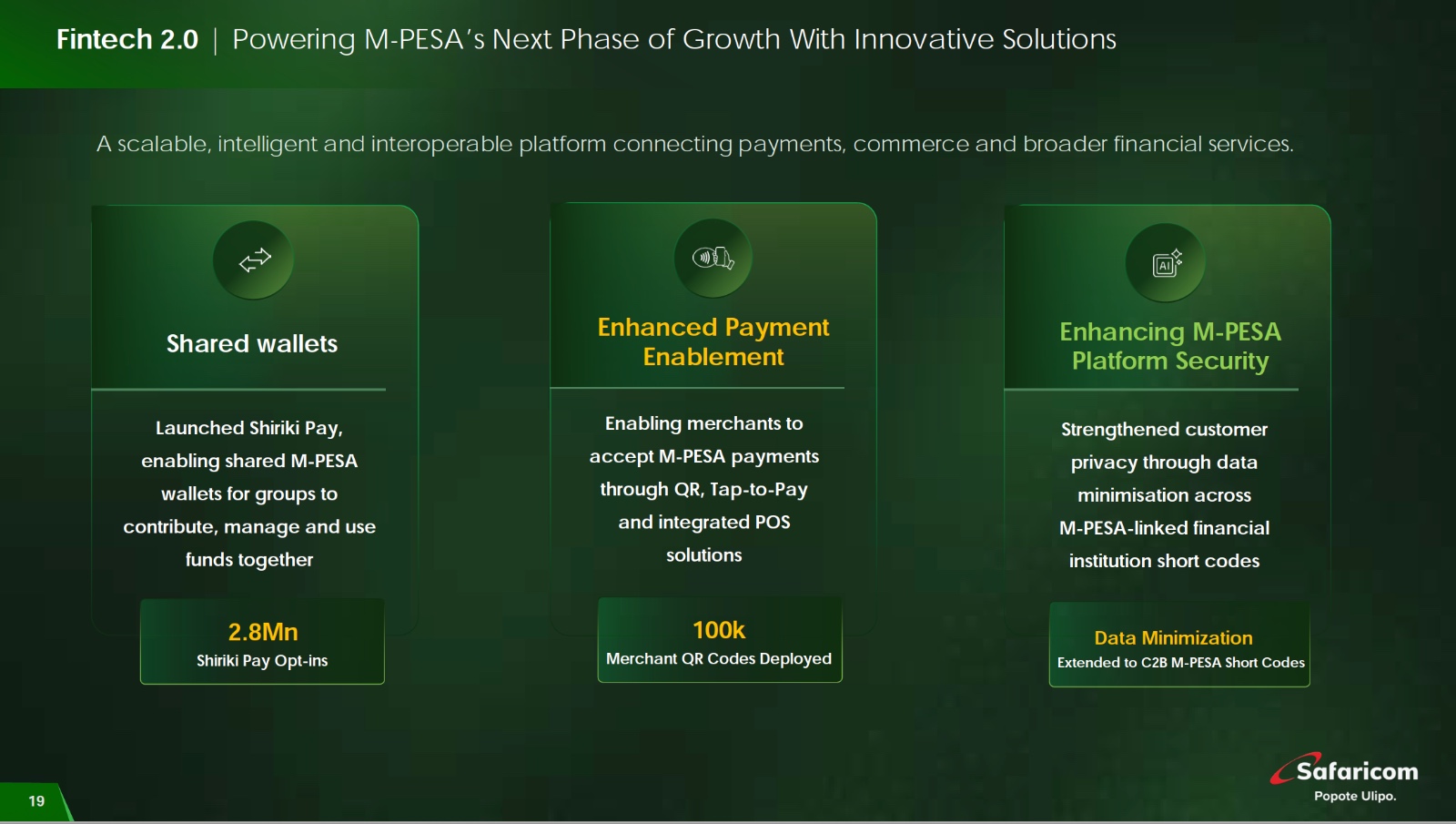
Safaricom launched Shiriki Pay, which lets groups contribute to and spend from a shared M-PESA wallet. A total of 2.8 million customers opted in.
Merchants can now accept M-PESA through QR codes, Tap to Pay and integrated point of sale systems, and Safaricom deployed 100,000 merchant QR codes.
The company also extended data minimisation, a privacy measure, to C2B M-PESA short codes. C2B means payments from customers to businesses. Khusoko reported on 30 October that Safaricom cut fraud incidents 82% but missed its target.
Most shop payments cost nothing, and revenue per payment falls
Safaricom serves 4.5 million merchants, and about 80% of merchant transactions cost nothing, Ndegwa said. Dilip Pal, Safaricom’s chief financial officer, put the figure at 81% and said 63% of consumer payments also cost nothing.
He said Safaricom raised the payment size that stays free from KSh100 to KSh200 for small merchants and from KSh200 to KSh500 for formal merchants.
Dilip said lower revenue per transaction, which Safaricom calls the take rate, is deliberate. “Take rate will decline,” he said, and he expects volume growth to offset it. He said overall volume grew 25% and value grew 70%.
These merchants work in a labour market where informal jobs made up 83.8% of Kenya’s employment in 2025, according to a World Bank update. Safaricom also plans business asset cover from KSh1,700 yearly, and it serves 17.5 million active credit customers each month. Ndegwa said the second half will bring more credit services for merchants, and tools to help them run their businesses.
AI tailors offers for 70.7 million customers each month
Safaricom said its AI tools now deliver recommendations and tailored offers to 70.7 million customers a month, about half of its active base. It also uses AI for fraud detection and for digital customer journeys. Internally, it runs a programme to build AI skills among staff.
Adil Khawanja, Safaricom’s board chair, set a test for this spending. “We should not judge our progress simply by how much we invest, but by the value of those investments,” he said. M-PESA and Safaricom also took first and second place on the 2026 Kenya Superbrands list.
Fixed broadband passes 900,000 homes and connects 474,000 on fibre
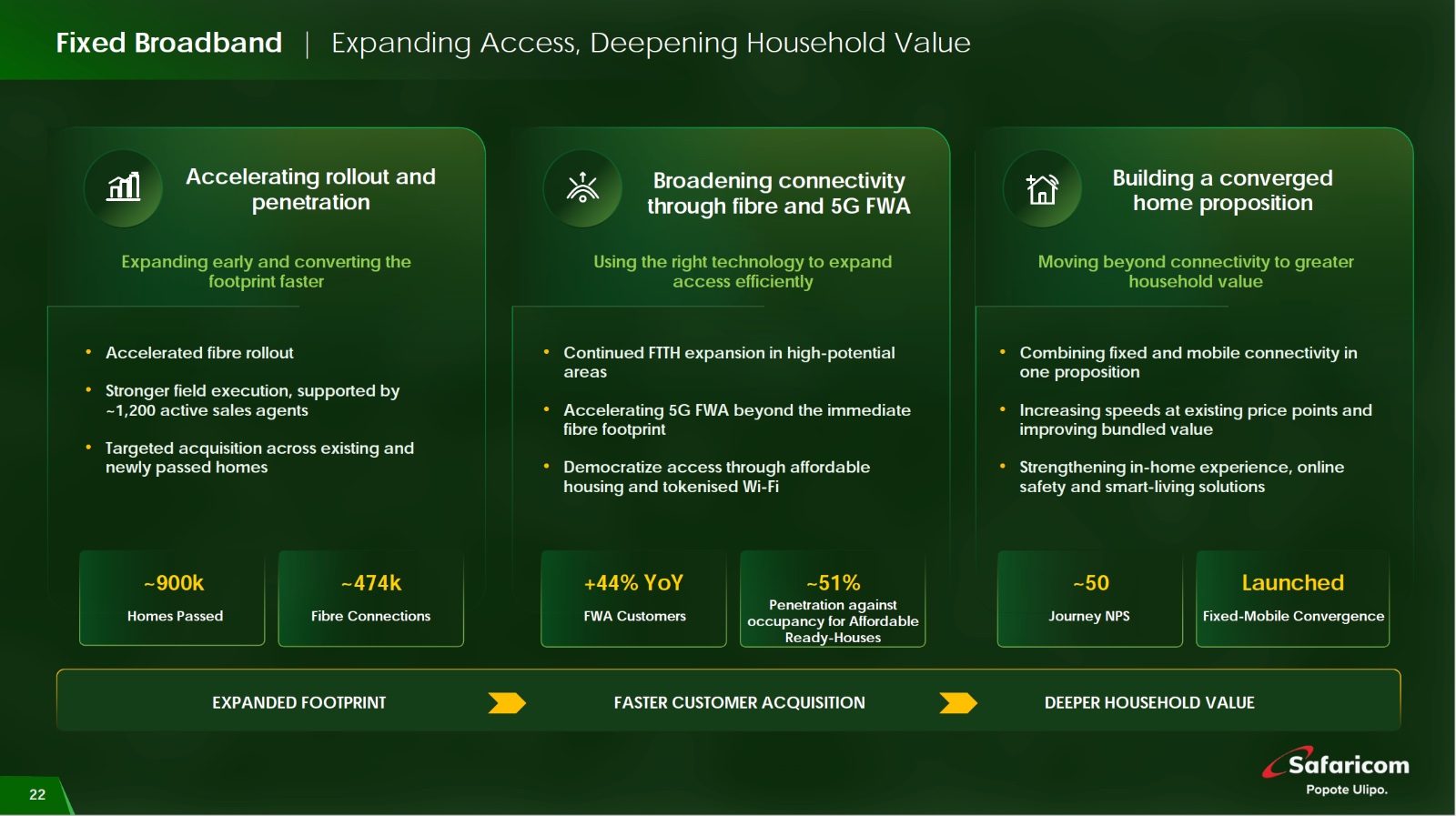
Safaricom reported about 900,000 homes passed and about 474,000 fibre connections. Customers on fixed wireless access over 5G rose 44% year on year. About 1,200 active sales agents support the rollout.
The company sells tokenised Wi-Fi, which lets customers buy connectivity in smaller packages. It also launched a bundle that combines fixed and mobile connectivity. Airtel Kenya, a rival, paid US$65 million for 100 MHz of 5G spectrum in the 3500 MHz band, according to its parent company Airtel Africa.
Enterprise and government customers get cloud, security and connected devices
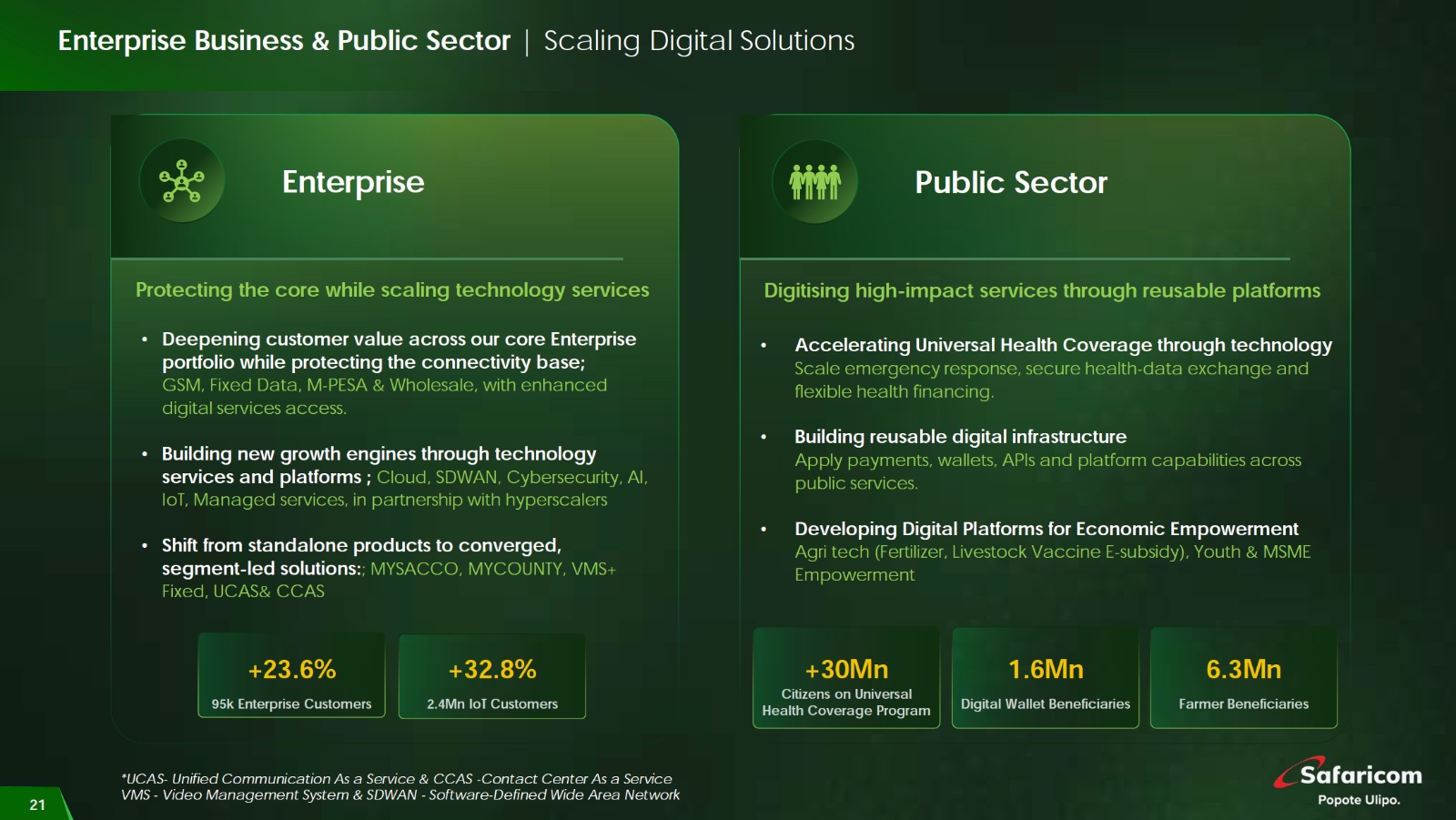
Safaricom reported 95,000 enterprise customers, up 23.6%, and 2.4 million IoT customers, up 32.8%. IoT means connected devices such as sensors and trackers.
Its enterprise offer now includes cloud, cybersecurity, AI, managed services and SDWAN, a software controlled network that links company sites. It builds these with hyperscalers, the large cloud providers.
In the public sector, the slides show more than 30 million citizens on the Universal Health Coverage programme, 1.6 million digital wallet beneficiaries and 6.3 million farmer beneficiaries. Khusoko reported that four in ten Kenyans hold health insurance, mostly through the Social Health Authority.
What changes for customers
M-PESA and MySafaricom app users will need to move to the One app. Shop owners keep most payments free while Safaricom shifts its earnings to volume.
Households can buy fibre or 5G fixed wireless access and bundle either with mobile service.
Safaricom Kenya’s service revenue grew 11.3% to KSh216 billion in the half. Kenya earnings before interest and tax rose 13.7% to KSh101.8 billion, and net income rose 13.8% to KSh66.3 billion.
Ethiopia served 15.4 million customers, and its loss before interest, tax, depreciation and amortisation narrowed by 96.5% to KSh400 million.
Safaricom kept its financial year 2027 guidance, and capital spending guidance is unchanged. The next facts to watch are the retirement dates for the two older apps, which Safaricom has not set, and the end of the financial year, when Ndegwa expects Ethiopia to break even at that earnings level.
