



African AI audits tend to examine models. A panel convened by the African Internet Rights Alliance (AIRA) argued that the decisions that shape harm come earlier: who funds a system, who sets its purpose, whose data feeds it and which contract governs it. Public records on compute, regulation, courts and labour support much of that argument.
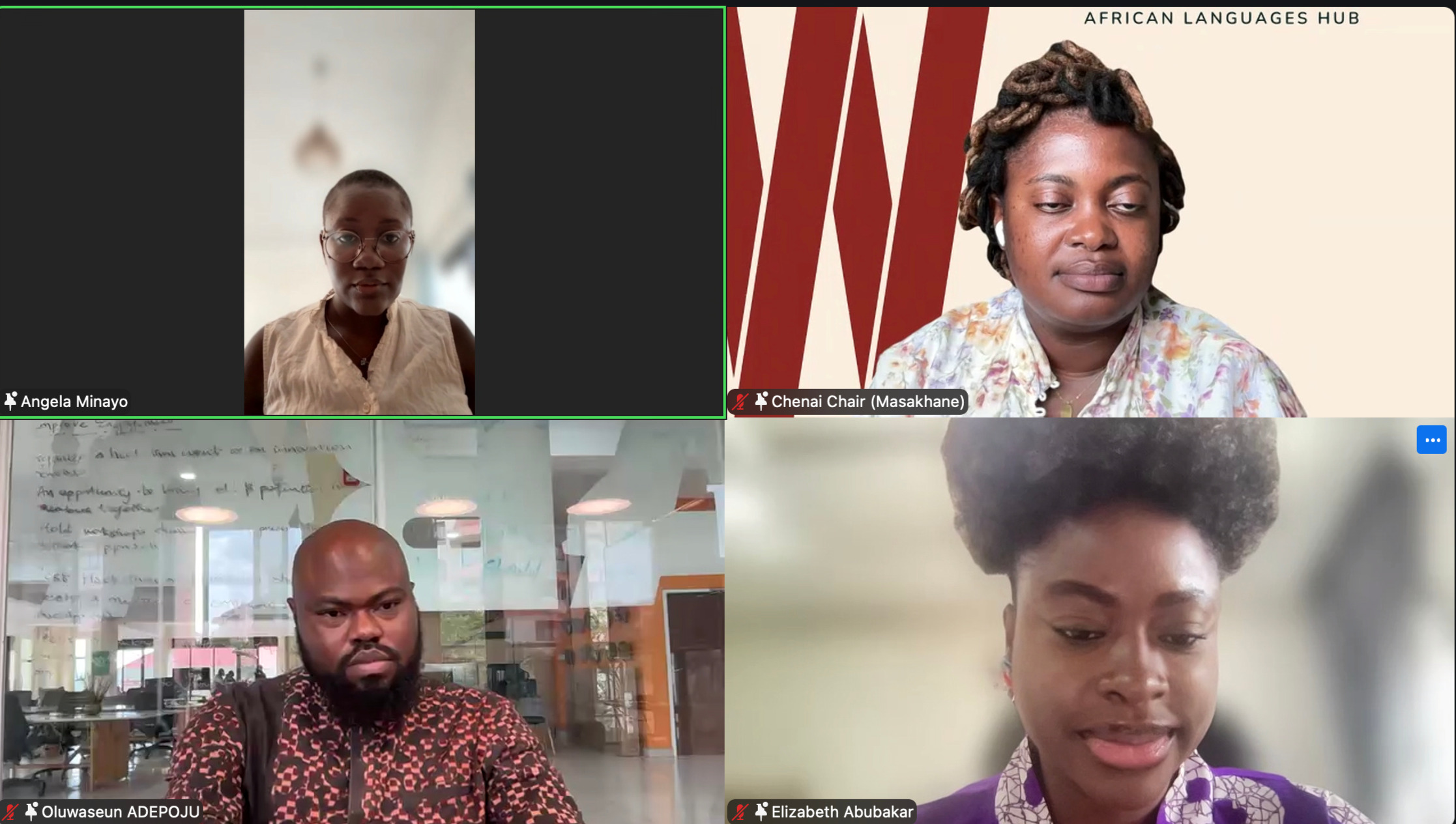
The webinar brought together Chenai Chair, Director of the Masakhane African Languages Hub, researcher Rebecca Ryakitimbo, policy specialist Elizabeth Abubakar and Dr Oluwaseun Adepoju. Angela Minayo of AIRA moderated. Her question was where civil society should enter the AI value chain.
The audit starts with the funder
Chair told civil society to audit the development money entering AI projects. “Tell me where the money came from, who was involved in the process, and ultimately, what does it benefit you?” she said.
She said many health and farming tools run on models built outside Africa, often Meta’s Llama, and that most compute contracts sit with Amazon, Microsoft and Google. She said the terms lock buyers in.
Her own sector shows how that money flows. In May 2026, Microsoft, Google.org and the Gates Foundation launched LINGUA Africa with the Masakhane Hub, with grants of up to $250,000. Twenty six projects won funding in data creation, tools and applied use, paid as cash and compute or compute only. The programme places large technology companies among the funders of African language data, the sector whose ownership terms Chair says need scrutiny.
Chair described the issue as value flowing in one direction. Early datasets relied on voluntary contributions from speakers. Later, she said, “people don’t capture those benefits of having contributed their text, their speech, their imagery into a data set.” She added that open source terms in older donor contracts mean “the African continent is always constantly providing the least valuable aspect of the chain.”
Masakhane has started to address licensing. Its workshop at the Deep Learning Indaba in August 2026 covered consent, data provenance and licensing frameworks that place ownership with African communities.
Abubakar said donors and states can use funding to influence compliance and audit standards. “It’s not just monetary support. It is becoming a geopolitical strategy to influence how standards are used,” she said. She urged groups to request procurement records and to ask who defined success and who sat in the room when the contract was signed.
Compute shapes who can say no
The panel returned to infrastructure several times. Ryakitimbo said gender analysis rarely reaches compute, cloud services and standards. Chair asked whether Africa needs large language models at all, or whether smaller models on better infrastructure would serve it.
The numbers support the concern. The Africa Data Centres Association reports that Africa holds 0.6% of global data centre capacity and projects installed capacity to reach about 1.2 gigawatts by 2030. The association says that growth tracks global expansion and does not close the gap. Outside South Africa, only about one third of built capacity is fully used. A summary of the World Bank’s October 2026 Africa Economic Update puts Africa at nearly 18% of world population, about 2% of AI training data and 0.6% of data centre capacity.
Abubakar cited Kenya as a case where power sets the limit. Microsoft and G42 planned a $1 billion geothermal data centre at Olkaria, starting at 100 megawatts with a path to one gigawatt. Talks stalled over payment guarantees and electricity demand. President William Ruto said that “to switch on that one data center, we would need to shut off power for half the country.” Kenyan officials said discussions continued.
Regulation is thin, and courts fill the gap
Abubakar said regulators lack capacity to enforce rules and asked whether people have a route to appeal when an AI system harms them. The African Union endorsed its Continental AI Strategy in July 2024. As of July 2025, 16 of 54 countries had launched national strategies, according to Intelpoint.
In one case Abubakar cited, litigation has moved faster than legislation. In January 2025, the Pretoria High Court declared several regulations for South Africa’s Social Relief of Distress (SRD) grant unconstitutional, including the rule that applications be lodged on an electronic platform only. The Institute for Economic Justice and #PayTheGrants brought the case, represented by the Socio-Economic Rights Institute. The court also found the R624 monthly income threshold and the database checks on income unconstitutional, according to a Fasken summary.
The algorithm entered the case through the South African Social Security Agency’s online system, which checks eligibility automatically. The Centre for Applied Legal Studies describes an automated verification system that excluded applicants it judged to have income above the threshold. The Global Center on AI Governance, represented by the Centre, joined the appeal as a friend of the court.
The state appealed. The Supreme Court of Appeal in Bloemfontein heard the matter on 25 August 2026. Daily Maverickreported that the applicants cited a 33% database error rate and a 99% appeal rejection rate. National Treasury warned that expanding the grant as the High Court ordered could cost up to R139 billion a year. The court reserved judgment, and no ruling had been published at the time of writing.
Abubakar described civil society as an “evidence builder” in such cases. In this one, the applicant groups carried the case in the High Court and the Centre supplied the AI governance argument on appeal.
Regional bodies are gathering evidence too. The African Commission on Human and Peoples’ Rights is conducting a study under Resolution 473, and it invited comments on a draft in 2025. Minayo said the research was desk based and that the Commission needs support to build its own AI capacity.
Workers sit inside the value chain
Ryakitimbo asked whose labour makes a system work. She named data annotators, content moderators, community researchers and translators. “Their labour is invisible and undervalued,” she said. Chair said Masakhane’s published standards cover labour at the data labelling end of the chain.
Kenya offers a documented case. Around 200 former content moderators sued Sama and Meta in Nairobi over pay and mental health support, and they seek $1.6 billion. Sama says it paid four times the local minimum wage and offered unlimited mental health support. In April 2026, Sama said it would lay off 1,108 staff after Meta ended a contract for AI data labelling. The case continues.
Gender is a question of power
Ryakitimbo said audits count women in datasets and stop there. She asked auditors to define gender before measuring it. “Whose gender are we talking about?” she said. She proposed four tests: who defines the problem, whose knowledge counts, whose labour is used and who controls access.
Adoption data shows the gap she described. The GSMA’s 2026 mobile money report, which Abubakar cited, recorded more than $2 trillion in transactions in 2025. It also found that, outside Ghana, Kenya and Nigeria, women who own accounts are less likely than men to have used them in the past month.
Adepoju raised harm that audits do not measure. He said AI generated sexual images are used against women, and that a report he worked on found a woman or girl on the receiving end of AI abuse every 30 seconds. “Any AI audit that doesn’t look at harms in terms of emotional, physical and psychological effect is not an audit,” he said. He also named a surveillance risk in paid add on tools that connect AI models to email and meetings, and said few audits examine them.
Knowledge as the entry fee
Adepoju said advocacy now requires technical knowledge. “There’s no advocacy without technical understanding in the age of AI,” he said. He cited Masakhane’s research as the reason groups can argue for linguistic equity with evidence. Masakhane’s benchmark work, including AfroBench, tests language models on 64 African languages and found large gaps between English and African languages.
Chair said capacity should run both ways. Civil society needs technical training, and builders need help entering policy spaces. She said the two groups attend separate events, such as Deep Learning Indaba and FIFAfrica, and should attend each other’s. On the African Union, she said Masakhane reaches intergovernmental bodies through foreign funders. “If you are African, you do not get first audience,” she said.
Blind spots named
Each speaker named a gap.
- Indigenous knowledge. Adepoju said sectoral AI will define the next five years and that African knowledge in areas such as agriculture and animal species is poorly captured. “The people who own the history need to do the work,” he said.
- Redress. Abubakar asked whether people can appeal a harmful AI decision. She said non enrolment or dropping out of a service can signal lost trust and should count in audits.
- Sustainability. Chair asked whether African groups buy tools built by African developers. She said an audit system should track growth as well as harm, and should cover banking and health sectors that already have safeguards.
- Gender across the chain. Ryakitimbo said gender analysis should reach infrastructure, not stop at data and applications.
