


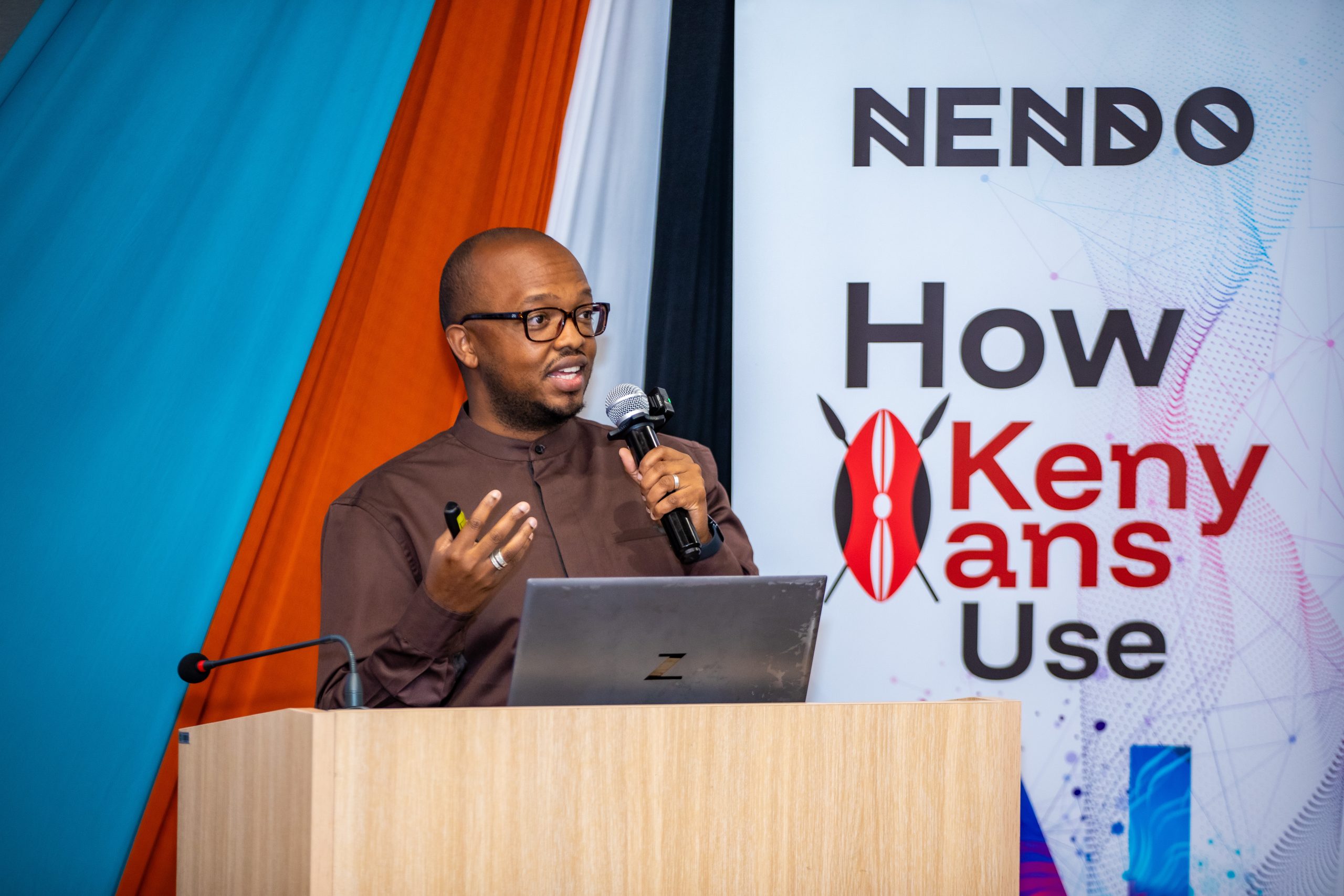
More than half of the Kenyans in a Nendo survey use AI every day. Seven in ten have turned to it for emotional support or a personal situation.
Nendo, a Nairobi based research, marketing and training agency, published the findings on 29 September 2026 in “How Kenyans Use AI.” Its founder, Mark Kaigwa, discussed them on NTV’s Fixing the Nation.
Kaigwa leads Nendo, which works across Africa and the Global South. The report rests on fieldwork by LOOKA in May 2026.

Who answered the survey
LOOKA interviewed 1,200 people online. A total of 1,161 who use AI completed the detailed module. They live in 18 counties, among them Nairobi, Uasin Gishu, Kiambu, Nakuru, Turkana and Marsabit. Women numbered 551 and men 610. Ages ran from 18 to 55 and over.
The sample is not the general population, and Kaigwa said so. Respondents were online, owned a smartphone and already used AI. The results are unweighted and self-reported.
In July 2025, GWI data put ChatGPT use among Kenyan internet users aged 16 and over at 42.1% in the past month, the highest of any country. The measure covered internet users, not all Kenyans. A later DataReportal update found that 97.5% of surveyed internet users in Kenya had used at least one AI tool in the past month.
Pew Research Center’s spring 2025 survey of 25 countries found Kenya at 12% for people who had heard a lot about AI, with 49% saying they had heard nothing. Pew’s 2026 update of 37 countries put Kenya at 16% and 50%.
“We said both can be true,” Kaigwa said. “Kenya is still the Silicon Savannah, but maybe Kenya is not the AI world leader.”
ChatGPT leads, Meta AI follows
ChatGPT was the most used tool in the past 30 days, followed by Meta AI and Gemini. Grok ranked ahead of Claude.
| Tool | Heard of (%) | Ever used (%) | Used in past 30 days (%) |
|---|---|---|---|
| ChatGPT | 92.8 | 90.8 | 84.5 |
| Meta AI | 80.2 | 74.9 | 67.0 |
| Gemini | 76.7 | 66.1 | 57.6 |
| Grok | 50.1 | 40.2 | 32.4 |
| Claude | 43.2 | 31.4 | 23.8 |
| Copilot | 46.5 | 30.9 | 19.7 |
| DeepSeek | 42.5 | 30.2 | 18.7 |
Source: Nendo and LOOKA, May 2026, n=1,161. Respondents could choose more than one tool.

Kaigwa credited distribution. Meta AI sits inside WhatsApp, Instagram and Facebook, so users need no download. Gemini reaches Android users, who hold about nine in ten smartphones in Kenya. Grok draws on its link to X. Kaigwa said people use it to argue with and fact check public figures. The report adds that Chinese tools are gaining users as American tools raise token prices.
Of respondents, 78.6% used two or more tools in the past 30 days. Another 34.9% used four or more. Kaigwa called ChatGPT “the Kiwi of AI,” meaning the brand name people use for the whole category.
Phone or laptop changes how people use AI
Respondents who also own a computer use AI more deeply than those on a smartphone alone.
| Measure | Smartphone only (%) | Smartphone and computer (%) |
|---|---|---|
| Daily use | 41.1 | 63.5 |
| Professional use | 42.8 | 72.5 |
| Four or more tools | 18.3 | 50.2 |
| Say AI made them more effective | 88.4 | 94.6 |
Source: Nendo and LOOKA, May 2026.
Women (52.1%) were more likely than men (42.3%) to rely on a smartphone alone. Nendo summarised the split this way: a phone gives people a companion, and a computer gives them a coworker. Kaigwa said most work happens at a keyboard, while the phone serves as a daily confidant.
Smartphones dominate Kenyan internet access overall. The Communications Authority of Kenya’s April 2026 report shows that 98.2% of Kenyan internet users access the web exclusively through mobile smartphones.
Age and gender shape what people ask
Use varies by age. People aged 25 to 34 reported the most emotional or personal use, at 81.4%. Those aged 18 to 24 led on education, at 80.8%. Professional use peaked among people aged 45 to 54.
| Age group | Education (%) | Professional work (%) | Emotional or personal (%) |
|---|---|---|---|
| 18 to 24 | 80.8 | 44.4 | 76.0 |
| 25 to 34 | 69.4 | 64.6 | 81.4 |
| 35 to 44 | 57.8 | 65.3 | 63.8 |
| 45 to 54 | 43.1 | 67.9 | 46.8 |
| 55 and over | 43.9 | 52.6 | 49.1 |
Source: Nendo and LOOKA, May 2026.
Research and information topped the list of uses at 77.3%. Education followed at 67.0% and professional work at 58.6%. Only 2.5% said they used AI by accident.
Kaigwa said younger users ask for help with job applications, cover letters and upskilling. Older users lean on Meta AI because it appears inside apps they already use. Some address it as “sir” or “madam.” He described a retired uncle who worked in the chemical industry. The uncle now asks AI the questions that once required flying in a specialist.
Respondents described their own use in similar terms. One woman aged 25 to 34 in Nairobi said she used AI for “building my business…researching business ideas…getting financial advice.” A man aged 25 to 34 in Nyeri listed meeting minutes, holiday homes and emotional support.
Private conversations with AI
The finding Kaigwa called the most surprising was emotional use. Overall, 72.0% of respondents said they had used AI for emotional support or a personal situation. Women reported 76.0% and men 68.4%. Nendo notes the question was not a therapy measure.
Another 46.3% said they use AI for things they have not told others. The survey did not ask why.
“People are turning to AI essentially for emotional support, and it’s not just women,” Kaigwa said. He expects the shift to move from text to voice within two years. “AI friends, where someone might not disclose it publicly, but AI is their friend. It is a place that they go to to exhale and unload.”
Trust varies by topic
Respondents who said they mostly or completely trust AI advice did so unevenly.
| Topic | Mostly or completely trust (%) |
|---|---|
| Career | 58 |
| Legal | 56 |
| Financial | 54 |
| Health | 50 |
| Family | 40 |
Source: Nendo and LOOKA, May 2026. Trust is not verified accuracy.
Kaigwa raised a risk tied to personal use. Chatbots can flatter users, and he said he has heard of cases where a chatbot convinced someone they were a prophet or had made a discovery no one else could grasp.
He said a counselor at a private school described AI apps giving advice cut off from pupils’ lived reality, and that some marriages have broken down. He advised anyone struggling to talk to a person and to use helplines. He urged parents to keep children away from AI for as long as possible. “Delay it as much as humanly possible,” he said.
Where AI misses Kenyan context
Some 72% of respondents said they would use AI more with better Kenyan cultural and language fit. Women (75.9%) said so more often than men (68.5%). Another 25.1% had received advice that felt wrong for Kenyan culture or values.
Language ratings split. About 34.9% rated Kiswahili and Sheng responses very good or excellent. Roughly 35.8% rated them fair or poor. Nendo says this reflects general perception, not a language benchmark.
Kaigwa gave examples from respondents. A woman in the Uasin Gishu area used AI to plan a traditional wedding and got help with the budget, invitations and poster. The menu came back with pizza and rice. A man in a highland area was told to take a walk by the beach. Others asked for business ideas and received plans that needed capital they lacked.
“I think Africa still is the greatest blind spot in AI,” Kaigwa said. He said Google has released a dataset trained on Kenyan vernacular languages. He also said voice tools are beginning to switch between English and Kiswahili without breaking.
A Khusoko analysis of separate research adds a related finding. Of the Kenyans surveyed, 63 percent cannot identify AI-generated content when they encounter it.
Productivity gains and job worries
Of respondents, 91.2% said AI made them more effective at work or study. Nendo marks this as perceived effectiveness, not a measured productivity gain. Within the sample, 52% said they felt more effective and had no worry about jobs or income. Another 39.2% felt more effective and worried about both.
Kaigwa said gains depend on the task. Math, coding and scientific work suit AI. He still writes by hand and brainstorms on paper, and his team runs some meetings with pen and paper.
“Pilots spend hundreds of hours in a simulator, and most of their flights run on autopilot, but they have to do the takeoff and the landing,” he said. He applies the same logic to AI, arguing that people must keep the ability to think without it.
He pointed to Kenya’s role in the AI supply chain. Many platforms were trained for years on data labelled in Kenya, he said, under conditions he called a problem for annotators.
Banks report similar results. Khusoko’s coverage of a banking survey says 76.8% of customers say AI tools improved their satisfaction at least moderately.
Agents and voice come next
Kaigwa said he runs four to five AI agents. One reads 200 or more emails and flags which need a reply. Another tracks school messages. He said an agent found a restaurant in Westlands for a client meeting. It checked his calendar, moved the time to four o’clock, drafted the email and made the booking. It stopped at a robot check and asked him to confirm at his computer.
He also described a woman who serves as secretary of her chama. She photographs the contribution book and uses AI to build the list and follow ups. He said people now ask Meta AI inside WhatsApp groups who has paid. He expects smart glasses within one to two years.
His advice on technique is to build skills and plugins rather than rely on single prompts. Asking the AI to interview you first lets it learn your preferences.
Kenyan founders building with AI
The same week, the Standard Chartered Foundation named seven winners of its Women in Tech Kenya accelerator, as Khusoko reported. It announced the winners on 29 September 2026 in Nairobi. Each startup receives KES 1.29 million, about USD 10,000, from the Foundation.
The programme runs with Village Capital and @iBizAfrica at Strathmore University. Since 2017 it has supported 107 startups founded by women and awarded more than KES 51.5 million. In 2024, Khusoko reported that it had trained 64 startups and given more than KES 40 million in seed funding to 32 of them over six cohorts.
Four of the seven winners build on AI.

| Founder | Startup | Sector | What it does |
|---|---|---|---|
| Cindy Gachuhi | ChipuRobo Center | Education | Teaches AI and robotics with kits fabricated in Kenya |
| Lilian Mutegi | Uptyke | Education | Builds AI learning for learners with disabilities, using sign language, audio and interactive content |
| Madeleine Mung’ei | FishBox Africa | Aquaculture | Sells AI software and connected smart feeders to fish farmers |
| Elizabeth Gakinya | Trident Analytics | Aquaculture | Uses sensors, AI and geospatial tools so smallholder fish farmers can monitor farms and reach markets |
| Jackline Murimi | Premac Care | Health | Connects families with trained professionals for home based care |
| Winnie Wambugu | Nakuru Tubers | Agriculture | Supplies verified seed, storage and distribution to potato farmers |
| Christine Njuguna | Seta Farm | Agriculture | Grows mushrooms from organic waste through out grower farmers |
Mutegi says Uptyke reaches more than 20,000 learners across more than 500 institutions. Gakinya is a Youth Advocacy Lead for the World Food Forum, Kenya Chapter. Wambugu’s recognitions include the WFP Ignite Seed programme in 2023 and the Aiducation International 1000 Young Entrepreneurs award in 2025. Njuguna’s company was an East African finalist in the 2026 FNF Afri GreenPitch Challenge.
These ventures speak to the local fit that 72% of respondents asked for. Uptyke’s lessons use sign language. ChipuRobo’s kits are made in Kenya.

Policy and the limits of AI
Kenya has concluded public consultation on the proposed 2026 Artificial Intelligence and Emerging Technologies Policy, which builds on the National AI Strategy 2025 to 2030.
Proposals include an AI safety institute, a public registry and a National African Languages and Voices Programme. Kaigwa said regulators often do nothing and then overregulate. He wants rules that attract investment and protect jobs.
Infrastructure remains a constraint. Khusoko reported in May that Kenya shelved a $1 billion Microsoft and G42 data centre over power capacity. Kaigwa listed electricity among the resources Kenya is still working on. He said building a Kenyan model from scratch would cost billions of dollars. He sees a more realistic route in locally trained versions of Chinese models, benchmarked against American ones.
Asked about a forecast from Elon Musk that AI will bring an age of abundance, Kaigwa disagreed. He said Kenyans start from food, shelter and clothing.
“Even if we reach artificial general intelligence today, I still don’t think it puts food on the table for Kenyans even a year from now,” he said.
Nendo’s report closes on a question for business, education and public institutions: who gains capability from AI, on whose terms, and with what safeguards.
