




Safaricom PLC added 10.32 million active mobile lines during the 2025/26 financial year, more than every other operator in the country gained combined.
The haul lifted the telecom’s share of Kenya’s mobile market to 69.8 per cent, a level the sector has not recorded in years, according to four quarterly reports published by the Communications Authority of Kenya (CA).
The numbers behind the surge
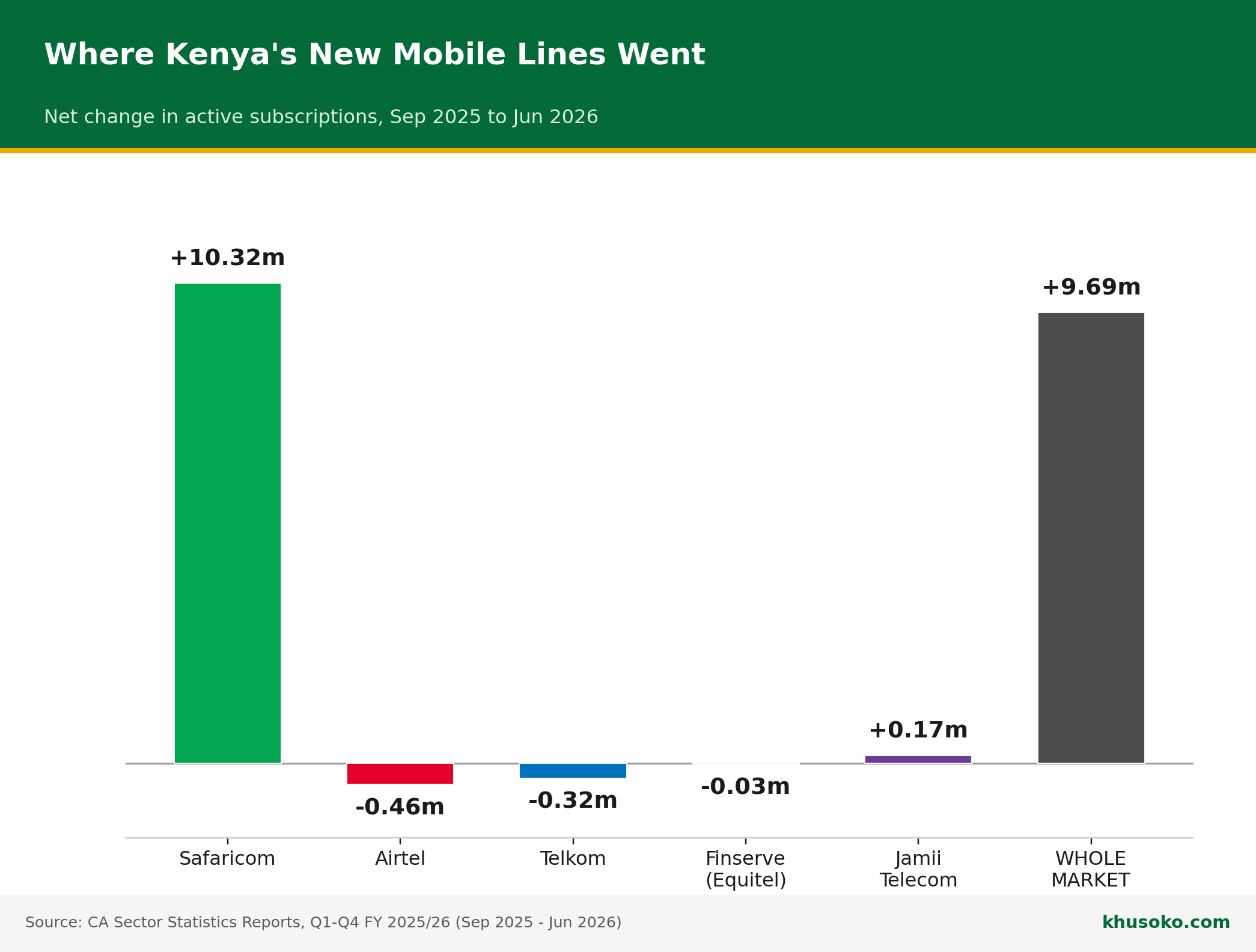
CA data shows Safaricom’s active subscriptions climbed from 51.12 million at the end of September 2025 to 61.45 million by June 30, 2026, a rise of 20.2 per cent. Airtel Networks Kenya lost ground over the same nine months, its base falling by 456,549 lines to 23.6 million. Telkom Kenya fared worse, shedding more than a third of its subscribers to close the year at 545,765, a continuation of a slide Khusoko has tracked since 2022.
Kenya’s entire mobile market grew by 9.68 million lines across the four quarters. Safaricom added 10.32 million, meaning its rivals lost customers on a net basis even as the market expanded.
| Operator | Sep 2025 | Dec 2025 | Mar 2026 | Jun 2026 | Change (9 months) |
|---|---|---|---|---|---|
| Safaricom PLC | 51,124,664 | 52,381,782 | 57,929,611 | 61,447,008 | +10,322,344 |
| Airtel Networks Kenya | 24,057,518 | 22,927,287 | 23,179,209 | 23,600,969 | -456,549 |
| Telkom Kenya | 868,788 | 744,902 | 584,438 | 545,765 | -323,023 |
| Finserve (Equitel) | 1,493,295 | 1,510,444 | 1,513,096 | 1,468,616 | -24,679 |
| Jamii Telecommunications | 771,119 | 826,006 | 883,944 | 937,640 | +166,521 |
| Total market | 78,315,384 | 78,390,421 | 84,090,298 | 87,999,998 | +9,684,614 |
“During the 2025/26 financial year, the telecommunications sub sector demonstrated continued growth with active mobile subscriptions growing to reach 88.0 million as of 30th June 2026,” CA said in its fourth quarter report. The regulator credited the gain to customer win back campaigns run by operators during the period.
Where the share went
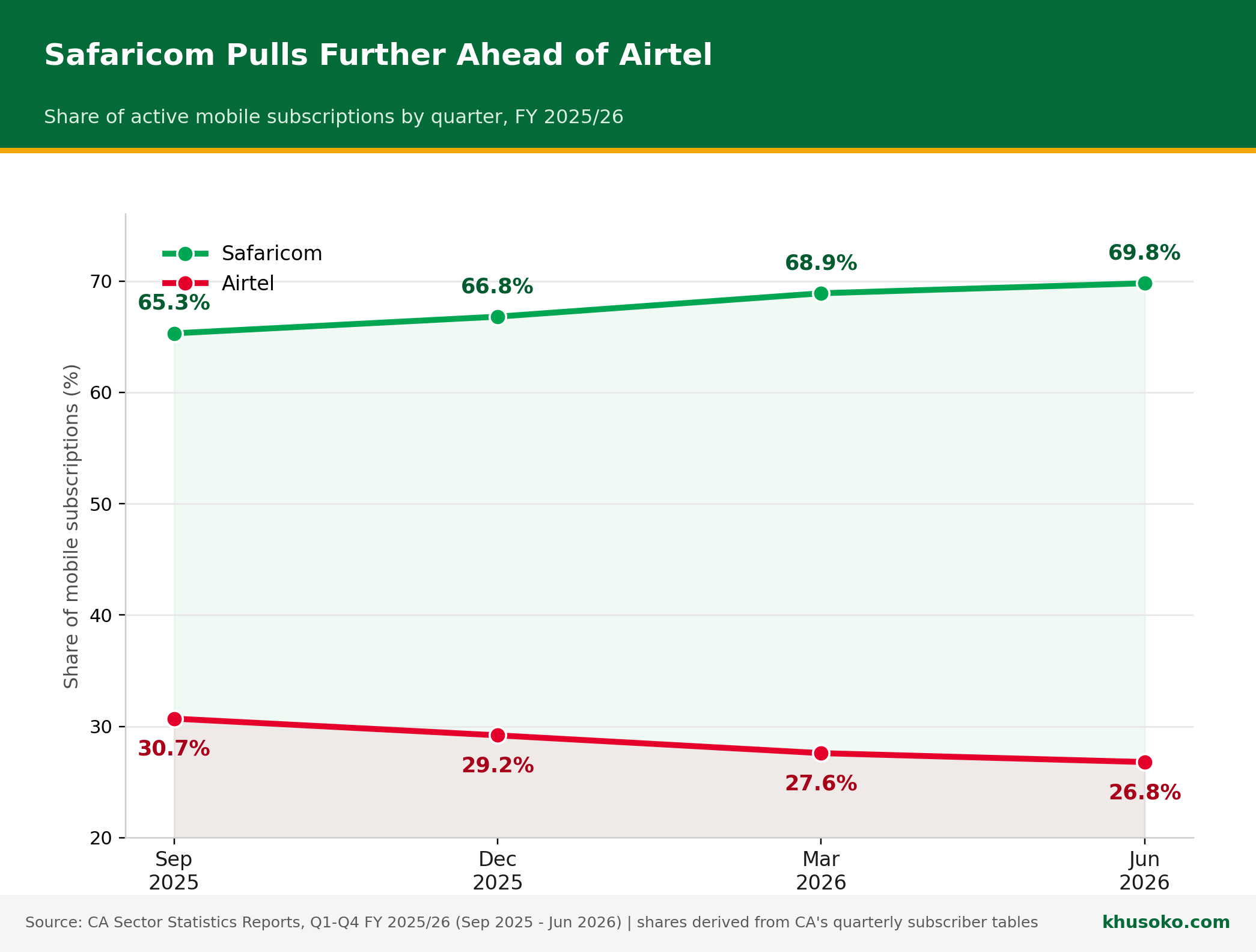
Those campaigns did not pay off evenly. Safaricom’s share of subscriptions rose steadily through the year, from 65.3 per cent in September 2025 to 66.8 per cent in December, 68.9 per cent in March and 69.8 per cent by June. Airtel moved the other way across the same four readings, sliding from 30.7 per cent to 26.8 per cent, a loss of nearly four percentage points in nine months.
| Quarter end | Safaricom share | Airtel share |
|---|---|---|
| Sep 2025 | 65.3% | 30.7% |
| Dec 2025 | 66.8% | 29.2% |
| Mar 2026 | 68.9% | 27.6% |
| Jun 2026 | 69.8% | 26.8% |
“As at the end of June 2026, Safaricom PLC recorded the highest market shares in mobile subscriptions (69.8%), mobile broadband subscriptions (64.4%) and mobile money transfer (88.8%). On the other hand, Telkom Kenya recorded the least market shares across the three service categories.”
Airtel’s growth strategy has leaned on network investment.
“We are committed to Kenya, and while we have made huge investments, our mission of enriching lives and driving progress is still not done,” Airtel Kenya managing director Ashish Malhotra said earlier this year as the operator pushed to close the gap with Safaricom.
More lines than devices
The additions are commercially real but not necessarily new customers. CA counts a line as active only if it generated revenue in the past three months. By that measure, Kenya closed June with 88.0 million SIM cards connected to just 79.68 million handsets, a gap of 8.3 million lines with no device behind them.
Mobile penetration climbed to 165.0 per cent of the population in June, up from 149.4 per cent nine months earlier, a rate that only holds if millions of Kenyans carry two or three lines each. The prepaid to postpaid mix shifted too, moving from close to 98 to 2 for most of the year to 97.1 to 2.9 by June, as Safaricom’s postpaid book grew to 1.80 million lines.
Traffic and revenue widen the gap
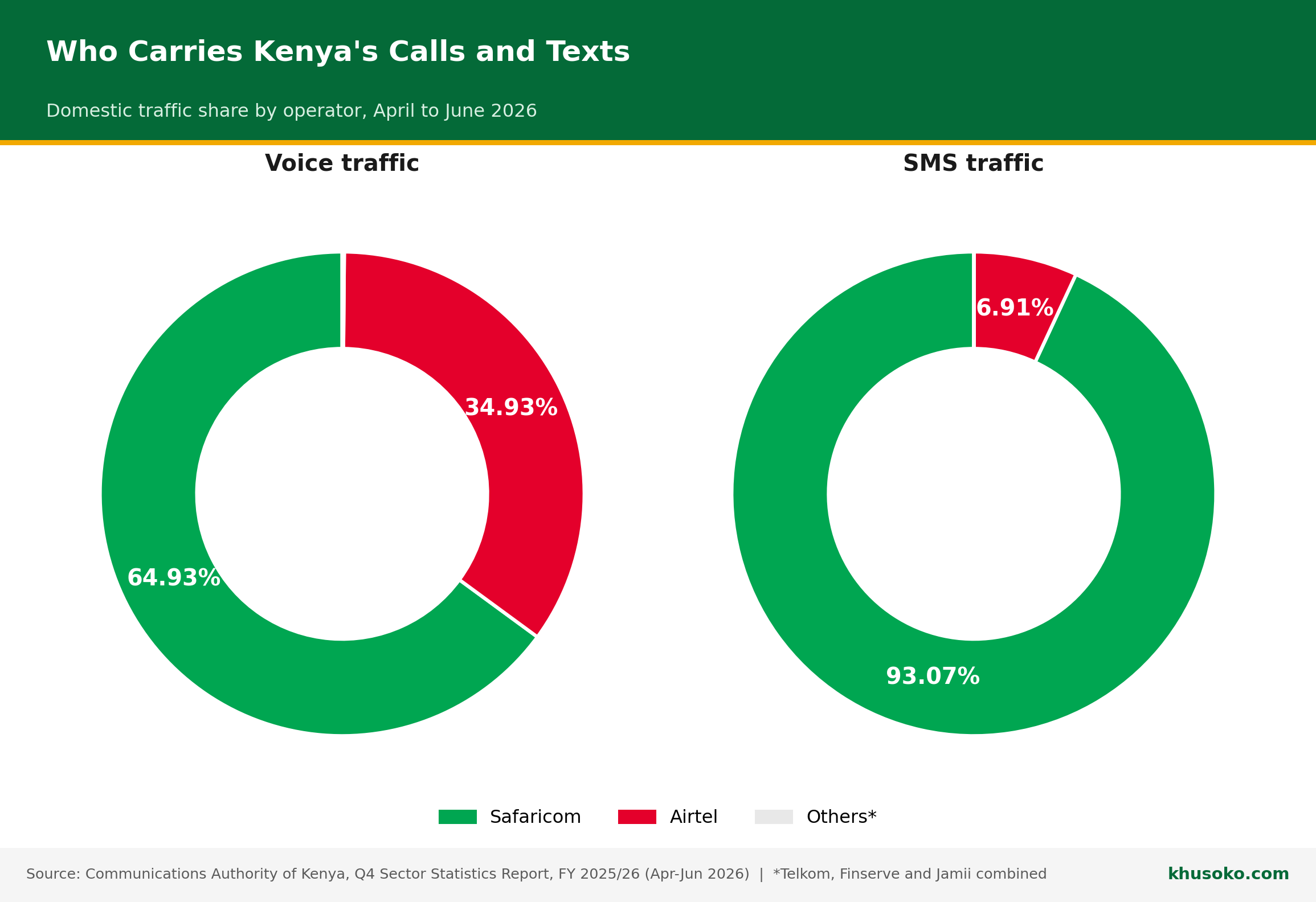
Scale advantage shows up hardest in usage. Safaricom carried 80.33 billion voice minutes over the financial year against Airtel’s 46.19 billion, and 52.79 billion SMS messages against Airtel’s 4.33 billion, itself down from 6.52 billion a year earlier. In the April to June quarter alone, Safaricom handled 64.93 per cent of domestic voice minutes and 93.07 per cent of SMS traffic.
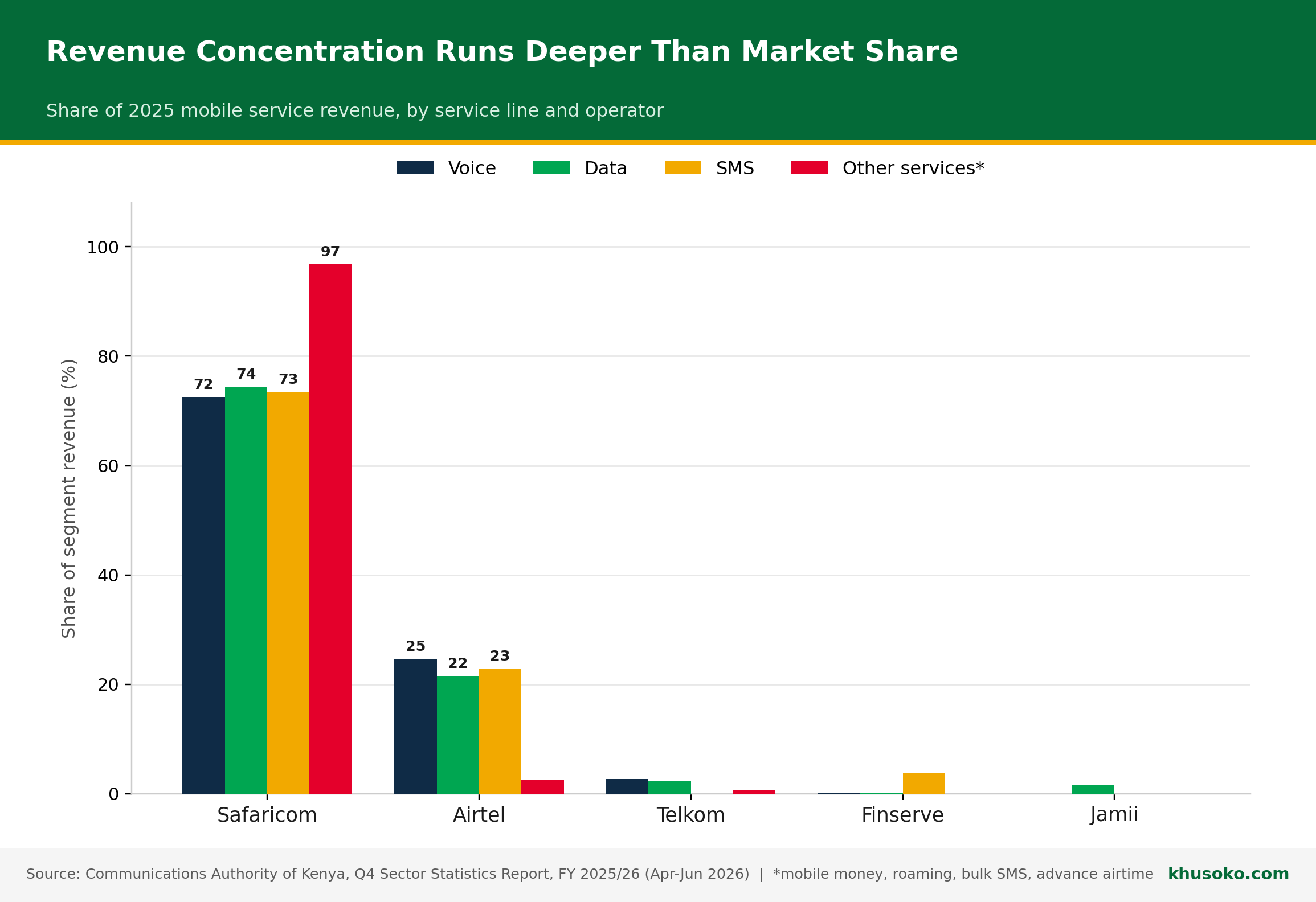
Money follows an even steeper curve. CA published operator level revenue splits for the first time in this report.
| Revenue category | Safaricom | Airtel | Telkom | Finserve | Jamii |
|---|---|---|---|---|---|
| Voice revenue | 72.5% | 24.6% | 2.7% | 0.2% | 0.0% |
| Data revenue | 74.4% | 21.5% | 2.4% | 0.1% | 1.6% |
| SMS revenue | 73.4% | 22.9% | 0.0% | 3.7% | 0.0% |
| Other services* | 96.8% | 2.5% | 0.7% | 0.0% | 0.0% |
*Other services includes mobile money, roaming, bulk SMS and advance airtime, and made up 42.8 per cent of all 2025 mobile service revenue, the largest single category.
Weighted across the full service mix, Safaricom earns close to 84 shillings of every 100 the sector makes, against a subscriber share of 69.8 per cent.
Growth is slowing even as the gap widens
Industry revenue is not keeping pace with subscriber growth. Mobile service revenue rose 3.6 per cent to KSh 440.9 billion in 2025, the weakest annual growth CA has recorded in five years. The three years before it posted gains of 7.7, 13.2 and 10.7 per cent.
Cracks in the dominance
Not every indicator favors Safaricom. M-Pesa’s share of mobile money subscriptions eased from 89.7 per cent in September to 88.8 per cent in June, while Airtel Money climbed from 10.3 to 11.1 per cent over the same period, extending a shift Khusoko covered in July when Airtel Money first crossed 9 per cent.
Registered mobile money agents fell 5.6 per cent in the final quarter alone, to 568,463. Usage per line is thinning too. Minutes of use per subscription per month dropped to 125.1 from 128.1 the previous quarter, and messages fell to 53.5 from 55.4, a decline CA links to rising use of “over the top messaging services such as WhatsApp.”
Fixed internet: the one real contest
Fixed internet is the segment where Safaricom’s lead is genuinely under pressure. CA describes the market as “experiencing unprecedented growth, driven by intense competition, a shifting digital economy, and aggressive infrastructure rollouts.”
Safaricom crossed one million fixed data subscriptions for the first time in June, closing the quarter at 1,024,950, yet its share moved only to roughly 36.1 per cent as Jamii Telecommunications, Ahadi Wireless and Vilcom Networks expanded behind it, a contest Khusoko first flagged back in 2023 when Safaricom’s fixed data share stood at 46.1 per cent and has been contested ever since. Starlink Kenya, still small at 27,616 subscriptions and a 1.0 per cent share, is growing off a low base as satellite technology migrates from older VSAT systems to low earth orbit networks.
What it means
Safaricom’s grip on Kenya’s mobile market has tightened to a level not seen in years, and four quarters of CA data leave little doubt about where new growth is landing.
The multi SIM effect and slowing revenue growth complicate the picture, but on subscribers, traffic and money, one operator is taking most of what the market has to give. Fixed internet remains the exception and the space worth watching as rivals fight for the one line item still genuinely up for grabs.
