


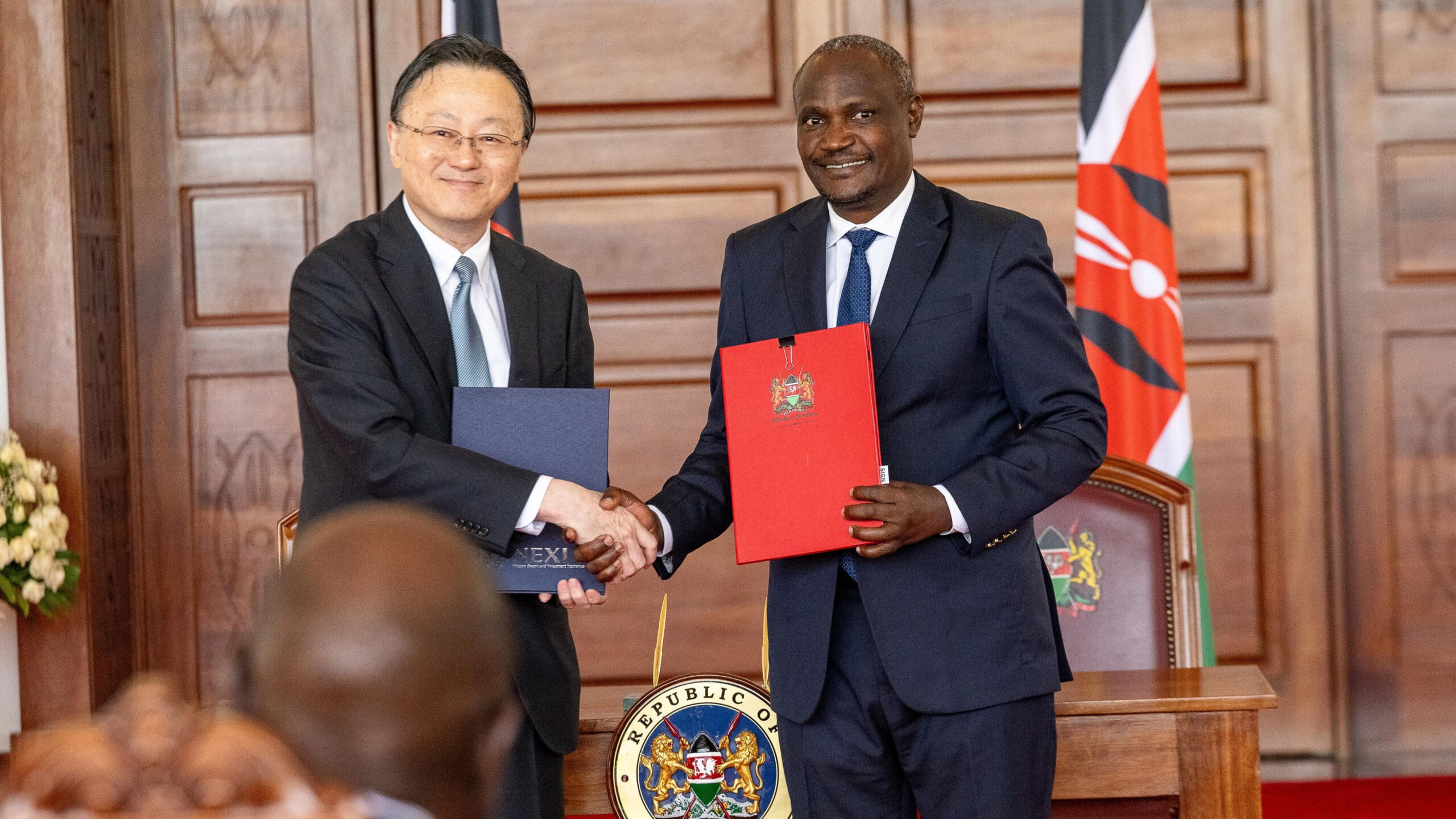
Kenya signed the long-awaited Samurai bond on June 22, 2026, bringing JPY 25 billion — about KSh22.1 billion — into the country through a structured deal with Japan backed by Nippon Export and Investment Insurance (NEXI).
The signing took place at State House, Nairobi, and marks a concrete step in Kenya’s push to diversify its funding sources and reduce dependence on costly dollar-denominated debt.
President William Ruto described the moment as the opening of a new chapter.
“Today, Kenya and Japan open a new chapter in a friendship built over decades as we strengthen our strategic partnership through new commitments in financing, investment, and development cooperation,” he said in his address at the ceremony.
Kenya-Japan Development Co-operation, State House, Nairobi https://t.co/4sICevHBXi
— State House Kenya (@StateHouseKenya) June 22, 2026
What Is a Samurai Bond?
A Samurai bond is a yen-denominated bond issued in Japan by a foreign entity, subject to Japanese regulations. For a borrower like Kenya, the appeal lies in what Japan’s financial market offers: lower interest rates than most dollar-denominated loans and access to one of the world’s deepest pools of capital.
With global debt burdens rising, tools like Samurai bonds give nations greater financial flexibility and protection from volatile Western credit markets. Countries such as Indonesia and the Philippines have used similar instruments to broaden their financing mix.
Kenya first explored Samurai financing in 2024, when President Ruto’s administration signed an MOU with NEXI during a state visit to Tokyo. That agreement paved the way for up to USD 500 million in two phases. The June 2026 signing closes the loop on that earlier commitment and puts the money to work across three specific national priorities.
One note of caution has followed these deals from the start. Analysts point out that if the Bank of Japan raises interest rates over the next decade — which its monetary policy trajectory suggests is likely — yen-denominated borrowing could become more expensive for Kenya. That risk sits alongside the benefits and warrants watching.
Three Buckets, One Strategy
The KSh22.1 billion breaks into three targeted allocations. Each bucket addresses a different pressure point in Kenya’s economy.
Automotive Sector: KSh13.1 Billion
The largest portion — JPY 15 billion, or roughly KSh13.1 billion — funds Kenya’s National Automotive Policy. President Ruto called this “the centrepiece of today’s agreement and of our industrial ambition.”
Kenya currently imports the vast majority of its vehicles as finished goods, sending jobs and value abroad in the process. The automotive fund pushes against that pattern by supporting local assembly. “Every vehicle assembled on Kenyan soil creates Kenyan jobs, builds Kenyan talent, skills, and expertise, and keeps Kenyan value at home,” Ruto said. “It deepens our manufacturing base, reduces our dependence on imports, and moves us towards a competitive, export-ready automotive sector.”
NEXI confirmed that the financing “is expected to support Kenya’s industrial development and local job creation and contribute to the sales of Japanese vehicles, which hold a strong market share in the Kenyan market.”
Ruto drew a sharp illustration from his recent state visit to South Africa to explain why this direction matters. Kenya sells South Africa roughly KSh6 billion in goods each year. South Africa sells Kenya close to KSh65 billion in return. “For every single shilling of goods we export to South Africa, we buy back nearly KSh10,” he said. Kenya exports what it grows — coffee, tea, flowers, edible oils. South Africa sends back what it builds — vehicles, machinery, iron and steel.
That gap is what the automotive investment targets. “We close the trade gap not by buying less, but by building more and adding value to what we produce here in Kenya,” Ruto said.

Energy Loss Reduction: KSh5 Billion
The second allocation — JPY 5.5 billion, or about KSh5 billion — funds the Reduction of Energy Losses Programme. Kenya loses a significant share of its electricity through technical and commercial inefficiencies in the transmission network. Estimates place transmission losses at close to a quarter of national output — a staggering drain on an economy trying to industrialise.
“Reliable, affordable power is the backbone of every factory and every home,” Ruto said. “By cutting technical and commercial losses, we lower the cost of energy, steady our grid, and make Kenyan industry more competitive. Cheaper and cleaner power is the foundation of an industrial economy.”
The energy component connects directly to the automotive ambition. Vehicle assembly plants need stable, affordable electricity. Getting both right simultaneously reflects a deliberate sequencing in the government’s industrial plan.
Reform and Development Support: KSh4 Billion
The third tranche — JPY 4.5 billion, or approximately KSh4 billion — supports Kenya’s broader reform and development agenda. Ruto framed this as a reflection of Japan’s confidence in Kenya’s fiscal trajectory, saying the allocation “will help reinforce essential public services, protect key social investments, and strengthen the institutions that underpin sustainable growth.”
Why Japan, Why Now
Japan’s engagement with Kenya runs decades deep. The Mombasa Port Development Project and the Olkaria Geothermal Programme both carry Japanese fingerprints. Ruto drew a distinction between Japan’s approach and that of other partners.
“Japan does not merely build projects; it builds people,” he said, pointing to technical cooperation, training, and technology transfer as defining features of the relationship. “That is the difference between a transaction and a partnership.”
The timing matters beyond the bilateral relationship. Japan committed USD 5.5 billion in loans to African nations at TICAD 9 in August 2025, partly in response to aid cuts by the United States and United Kingdom. Kenya was among the first to convert that commitment into a signed facility. The NEXI backing provides an insurance layer that makes the deal attractive to Japanese investors while giving Kenya access to more competitive borrowing terms.
For Kenya, the deal also advances a deliberate debt diversification strategy. As of recent analysis, 43% of Kenya’s external debt is multilateral, 31% bilateral, and 27% commercial — mainly Eurobonds. Samurai bonds rebalance that mix and reduce exposure to high-cost dollar borrowing. “Panda Bond is also a small ticket, but it is still a new area,” Treasury PDMO Director General Raphael Owino noted earlier in the process, signalling that Japan represents one lane in a broader strategy to access new capital markets.
What Comes Next
The three priorities in this agreement carry a single message, as Ruto put it: “Japan’s trust in Kenya’s direction, and Kenya’s commitment to manage every shilling with discipline, transparency, and accountability.”
