



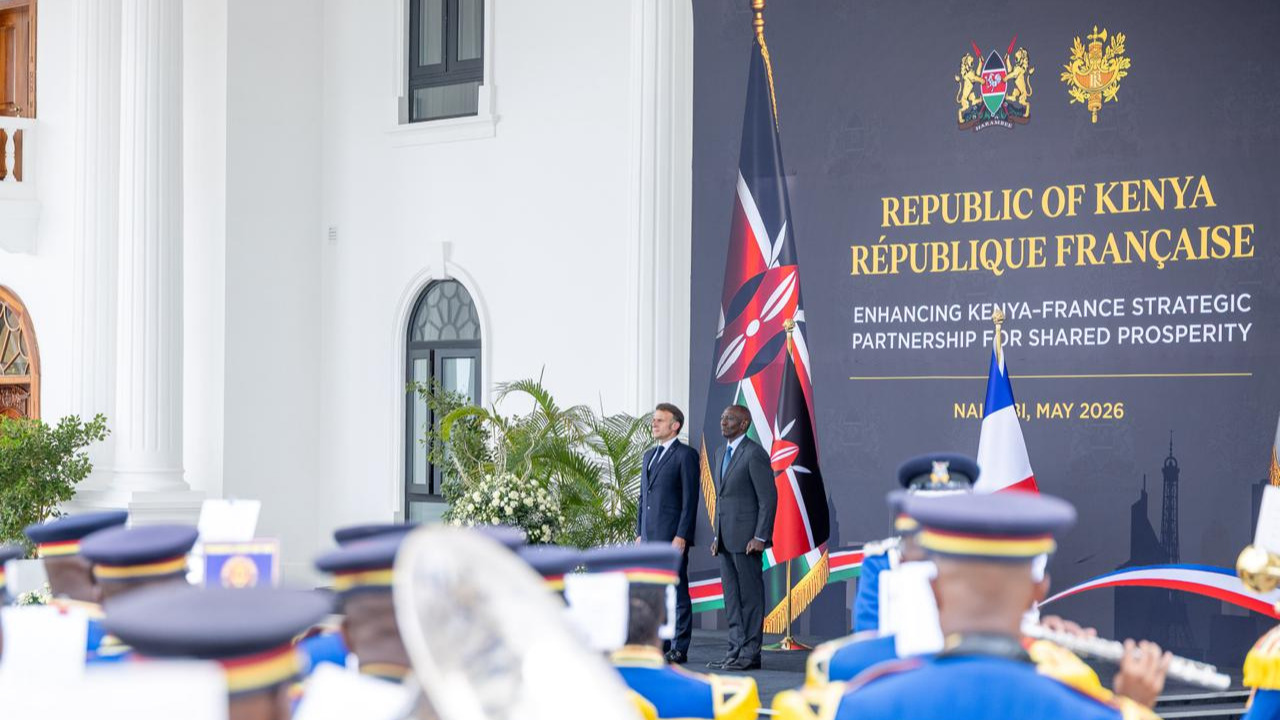
French President Emmanuel Macron arrived in Nairobi on Sunday and moved immediately to business. Before the Africa Forward Summit formally opened, he signed a package of bilateral agreements with President William Ruto covering ports, wind energy, rail, water, digital infrastructure and nuclear cooperation.
When the summit opened Monday, Macron announced €23 billion in investment for Africa — €14 billion from French public and private entities and €9 billion from African investors — targeting energy transition, artificial intelligence, the maritime economy and agriculture. He said the deals would generate 250,000 direct jobs across France and Africa.
Macron told the audience at Nairobi’s convention centre that the relationship between France and Africa had moved beyond the weight of history. “We are not simply here to come and invest on the African continent alongside you — we need the great African business leaders to come and invest in France,” he said. “And that too is what underpins this relationship, now entirely free of hang-ups.”
What Kenya and France Agreed
The largest deal is a planned KSh 104 billion joint venture to finance and operate cargo infrastructure at the Port of Mombasa and along inland freight corridors, with French operators taking a lead role.
On energy, the two countries agreed to expand the Kipeto Wind Project by 100 megawatts at a cost of roughly KSh 32.5 billion. The expansion follows Kenya’s established independent power producer model, where private developers finance generation and sell electricity through long-term contracts. France and Kenya also agreed to cooperate on sustainable aviation fuel production, a sector that could position Kenya as a future supplier to international carriers.
France is also entering Kenya’s nuclear planning. The current arrangement covers technical cooperation — regulation, safety standards and skills development — and aligns with Kenya’s stated target of building up to 10,000 megawatts of nuclear capacity over time.
Transport investment centres on a KSh 12.5 billion upgrade of Nairobi’s commuter rail network, covering lines to Syokimau, Embakasi, Ruiru and Kikuyu as well as the Riruta to Ngong corridor. The French Development Agency is expected to provide financing. Water deals include funding tied to raising the Masinga Dam and upgrading Kenya’s national weather services.
Digital cooperation covers cybersecurity, artificial intelligence and public service platforms connected to the Konza Technopolis programme. In agriculture, the focus falls on promoting Kenyan specialty teas, particularly purple varieties, within French retail channels. France also committed KSh 5.6 billion toward an engineering and science complex at the University of Nairobi and equipment programmes at four universities.
President Ruto framed the gathering in terms of what it should produce rather than what it symbolises. “The Summit will prioritise bankable projects, investment pipelines, technology transfer, and skills development, ensuring that partnerships translate into real economic opportunities, jobs, and improved livelihoods for citizens across the continent,” he said. “Our shared objective is clear: to unlock capital, scale innovation, deepen trade and investment linkages, and create inclusive growth pathways that are resilient, sustainable, and African-led.”
Why Nairobi
The Nairobi summit is the first time France has held the Africa Forward gathering outside a Francophone country. Ruto acknowledged the significance directly. “The decision to host the Africa Forward Summit in Kenya, for the first time in a non-Francophone country, is a strong affirmation of the growing ties between our two countries,” he said. “The summit marks a significant step towards a more balanced, action-oriented and results-driven partnership. Kenya and France have maintained strong diplomatic relations since 1963. We continue to deepen this partnership in areas of shared interest for the benefit of the people of both nations.”
France’s pivot to Anglophone East Africa follows the loss of its military footholds across the Sahel. Since 2022, Mali, Burkina Faso, Niger and Chad have all expelled French forces following coups. Paris has moved to replace that presence with investment partnerships in economies it considers politically stable. The Nairobi summit drew more than 30 heads of state and 1,500 business leaders.
At the summit, Macron positioned Europe as an alternative to both China and the United States. On critical minerals and rare earths, he accused Beijing of operating on what he called “predatory logic — it does the processing at home” and creates “dependencies with the rest of the world.” He called for an overhaul of international finance to bring private capital into Africa. “There is no reason today for there to be so little private investment coming into a continent as full of energy and youth as yours,” he told the closing session of day one.
Macron also addressed colonial history. He told The Africa Report that colonialism could no longer carry sole responsibility for Africa’s present difficulties, and called on African leaders to confront governance failures in the decades since independence. “We must not exonerate from all responsibility the seven decades that followed independence,” he said. On the return of looted artefacts, he told the summit the process had become “unstoppable,” following legislation the French parliament passed last week to allow their handover.
On the Sahel withdrawals, Macron was direct. “When our presence was no longer wanted after the coups, we left. That wasn’t a humiliation but a logical response to a given situation,” he said. He predicted the region would return to elected governance with leaders who “genuinely care about their people.”
The Defence Agreement
Running alongside the investment announcements is a more contested issue. About a month before the summit, roughly 800 French troops arrived in Kenya aboard a naval vessel. Their presence operates within a Kenya-France Defence Cooperation Agreement signed on 29 October 2025 by Defence Minister Soipan Tuya and French Ambassador Arnaud Suquet, and ratified by Parliament on 8 April 2026 — the same month Kenya ratified defence agreements with the Czech Republic, China and Italy.
The agreement grants visiting French forces primary jurisdiction over their personnel for offences committed while on duty. Civil society organisations have challenged this provision, arguing it offers excessive legal protection for foreign soldiers operating in Kenya.
The concern draws directly from experience with a comparable British agreement. That arrangement shielded soldiers from Kenyan courts in serious cases, among them the 2012 murder of Agnes Wanjiru, last seen with British troops near Nanyuki, and the 2021 Lolldaiga ranch fire. A British soldier currently faces extradition following Kenyan court findings linking him to Wanjiru’s death.
Nelson Koech, Chair of the Parliamentary Defence Committee, defended the agreements as vehicles for training and intelligence sharing. He said new provisions require foreign troops to face Kenyan courts for serious offences including murder, and that the agreements do not amount to a surrender of sovereignty.
The broader pattern is notable. As governments across Africa move to reduce foreign military footprints, Kenya is expanding its own. Whether the legal frameworks underpinning these arrangements deliver the partnership terms Koech describes, or entrench the asymmetries critics warn against, will depend on whether Kenyan institutions prove willing and able to enforce them.
