


Kenya’s High Court has issued conservatory orders barring the government from admitting, receiving, or facilitating the entry of any person exposed to or infected with Ebola under its arrangement with the United States. The matter returns to court on June 2, 2026, for further directions.
The ruling delivers the Katiba Institute’s first legal victory in what has rapidly become one of the most consequential public health cases Kenya’s judiciary has handled in recent years. The petition was filed just days ago under a certificate of urgency. The court acted within hours.
Yet even as the orders took effect, events on the ground moved in the opposite direction. A 50-bed quarantine unit at the Laikipia Air Base, about 200 kilometres north of Nairobi, was reported to be nearing operational readiness. US Public Health Service officers had already departed for Kenya. Around 30 received three days of training ahead of deployment, with more scheduled for training this weekend.
The facility sits at the intersection of a diplomatic agreement, a constitutional dispute, a doctors’ revolt, and a deepening public health emergency — all converging at the same moment.
The Facility Kenya Never Confirmed
The White House confirmed it is establishing a facility in Kenya to receive Americans exposed to Ebola, built, staffed, and run entirely by Americans, with no Kenyan public health officers involved in the project in Laikipia County. Senior Trump administration officials told Reuters that patients who need to be evacuated from Kenya will be taken to third countries, not the United States, because it is faster, and to protect Americans at home.
Additional isolation and biocontainment units will be available at the site later. If someone develops symptoms or tests positive, they will be evacuated to other facilities. The CDC and Department of State are working to determine where in Europe those facilities will be located. KVIA
Kenya’s government never made a public statement confirming the arrangement. When the Daily Nation sent Health Cabinet Secretary Aden Duale ten specific questions about the facility — where it would be located, when Americans would arrive, and why Kenya was chosen — the response that came back did not answer any of the questions raised. CS Duale’s statement neither confirmed nor denied the existence of the facility, acknowledging only “ongoing discussions” while insisting that “any arrangements regarding international health cooperation will be guided by Kenya’s national laws, public health regulations, biosafety and biosecurity standards.”
US Secretary of State Marco Rubio subsequently spoke with President William Ruto to discuss the outbreak, with the US committing $13.5 million toward Ebola preparedness in Kenya, including securing vital medical supplies. The two leaders agreed to maintain close coordination as the situation evolves.
How the Court Got Here
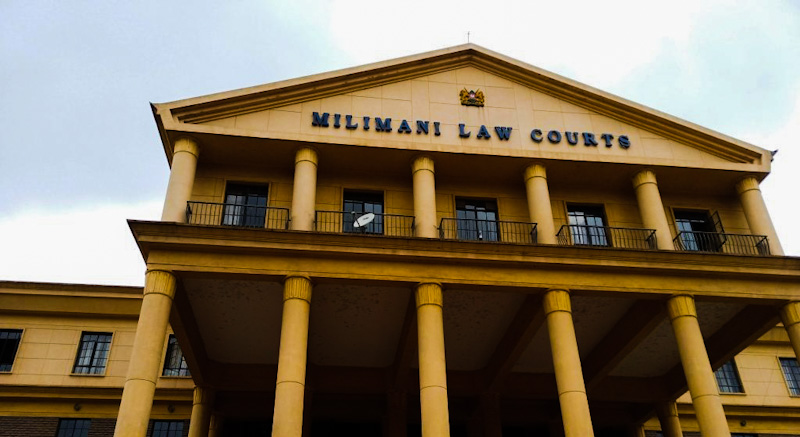
The Katiba Institute filed its petition at the Milimani High Court on May 28, naming Attorney General Dorcas Oduor and Health Cabinet Secretary Aden Duale as respondents, with health rights organisation KELIN Kenya listed as an interested party. Through counsel Malidzo Nyawa, the institute argued that the proposed facility would effectively convert Kenya into an offshore quarantine centre for a foreign state — arranged in secrecy, without parliamentary approval, public participation, or any disclosed legal framework.
“The impugned arrangement is being undertaken in a manner that is not transparent and is devoid of constitutional accountability, public participation, parliamentary oversight, or full disclosure of its health, environmental, and security implications,” the application states.
The court agreed the matter warranted urgent intervention. The orders now in place restrain the government from admitting, transferring, receiving, or facilitating the entry into Kenya of any persons exposed to or infected with Ebola pursuant to the arrangement, pending the inter-parties hearing and full determination of the case.
“KI is asking the Court to determine whether the Executive can expose the public to such significant risks without complying with constitutional safeguards,” said Nora Mbagathi, Executive Director of the Katiba Institute. “At its core, the case is about preserving constitutional accountability, protecting public health, and ensuring that no government may place expediency above the lives and safety of the people of Kenya.”
The Biosafety Gap
The petition raises a practical concern that runs deeper than constitutional procedure. Ebola requires a Biosafety Level 4 laboratory — the highest classification in existence — to be safely handled. Kenya does not currently have a BSL-4 facility. The country operates Biosafety Level 1 to 3 laboratories, with only three BSL-3 facilities nationwide, leaving the country vulnerable in the event of an outbreak. Citizen Digital
Independent consultant pathologist Dr Ahmed Kalebi explained what that gap means in practice: “You cannot build this in an emergency. You cannot temporarily upgrade a BSL-2 facility. The standard is binary: the building either meets it or it does not. Most Kenyan laboratories operate at BSL-2. A small number at BSL-3. Neither is adequate for Ebola.”
The petition puts the question plainly: “What if there is an outbreak of Ebola? Can we manage to contain it?” The government has not yet answered.
Doctors Issue a 48-Hour Ultimatum
The Kenya Medical Practitioners, Pharmacists and Dentists Union moved swiftly. KMPDU gave the government a 48-hour ultimatum to publicly disclose the full terms of its deal with the US or face a nationwide doctors’ strike.
Secretary General Dr Davji Bhimji Atellah framed the objection in blunt terms: “Kenya is a sovereign republic, not a geopolitical isolation ward. We will not sit back and watch Kenya be treated as a containment colony for a lethal pathogen that we did not generate.”
The union challenged the logic of the arrangement directly. “If the United States believes the 12-hour medevac flight back to Washington is too dangerous for its citizens, by what logic is it safe to fly infected or exposed individuals into Kenyan airspace and drop them in Laikipia?”
KMPDU issued three demands. First, the government must immediately publish the bilateral text of the agreement and explain why Kenya was chosen. Second, it must explain how it prioritises a foreign biohazard facility while public hospitals cannot afford basic supplies. Third, if the facility proceeds, the government must use it as leverage to permanently resolve the structural funding gaps in Kenya’s public health system.
Dr Atellah also questioned why the Trump administration wants to set up an isolation facility specifically for Americans, when Kenya has a “longstanding gap” in its chronically underfunded healthcare system. “What makes the US choose Kenya when the epicentre of the outbreak is in the Democratic Republic of Congo?”
Ruto Forms a National Response Committee
President Ruto convened a high-level emergency meeting at State House, Nairobi, bringing together ambassadors from the United States, the United Kingdom, the European Union, France, Germany, China, Japan, India, Qatar, the UAE, Saudi Arabia, Ethiopia, and Turkey, alongside officials from the United Nations Office at Nairobi.
To strengthen coordination, Ruto announced the establishment of a National Response Committee to be led by Prime Cabinet Secretary and Cabinet Secretary for Foreign and Diaspora Affairs Musalia Mudavadi. The committee will oversee a whole-of-government and whole-of-society response strategy, including public awareness campaigns, laboratory strengthening, cross-border coordination, and resource mobilisation.
Ruto said Kenya had intensified surveillance and screening measures at 26 Points of Entry across the country, with more than 58,000 travellers already screened. He reiterated that Kenya would act transparently, responsibly, and decisively to safeguard lives while contributing to regional and global health security efforts.
The formation of the committee is significant. It signals that Ruto has shifted from managing the arrangement quietly to building a visible institutional response — one that can absorb public scrutiny while the court case plays out.
What the Constitution Demands
The Katiba Institute’s legal argument rests on Articles 26 and 43 of Kenya’s constitution — the rights to life and health — which it argues trigger a heightened obligation on the state to exercise maximum precaution in any policy response involving a pathogen the WHO classifies as highly infectious and often fatal.
Through lawyer Malidzo Nyawa, the institute argues that such an arrangement would effectively position Kenya as an offshore quarantine centre for foreign states and raises serious constitutional, sovereignty, and public health concerns. According to the petition, the process lacks transparency, public participation, and parliamentary oversight, and there is no indication that any environmental or health impact assessments have been carried out.
The institute is also seeking a separate order compelling the Health CS to present the court with a detailed contingency plan within 24 hours, covering Kenya’s preparedness for prevention, surveillance, control, and outbreak response.
The Outbreak Driving Everything
Africa CDC has approved a $319 million emergency response plan. The Bundibugyo strain responsible for the current outbreak has no approved vaccine and no targeted treatment. Over 1,077 suspected cases and 246 deaths have been recorded across the DRC and Uganda. The International Rescue Committee has warned that without urgent international action, this outbreak risks becoming the deadliest Africa has seen since the 2014 West Africa epidemic.
Although there are no approved treatments specifically for the Bundibugyo virus, antibody therapies and antivirals including Remdesivir will be available at the Laikipia facility, according to US officials.
The court’s orders now stand until June 2. The doctors’ ultimatum expires within 48 hours. The facility at Laikipia was readying its beds. And the government that agreed to all of this has still not told Kenyans what it agreed to.
