



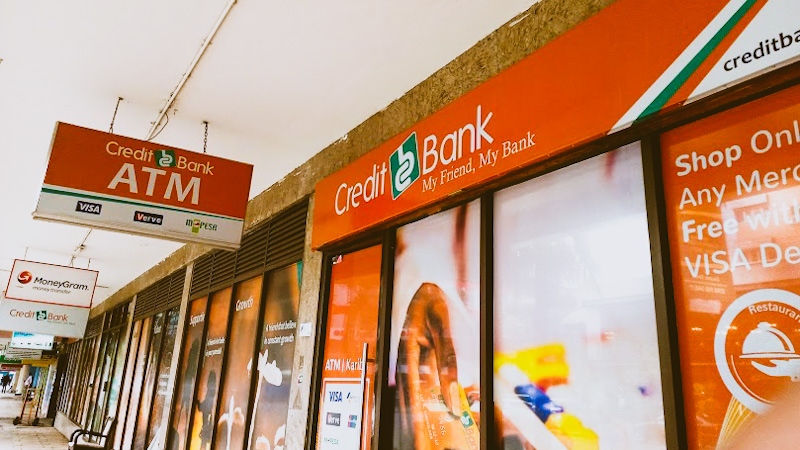
Credit Bank cut its pre-tax loss to KSh 26.6 million in the first quarter of 2026, down sharply from KSh 68 million in the same period a year earlier, as the lender pressed ahead with a deliberate strategy to rebuild capital, tighten asset quality, and reduce its reliance on loan income in a market where lending carries rising risk.
The results reflect a bank navigating a difficult but familiar tension: grow too fast and absorb bad loans, or slow down and take the hit on short-term earnings. Credit Bank chose the latter — and the numbers suggest the trade-off is working.
Liquidity Strengthens as Deposits Climb
The bank’s liquidity ratio nearly doubled from 15.5 percent to 22.74 percent year on year, a significant shift in a market where the Central Bank of Kenya’s statutory minimum stands at 20 percent. That improvement gives the bank greater room to manage short-term obligations without relying on expensive borrowed funds.
Deposits drove much of the balance sheet expansion. Customers grew their deposits at Credit Bank from KSh 19.3 billion in Q1 2025 to KSh 22.9 billion by March 2026, an increase of KSh 3.6 billion. Total assets rose from KSh 26.3 billion to KSh 28.3 billion over the same period.
“This was rewarded with the belief of our customers, who grew deposits in the bank from KSh 19.3 billion last year to KSh 22.9 billion in the period ending March this year, underscoring the confidence in the lender,” said Credit Bank CEO Betty Korir.
Key Q1 2026 Financial Highlights
| Metric | Q1 2025 | Q1 2026 | Change |
|---|---|---|---|
| Pre-tax loss | KSh 68.0M | KSh 26.6M | Improved by 60.9% |
| Customer deposits | KSh 19.3B | KSh 22.9B | +KSh 3.6B |
| Total assets | KSh 26.3B | KSh 28.3B | +KSh 2.0B |
| Gross loans | — | KSh 15.8B | Deliberately slowed |
| Liquidity ratio | 15.5% | 22.74% | Nearly doubled |
| Paid-up capital | — | KSh 1.48B | — |
Loan Growth Slows Deliberately as NPLs Rise Across the Sector
Credit Bank pulled back on new lending, holding gross loans at KSh 15.8 billion. The decision reflects the broader deterioration in credit quality across Kenya’s banking sector. The industry ratio of gross non-performing loans to gross loans stood at 15.6 percent in March 2026, up from 15.4 percent in December 2025, according to the Central Bank of Kenya — a trend that has prompted several lenders to tighten credit standards.
Rather than chase loan growth, the bank focused on recovering and restructuring existing facilities, making provisions for non-performing loans, and redirecting resources toward government securities and higher-yielding deposits to protect non-interest income. That strategy compressed short-term earnings but reduced the risk of a larger provision charge further down the line.
“We made a strategic move to balance asset growth with caution in order to retain high asset quality amidst tough macroeconomic times,” Korir said.
Capital Build Accelerates Ahead of Regulatory Deadlines
The bank’s paid-up capital stood at KSh 1.48 billion at the end of the quarter. That figure matters because Kenya’s regulatory clock is ticking. Parliament passed the Business Laws (Amendment) Act in December 2024, which raised the minimum core capital requirement for banks in annual increments — to KSh 3 billion by end of 2025, and KSh 10 billion by end of 2029, up from the previous threshold of KSh 1 billion.
Credit Bank still has ground to cover. The bank confirmed it plans to raise KSh 4.5 billion in fresh capital through private placements, backed by shareholder support. The capital raise will determine how quickly the bank can build the buffer needed to meet the 2029 deadline and fund the asset growth required to generate meaningful returns at scale.
The Macro Environment Adds Pressure
The results land in a macroeconomic environment that has tested the resilience of even well-capitalised lenders. Geopolitical tensions, conflict in the Middle East, and disruptions to global shipping have pushed up energy and food prices, compressing consumer spending and dampening private sector credit demand across emerging markets. For Kenyan banks, that external pressure compounds domestic challenges — including slow private sector credit uptake and a public sector that has increasingly crowded out commercial borrowers through heavy issuance of government securities.
Credit Bank has leaned into that environment rather than fought against it, using government securities as a yield-generating alternative to loans while it works through asset quality concerns.
What Comes Next
The bank exits Q1 2026 in a stronger liquidity position, with a narrowing loss and a deposit base that continues to grow. The unresolved question is capital. With the next regulatory threshold already past and the KSh 10 billion target nine billion shillings away, the private placement must move quickly and at sufficient scale to keep pace with the mandate.
“Credit Bank sees a real opportunity in repositioning for growth as the business environment adapts to multiple pressures,” Korir said. “Our belief and desire to transform the socioeconomic welfare of our people through innovative financial solutions remains central to everything we do.”
The bank’s ability to turn that stated ambition into a return to profitability will depend on how fast the capital raise closes, how quickly the NPL environment stabilises, and whether the macro conditions that have made lending expensive and risky begin to ease in the quarters ahead.
