


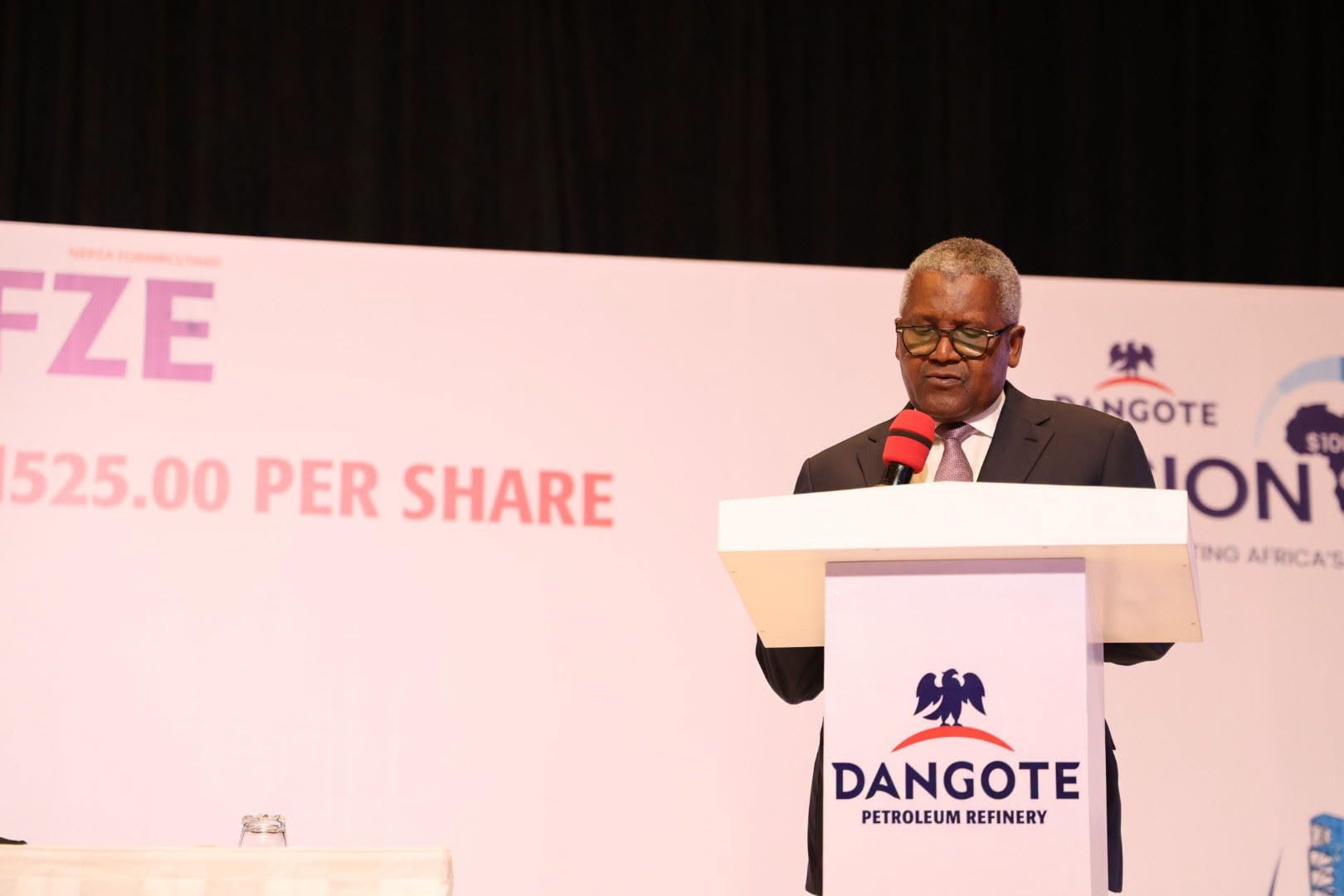
Billionaire Aliko Dangote is taking his oil refinery to Nigeria’s stock exchange at a valuation approaching US$50 billion, asking investors to fund the next phase of a project that has only recently started turning a profit at industrial scale.
Dangote Petroleum Refinery and Petrochemicals signed its initial public offering documents in Lagos on Monday, clearing a step toward what is expected to become Africa’s largest ever share sale.
The Offer at a Glance
The company will sell 4.1 billion shares at 525 naira each, or roughly US$0.40, from September 14 to October 13. A full subscription would raise about 2.15 trillion naira, equivalent to US$1.63 billion.
Dangote intends to spend US$14.3 billion to double the refinery’s processing capacity to 1.4 million barrels a day by 2029.
| IPO Detail | Figure |
|---|---|
| Shares on offer | 4.1 billion |
| Price per share | ₦525 (~US$0.40) |
| Minimum subscription | 10 shares (₦5,250 / ~US$3.97) |
| Subscription window | September 14 to October 13, 2026 |
| Target raise | ₦2.15 trillion (~US$1.63 billion) |
| Implied company valuation | ~₦65.22 trillion (~US$49.35 billion) |
| Planned listing | Nigerian Exchange, November 2026 |
| Greenshoe option | Up to 30% additional shares |
“We are opening ownership of this strategic asset to a broader community of investors and creating an opportunity for Nigerians to participate directly in its future growth and value creation,” Dangote said at the signing ceremony.
From Construction to Cash Flow
Built near Lagos at a cost of about US$20 billion, the refinery began operating in 2024 and reached its full nameplate capacity of 650,000 barrels a day in February. Since then, it has pushed throughput to roughly 700,000 barrels a day, ahead of its original design target.
That output is now translating into earnings. The refinery generated US$13.91 billion in revenue during the first six months of 2026, along with US$2.50 billion in gross profit, US$2.60 billion in EBITDA and US$1.82 billion in net income, according to figures in the IPO prospectus.
| Financial Metric (H1 2026) | Value |
|---|---|
| Revenue | US$13.91 billion |
| Gross profit | US$2.50 billion |
| EBITDA | US$2.60 billion |
| Net income | US$1.82 billion |
At the offer price, the refinery’s existing 120.13 billion shares are worth roughly US$47 billion. Add the 4.1 billion new shares, and the enlarged share count of about 124.23 billion puts the company’s implied equity value near US$49.35 billion, based on the exchange rate used for the offering.
Built for Retail Investors
The minimum subscription sits at just 10 shares, costing 5,250 naira, or about US$3.97, low enough to draw in first time investors alongside seasoned ones.
Subscriptions will run through a Bank Verification Number linked digital process, letting individuals apply through banks and fintech platforms without the paperwork that typically slows down large offerings. Dangote’s team is targeting as many as 10 million shareholders across Nigeria, spanning lower income earners as well as the company’s own drivers, cooks and managers.
“We want every human being living on the continent to be part of this action,” Dangote said, adding that the group hopes to draw shareholders from across Africa and beyond.
The strategy converts a refinery once controlled almost entirely by one man into an asset with a genuinely broad ownership base, with shareholders standing to collect dividends if the company declares them. Under a retail incentive scheme, investors who hold the minimum stake for a set period may also qualify for up to two bonus shares at no extra cost, pending regulatory approval.
If demand outstrips supply, Dangote can issue up to 30% more stock, subject to regulatory sign off, lifting the potential share count to about 5.33 billion.
A Financing Trail Already in Motion
Monday’s signing follows months of capital raising that laid the groundwork for the public offer. In July, the refinery closed a US$2.5 billion private placement that was oversubscribed 3.7 times and implied a valuation of about US$41.7 billion. It has also lined up a US$1 billion underwriting programme, including a US$400 million commitment tied directly to the IPO, giving the company a cushion against any shortfall in demand.
Chuka Eseka, group managing director and chief executive of Vetiva Capital Management, parent of lead issuing house Vetiva Advisory Services, said the offer structure was designed to widen retail access while setting new standards for how capital market deals are distributed in Nigeria. He noted the offering carries added complexity because the issuing entity is a free zone company rather than one incorporated under Nigeria’s Companies and Allied Matters Act. The company is dollar denominated, and dividends are expected to be paid in dollars.
David Bird, the refinery’s managing director and chief executive, described it as a merchant refinery capable of processing a range of crude grades and selling into multiple markets, rather than depending solely on Nigerian crude and domestic demand. He said the plant has become the largest single supplier of jet fuel into Europe, and that the planned expansion to 1.4 million barrels a day is already engineered, procured and funded.
A Second Continental Bet, This Time in Kenya
Dangote is not stopping at Nigeria. He is planning a separate 700,000 barrel a day refinery in Kenya to serve the East African market, with Lamu identified as the site and construction expected to run about 30 months. The project, estimated at roughly US$17 billion, would give the Nigerian industrialist a second major refining base on the continent, extending a model now being tested in Lagos into a region still heavily dependent on imported fuel.
Bird said the group’s longer term plans extend further still, including a bigger petrochemical portfolio and new distribution infrastructure across West Africa, with tank farms and a pipeline planned in Namibia to serve inland markets. Dangote framed the entire push, from the Lagos IPO to the Kenyan refinery, as part of a broader strategy to accelerate industrialisation across Africa, arguing that reliable energy supply underpins everything else the continent hopes to build. The Dangote Group has also flagged expansion plans in Ethiopia, Tanzania and Namibia, suggesting the Lagos listing is less an endpoint than the opening move in a much larger continental ambition.
