


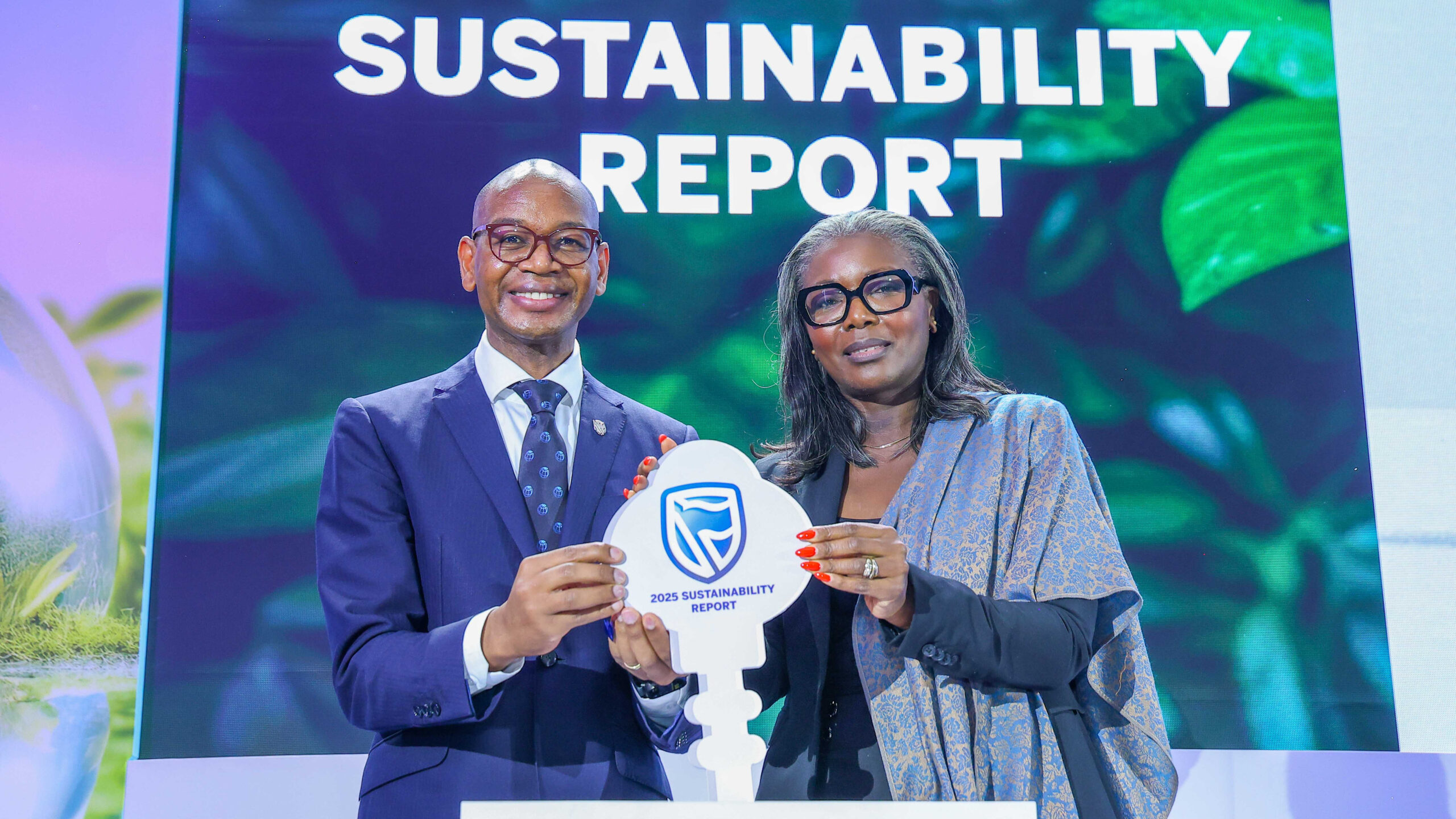
Stanbic Holdings Plc delivered a great year in 2025, embedding sustainability so deeply into its operations that the word “compliance” no longer fits.
What emerges from its 2025 Sustainability Report is a portrait of a bank that has moved from reporting on ESG to building its entire business model around it.
Trade financing surged to KShs 133 billion, nearly 50% above its KShs 90 billion target. The D.A.D.A women’s platform crossed KShs 49.5 billion in cumulative loans disbursed. Over 200,000 trees were planted in a single year. For the first time, the Board formally adopted IFRS S1 and S2 disclosures, placing Stanbic among East Africa’s earliest voluntary adopters of the new global sustainability reporting standards.
Chief Executive Dr. Joshua Oigara captured the shift:
“We made a deliberate strategic shift, re-orienting our portfolio toward sectors and segments that foster long-term national resilience, including green financing. We have embedded sustainability into the fabric of our daily decision-making, ensuring that performance is measured against clear targets and aligned to our strategic direction.”
Khusoko examines how Stanbic structures its impact strategy, where the numbers are most compelling, and what its targets signal about the direction of Kenyan banking.
Three Pillars Driving Socioeconomic Growth
Stanbic organises its positive impact work around three interconnected goals, each designed to address structural gaps in Kenya and South Sudan’s economies.
Driving Sustainable Industrialisation
The bank finances large-scale projects in agriculture, energy, transport, and telecommunications, sectors that form the backbone of Kenya’s economy. In 2025, Stanbic acted as Joint Lead Arranger for Safaricom’s KShs 20 billion green bond, the largest corporate green bond ever issued in East Africa.
The bond broke new ground not just in scale but in access. By introducing Kenya’s first mobile-based subscription channel through USSD and M-PESA, the issuance allowed ordinary retail investors to participate in major green infrastructure financing. The bond was oversubscribed, proving that digital innovation can unlock domestic savings for large-scale projects.
Stanbic also committed USD 25 million as part of a USD 156 million receivables financing deal for Sun King, the world’s leading off-grid solar provider. The transaction funded the acquisition of approximately 3.7 million solar products and smartphones across Kenya, extending clean energy access to low and middle-income households at as little as KShs 25 per day.
Facilitating Sustainable Trade
Trade finance surged from KShs 76 billion in 2024 to KShs 133 billion in 2025, surpassing the KShs 90 billion annual target by nearly 50%. This capital supported 5,750 businesses along the Africa-China trade corridor, providing working capital for smoother import-export operations.
The bank’s borderless banking solution enables clients to open accounts and transact in local currencies across East African markets, directly addressing the persistent challenge of foreign exchange availability. Agriculture, which accounts for 9.9% of the total loan book (up from 9% in 2024), received KShs 2.5 billion in climate-smart agriculture loans.
| Trade and Agriculture Metrics | 2024 | 2025 |
|---|---|---|
| Trade financing disbursed | KShs 76 billion | KShs 133 billion |
| Businesses supported (Africa-China corridor) | — | 5,750 |
| Agriculture loan book (% of total loans) | 9% | 9.9% |
| Climate-smart agriculture loans | — | KShs 2.5 billion |
| MSME catalytic funding (annual) | KShs 63 million | KShs 105.73 million |
| Cumulative MSME grants since 2021 | KShs 182.4 million | KShs 288.1 million |
Fostering Equitable Access to Finance
No initiative better captures Stanbic’s social mission than D.A.D.A (Dare to Aspire, Dare to Achieve), its dedicated women’s banking proposition. The platform onboarded 112,640 women in 2025, growing the cumulative loan book to KShs 49.5 billion since inception.
Beyond credit, Stanbic trained 126,901 women through capacity-building programmes in partnership with the African Guarantee Fund, IFC, WeConnect International, Goldman Sachs, and Leeds University. In the first full year of its partnership with the Gates Foundation, the bank empowered 6,700 women-owned enterprises with KShs 100 million in targeted support.
Dr. Oigara described the model: “When we help a woman-led enterprise in Nairobi access capital through our D.A.D.A platform and pair it with mentorship, or when we support a small business in Juba with the digital tools to thrive, we are building loyalty and demonstrating our dedication to their long-term success.”
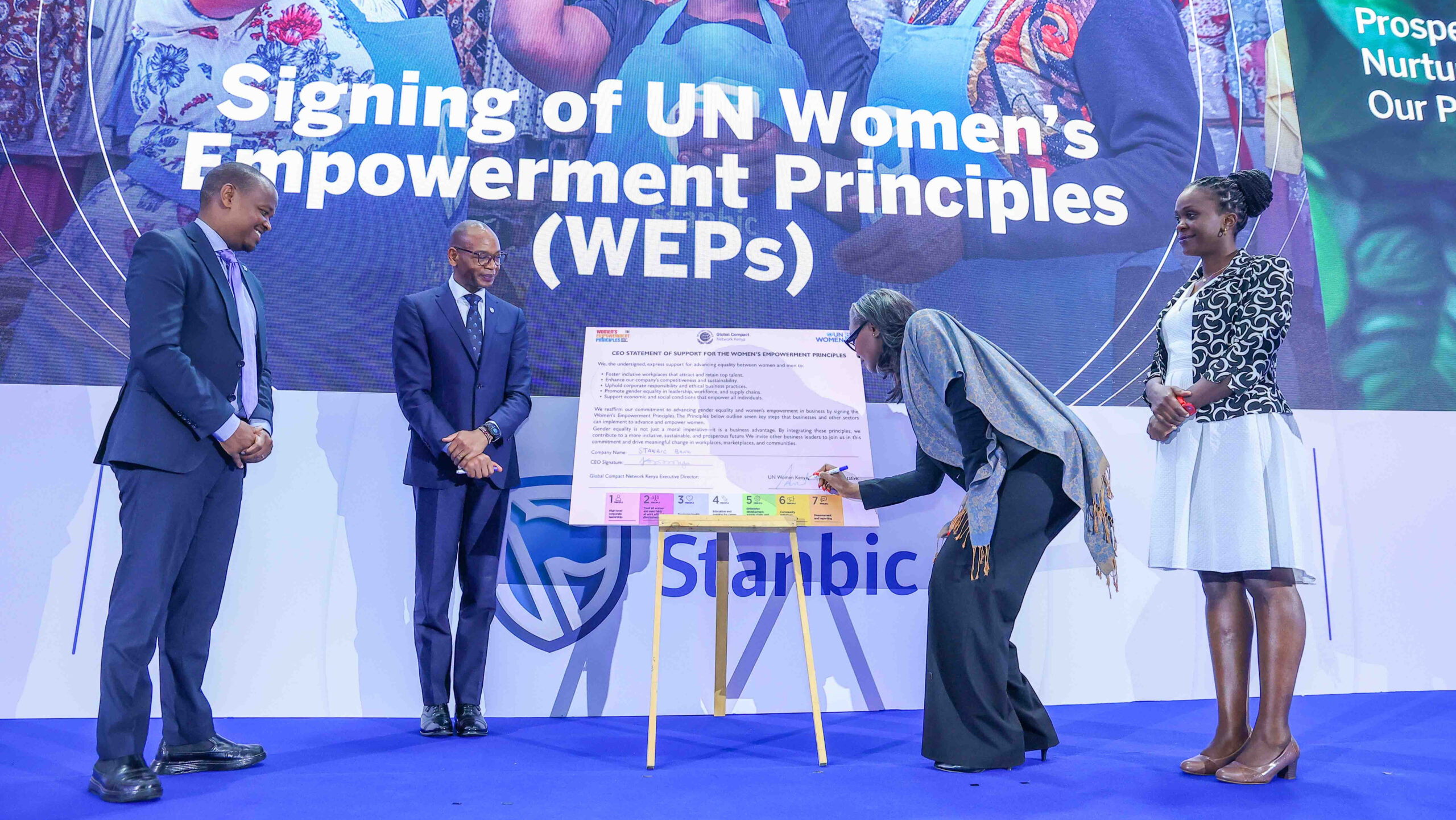
During the 2025 Sustainability Report launch, Stanbic signed onto the UN Women’s Empowerment Principles, formally adopting all seven principles covering corporate leadership, non-discrimination, health and safety, professional development, supply chain practices, community advocacy, and measurement and reporting. The signing built directly on the bank’s existing track record, including the 15.53% of procurement spend now directed to women-owned businesses, up from 10% in 2024.
Financial literacy reached 9,103 individuals through 74 sessions in 2025. The Chama app supported 54,000 users in managing group funds. And 92% of insurance policies now cover key environmental and social risks including floods, fire, terrorism, and geopolitical violence, giving clients a financial safety net where it is most needed.
Greening the Lending Portfolio
Stanbic has set a clear corporate mandate to scale green financing to 10% of its total lending portfolio. It reached 4% in 2025, up from 3% the year before.
During the year, the bank advanced KShs 4.5 billion in green building loans and KShs 273 million in solar energy financing. It also disbursed KShs 1.8 billion in affordable housing finance, reinforcing the role financial institutions can play in addressing Kenya’s persistent housing deficit through structured partnerships with the Kenya Mortgage Refinance Company (KMRC).
| Green and Social Finance Metrics | 2024 | 2025 |
|---|---|---|
| Green financing (% of total lending) | 3% | 4% |
| Green building loans | KShs 3.8 billion | KShs 4.5 billion |
| Solar financing | KShs 500 million | KShs 273 million |
| Affordable housing financing (annual) | KShs 1.79 billion | KShs 1.8 billion |
| Affordable housing (cumulative) | KShs 2.7 billion | KShs 4.5 billion |
The Environmental and Social Risk Management (ESRM) framework sits at the core of responsible lending. Chief Risk Officer Edwin Mucai explained its purpose: “Our Environmental and Social Risk Management framework, which mandates screening for all loans above USD 1 million, strengthens the quality and resilience of our loan portfolio. It protects the Bank and its clients from financing projects with material environmental and social vulnerabilities, helping us build a more resilient book that can withstand economic shocks.”
In 2025, 289 clients were screened across the portfolio, 60% through Corporate and Investment Banking and 40% through Business and Commercial Banking. Medium and high-risk transactions required documented mitigation plans embedded in credit approvals and legal documentation before any capital was deployed.
Stanbic declines to finance thermal coal power plant construction, Arctic oil and gas exploration, illegal logging, mountaintop removal, and operations involving forced or child labour. High-risk sectors including oil and gas, mining, and large dams require enhanced due diligence before any approval proceeds.
ESG Governance: From Oversight to Accountability
Board Leadership and Capacity Building
In 2025, sustainability became a standing agenda item at every Board and relevant committee meeting, a structural change that signals intent at the highest level of the organisation.
The Board invested in governance capability throughout the year. Directors completed training in ISSB disclosures, climate risk, AI, cybersecurity, and corporate governance, including direct engagement sessions with the Capital Markets Authority. Committee chairs attended advanced programmes in South Africa covering peer benchmarking and technical oversight.
The Board comprises seven directors. Women hold 43% of Board seats. Independent directors account for 29% of Board composition. All committees are chaired by non-executive directors.
Executive Accountability Tied to Sustainability Outcomes
The introduction of a Sustainability Scorecard represents the most consequential governance development of 2025. The scorecard ties executive remuneration directly to ESG performance targets. Goals including growth in the green lending portfolio and progress on financial inclusion carry defined weightings in performance reviews, reviewed formally at year-end.
Chairman Joseph Muganda described the accountability mechanism: “Sustainability-related goals, such as growth in our green lending portfolio or progress on our inclusion targets, have defined weightings that are formally evaluated during performance reviews. This directly links sustainability outcomes to accountability and reward, ensuring that our leadership is measured and incentivised in practice.”
The scorecard cascades from the Board level down through organisational and departmental targets to individual performance plans, creating an unbroken chain of accountability from strategic direction to daily execution.
IFRS S1 and S2 Adoption
Stanbic’s voluntary adoption of IFRS S1 and S2 in the 2025 financial year places it among East Africa’s first movers in sustainability disclosure. The framework directly connects sustainability data to governance, strategy, risk management, and financial metrics, embedding the sustainability narrative within the Group’s audited financial statements rather than treating it as a separate exercise.
The bank applies a double materiality framework. It assesses topics both from the outside in (how ESG risks affect Stanbic’s financial performance) and from the inside out (how Stanbic’s operations affect the environment, economy, and people). A topic qualifies as material if it meets significance through either lens.
Reducing the Carbon Footprint
Emissions Performance
Stanbic tracks and publicly reports its Scope 1 and Scope 2 greenhouse gas emissions. Total emissions rose from 286 tCO2e in 2024 to 357 tCO2e in 2025, reflecting operational expansion across the Group.
| GHG Emissions (tCO2e) | 2024 | 2025 |
|---|---|---|
| Scope 1 (direct) | 85 | 133 |
| Scope 2 (energy-related) | 201 | 224 |
| Total | 286 | 357 |
The bank targets a 39 tCO2e reduction in Scope 1 and 2 emissions and has committed to net zero from its own operations for newly built facilities by 2030 and existing facilities by 2040.
Tree Planting and Ecosystem Restoration
Stanbic planted 100,000 indigenous trees in 2025, restoring 100 hectares of degraded land at Mount Kenya. Three Community Forest Associations (Gathiuru, Kabaru, and Hombe) supported the effort, collectively counting 6,523 registered members. A total of 554 community members earned KShs 5 million through paid planting work, seedling sales, and transport services.
At the Sabaki Estuary, the Foundation planted 104,000 mangrove trees, more than double the 50,000 target, restoring 7.5 hectares of degraded coastal habitat. Over 130 community beneficiaries earned KShs 3.2 million through related work. Mangroves function simultaneously as carbon sinks, coastal shields, and biodiversity corridors, making this investment productive across environmental and economic dimensions at once.
Waste recycling reached 49,974 kilograms in 2025. The bank targets a 15% reduction in energy consumption and costs in the year ahead.
The Stanbic Kenya Foundation: Community as Strategy
The Foundation, now in its fifth year, disbursed KShs 187 million in corporate social investment during 2025. It operates across four pillars: economic empowerment, education, digital literacy, and climate resilience.
Head of Sustainability Priscilla Were framed the Foundation’s role within the broader business purpose:
“To deliver on our strategy and advance our purpose, we are focused on tackling critical challenges in Kenya and South Sudan while contributing to greater prosperity for our people. Through our sustainability agenda, we are able to generate strong financial returns for our shareholders and create meaningful social, economic and environmental value for the communities we serve.”
Digital Skills for Youth
The Foundation equipped 100,000 young people across eight counties with digital skills through a network of 139 training centres. American Tower donated 200 computers, complementing the Foundation’s 250 devices to create a combined fleet of 450 that powered the programme. A further 7,100 individuals completed training at Vocational Training Centres.
The bank’s broader digital inclusion strategy extends to USSD banking, which allows customers without smartphones to access formal financial services. Over 91% of transactions now flow through digital channels, and the bank’s active digital customer base exceeds 120,000.
Stanbic Bank Kenya Scales Renewable Energy Financing to Advance ESG Goals
Sustainability Academy: Equipping Businesses for the Green Economy
In 2025, Stanbic launched the Sustainability Academy, a free learning platform built to bridge the sustainability knowledge gap for businesses across Africa. The Academy offers practical, on-demand training across five core areas:
- Sustainability and ESG principles
- Climate-smart agriculture and its production benefits
- Renewable energy options across industries
- Carbon markets
- Water and wastewater management
The Academy reflects a broader ambition. Rather than positioning ESG as a compliance requirement, Stanbic treats sustainability literacy as a competitive advantage it can extend to the businesses it serves. Clients who understand carbon markets, water efficiency, and clean energy options make better borrowers and build more resilient enterprises.
Education and Scholarship
Sixty-six students from underserved communities received scholarships in 2025. The bank disbursed KShs 1.5 million each to the Brigid Kosgei Foundation and the Mary Immaculate Rescue Centre. The Mary Immaculate Girls Centre in Samburu shelters 98 girls and four boys who escaped child marriage, now in its third year of Foundation support.
Workforce and Inclusion
Stanbic maintained near-equal gender balance across its workforce in 2025, with a 51:49 male-to-female split at the organisational level and 53:47 at senior management. Female employees earn on average KShs 1 for every KShs 1 earned by their male peers.
| Workforce Metrics | 2024 | 2025 |
|---|---|---|
| Gender balance (M:F) | 51:49 | 51:49 |
| Female board representation | 4/7 | 3/7 |
| Differently abled employees | — | 0.6% |
| Average learning hours per employee | 97.2 | 104 |
| Spend on capacity building | KShs 47 million | KShs 89 million |
| Employee Net Promoter Score | 38 | 46 |
Youth represent 29% of the total workforce. The bank hired 83 new employees in 2025 and provided internships and graduate trainee placements for 36 young people aged 18 to 25. The target for filling vacancies through internal mobility stands at 60%.
The bank doubled its investment in capacity building from KShs 47 million in 2024 to KShs 89 million in 2025, a signal that workforce development is treated as a business investment rather than a cost line.
Targets for 2026 and Beyond
Sustainability Targets:
- Achieve 50:50 Board gender composition
- Reach 1% representation for differently abled employees
- Direct 25% of the total portfolio to sustainable finance
- Allocate 10% of the portfolio to underserved individuals and groups
- Direct 12.5% of procurement spend to marginalised groups
- Screen 100% of all loans above USD 1 million
- Reduce energy consumption and costs by 15%
- Train 40,000 young people through the digital skills programme
- Train and coach 300 businesses through the Women in Green programme
Climate Targets:
- Net zero from own operations for newly built facilities by 2030
- Net zero from existing facilities by 2040
- Reduce Scope 1 and 2 emissions by 39 tCO2e
- Scale green financing to 6% of total lending
- Plant one million indigenous trees directly or through partners over five years
- Plant 100,000 mangrove trees through the Foundation
