


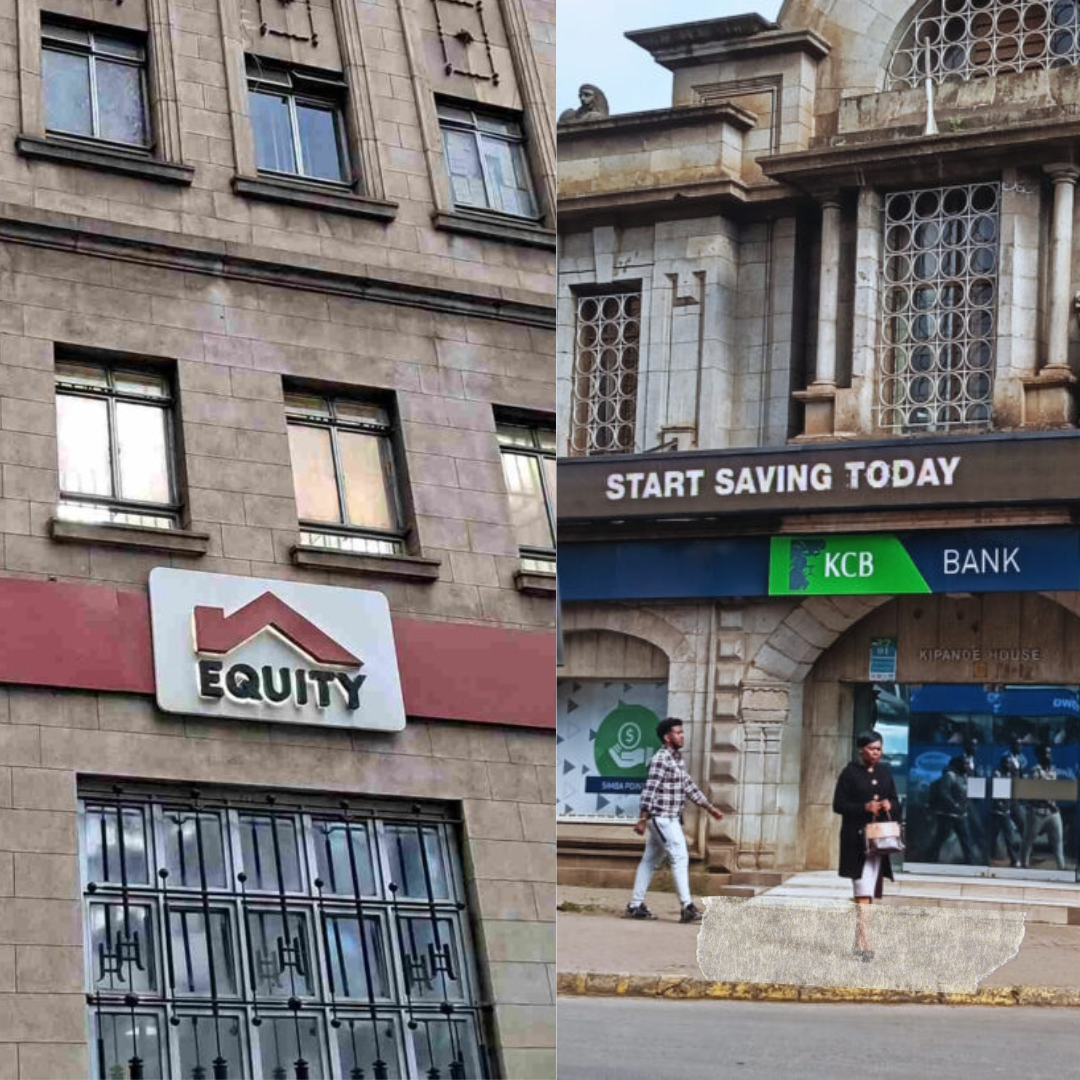
East Africa’s two most closely watched banks spent 2025 doing the same thing: making the branch redundant.
Equity Group Holdings and KCB Group, the region’s two largest banks by assets, released their 2025 annual results and sustainability disclosures within months of each other. Read together, the documents describe a banking sector in the middle of a structural shift — one that is moving transactions, lending, payments, and even customer onboarding off the teller counter and into digital infrastructure that operates at a fraction of the cost.
The Branch Is Losing the Transaction War
At Equity Group, 98.2% of all transactions in 2025 took place outside the branch through self-service channels. Digital platforms handled 88.4% of the Group’s total transaction volumes during the year — up from 85.7% the year before, a penetration level the Group’s annual report describes as placing Equity “among the leading financial institutions on the continent by digital adoption.”
KCB’s trajectory runs in the same direction. By Q1 2026, Equity reported that 98.3% of all transactions occurred outside branches, with 89.5% processed through digital platforms. For both institutions, fewer branch transactions mean lower variable costs per customer served, which matters enormously when both banks are expanding across markets where building physical infrastructure is slow and expensive.
The channel transaction data from Equity’s 2025 integrated report is instructive. Equity Mobile and USSD together processed 174.3 million transactions worth KES 4.36 trillion, a 37% jump in value from 2024. Equitel processed 400.9 million transactions, up 30% by volume. EazzyBiz, the corporate platform, processed KES 4.56 trillion in value, rising 19% from the prior year.
KCB Builds the Pipes Customers Never See
KCB’s most consequential technology move of 2025 did not generate consumer headlines. The bank’s integration of the Pan-African Payment and Settlement System, PAPSS, changed the cost structure of cross-border transactions for businesses trading across the continent.
Before PAPSS, a standard SWIFT-based transfer cost around KSh 2,500 per transaction and could take 24 hours, routed through offshore correspondent banks. KCB’s PAPSS integration cut that to between KSh 390 and KSh 1,950, with near real-time settlement directly between African banks in local currencies.
The adoption figures confirm the shift was real. KCB processed KSh 74.8 billion in transaction value through PAPSS in 2025, across 538 million transactions. For small and medium businesses trading across borders, the reduction in fees and faster settlement improved liquidity and reduced counterparty risk that had long made regional commerce more expensive than it needed to be.
Alongside PAPSS, KCB launched a new mobile banking application in February 2025, rolling it out across Kenya, Tanzania, South Sudan, and Burundi by year-end. The app supports fully digital KYC-enabled self-onboarding, family account management features, and bundles payments, lending, savings, insurance, and card management into a single interface. Monthly active users reached 1.35 million. Digital lending disbursements grew to KSh 520 billion from KSh 418 billion in 2024.
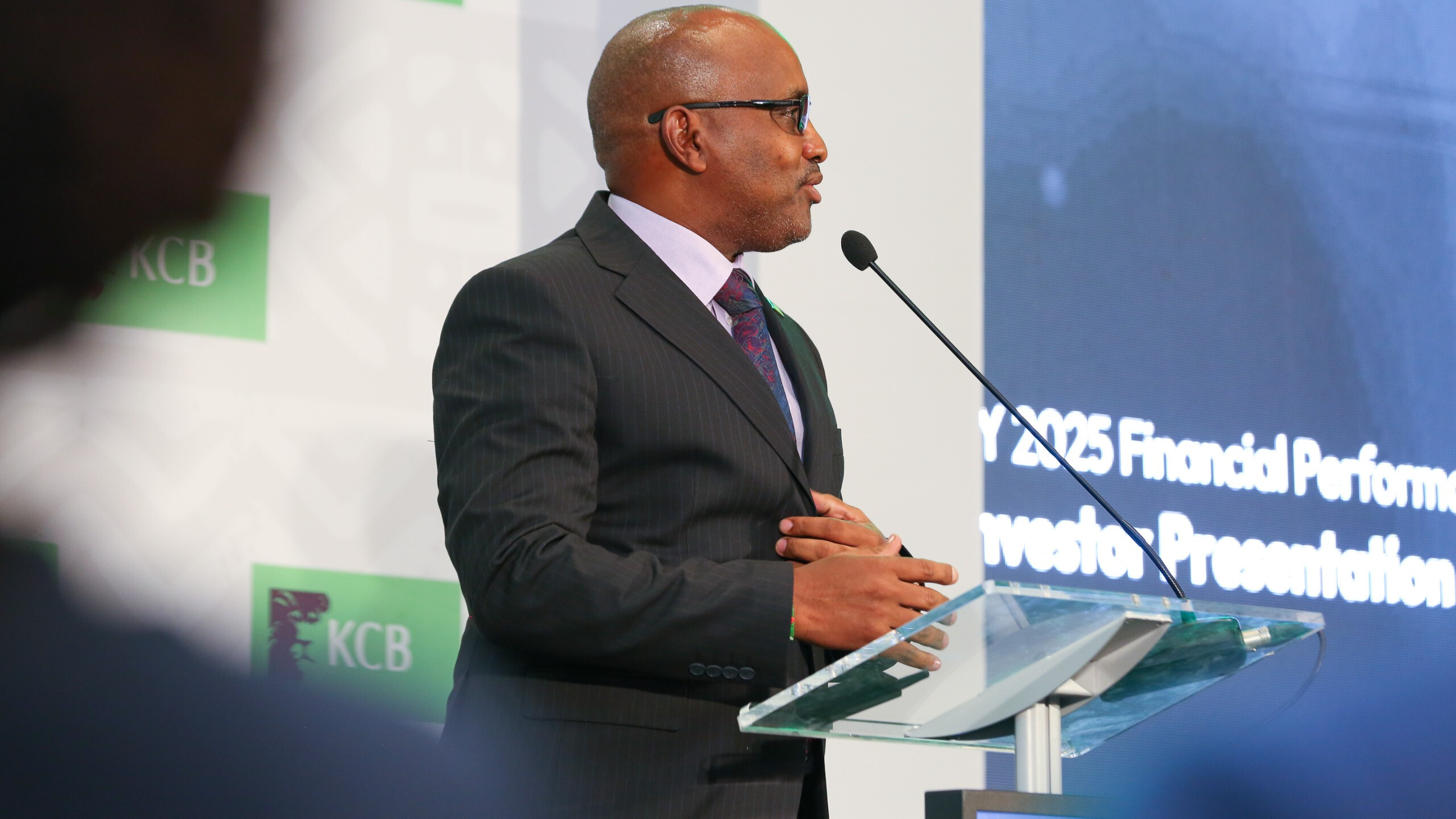
“Our platform is enabling seamless self-onboarding and wealth management, fostering a culture of financial planning,” KCB Group CEO Paul Russo said. “Our digital inclusion plan revolves around supporting our 6,400 chamas and 225,000 active businesses, who are the cornerstones of our economy.”
Equity Ships 180 Products in a Year
Equity Group’s technology delivery engine, the Product House, produced over 180 new minimum viable products during FY2025 — up sharply from 25 in 2024. The Group’s integrated report frames this acceleration as structural, not seasonal. The Product House operates on an agile delivery model that allows rapid testing, refinement, and scaling while reducing time to market and controlling capital allocation across the digital portfolio.
The Group’s technology agenda runs across six strategic focus areas. These span infrastructure modernisation, cloud transformation, platform-based business model integration through APIs, AI and data analytics, cybersecurity, and operational reliability. A target system availability of over 99.95% underpins everything else: when 98% of transactions happen outside branches, downtime has a direct revenue cost.
Equity also launched Equity Online for Business, an upgraded corporate cash management platform that deepened the Group’s penetration across SME and corporate segments across multiple country markets. The platform complements the Group’s “One Equity” operating model, through which customers access banking, insurance, and investment products within a single relationship rather than through separate product lines.
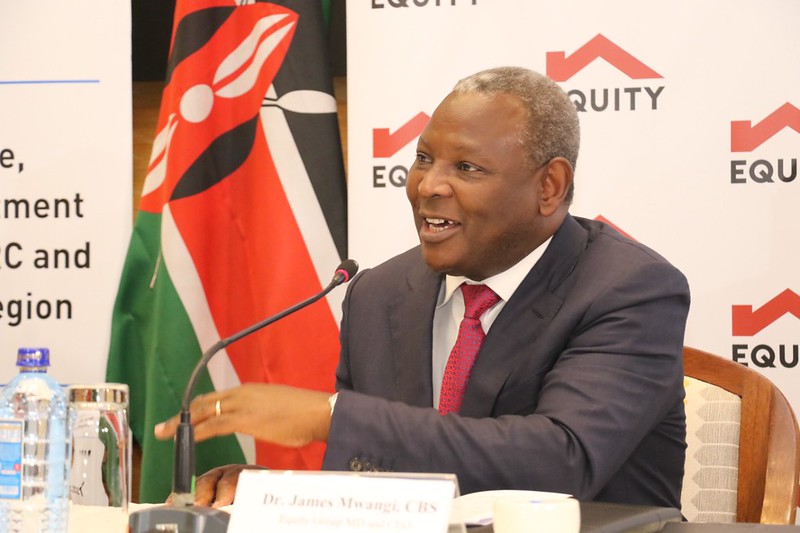
Group Managing Director and CEO Dr. James Mwangi described the trajectory as: “We are building a future-ready institution; scalable, secure, and impact-led, anchored in digital capabilities, staff upskilling, and a culture of disciplined execution.”
The financial results reflected the investment. Profit after tax surged 55% to KES 75.5 billion in FY2025. Total revenue reached KES 217.7 billion. Market capitalisation expanded 54% to KES 251.9 billion. Net loans stood at KES 882.5 billion, supported by deposits of KES 1.46 trillion. By Q1 2026, the Group reported a 24% year-on-year increase in profit after tax to KSh 19.1 billion, with the cost-to-income ratio falling to 50.6% from 54.2%.
Fraud: The Persistent Cost of Going Digital
Digital scale brings digital exposure. Both banks spent significant resources in 2025 on the fraud controls that expanding mobile platforms demand.
KCB deployed biometric authentication, document verification, selfie matching, and real-time transaction monitoring across its customer base of over 34 million. The bank also operates a 24-hour Security Operations Centre aligned to ISO/IEC 27001 and NIST Cybersecurity Framework standards. AI-driven application security tools scan for anomalous behaviour, flag malicious code patterns, and verify the integrity of third-party dependencies within a secure software development lifecycle.
The results were measurable. Fraud and forgery write-offs fell from KSh 4.5 million in 2024 to KSh 0.76 million in 2025. Frustrated fraud attempts — attacks the bank blocked before they succeeded — numbered 201 in 2025, down from 339 the prior year. KCB ran a customer awareness campaign under the Kiswahili name “Kaa Chonjo,” meaning “stay alert,” to reinforce responsible digital behaviour across its customer base.
Equity’s posture on fraud shifted from reactive to architectural. The Group’s 2025 integrated report acknowledges that as digital transformation accelerates, exposure to sophisticated internal and external fraud threats rises in parallel. The response was a prevention-first framework embedding layered controls across people, processes, systems, and data.
The Technology Group strengthened its Security Operations Centre with next-generation tooling for real-time threat detection. Enterprise Data Loss Prevention platforms were deployed to protect sensitive customer data and maintain regulatory compliance. Advanced monitoring now tracks activities connected to money laundering, sanctions breaches, and suspicious transactions across all six country markets.
Equity’s fraud investments built on machine learning and AI infrastructure. Initial use cases include fraud monitoring and automation, with the Group having built data warehouse capabilities and deployed generative AI agents and machine learning models for productivity use cases including credit and fraud detection. Fraud losses declined materially for the third consecutive year.
Equity’s report identifies the fraud risk landscape as evolving rapidly, “driven by artificial intelligence, expanding digital financial services, and increasing cyber-enabled criminal activity targeting institutions and customers.” The Group responds through enhanced due diligence, transaction monitoring, analytics, identity and access management, and continuous control monitoring that supports early detection and loss mitigation.

Building the Human Side of the Technology Organisation
Neither bank treats technology as a purely infrastructure question. Both made substantial investments in the workforce capacity needed to operate digital-first institutions.
Equity’s Technology Group formalised as a distinct organisational unit within the Group during 2025, serving as the technology execution arm of the broader transformation agenda. Its mandate covers six areas: strategic technology investment, future-proof architecture and cloud transformation, platform-based business model integration, AI and data intelligence, security and regulatory assurance, and operational excellence.
Staff capability programmes ran at scale. At Equity, 80% of Group employees completed a business-focused generative AI course, accumulating over 20,000 hours of instruction. The iamtheCODE Digital Academy recorded over 5,000 active users and 3,500 hours of learning. Through Huawei ICT Academy, 7,344 staff completed a GenAI course and were invited to undertake additional Huawei certification programmes. WorldQuant University admitted 641 staff to an MSc in Financial Engineering programme.
Mwangi framed this investment as a prerequisite for the next phase, not an optional addition: “As we progress toward our 2030 ambitions, we are evolving beyond traditional banking into a Transformation Finance Institution that mobilises capital, connects ecosystems, and accelerates inclusive, sustainable prosperity across Africa.”
KCB’s investment in human capability extended to its developer ecosystem. The bank scaled its Buni API Platform to a developer community of 2,600 engineers building solutions on top of the bank’s infrastructure. Public sector integration grew from 15 counties and 8 Ministries, Departments and Agencies in 2024 to 17 counties and 30 MDAs in 2025.
Technology Reaching Beyond Urban Markets
Both banks confronted the same challenge that defines East African financial services: how to take digital infrastructure to customers in markets where connectivity is thin and device ownership is growing but not yet universal.
KCB deployed its new mobile banking platform in South Sudan during 2025, the first time customers in that market could access an upgraded mobile experience through the KCB app rather than USSD text-based menus. In the Democratic Republic of Congo, KCB subsidiary GED Congo used mobile compensation payments to distribute KSh 26.73 million to communities affected by an infrastructure project in Haut-Katanga Province. In the Kwilu and Kasai regions, mobile teams and agent partnerships delivered KSh 705.81 million in civil servant salary payments to workers in remote areas.
Equity’s regional subsidiaries reported accelerating performance during 2025, with technology underpinning much of the growth. EquityBCDC in the DRC grew profit after tax 58% to KES 24.7 billion, supported by 17% loan growth. Uganda delivered a 500% increase in profit after tax to KES 3.6 billion. Rwanda contributed KES 5.4 billion, with its loan book expanding 22%. Tanzania recorded a 130% rise in profit after tax to KES 2.7 billion.
By Q1 2026, regional subsidiaries accounted for 50% of Equity’s Group banking profitability and 52% of total banking assets — a milestone the Group frames as central to its ambition of becoming a continental institution rather than a Kenyan bank with regional operations.
KCB also demonstrated that technology infrastructure can serve non-financial community needs. Working with Kenya’s Ministry of Education, the bank financed the transition of 266 schools from firewood to solar power, electric stoves, biogas, and LPG cooking systems, at a concessional rate of 9.75%. Pilot schools reported energy cost savings of up to 90%, with freed-up funds redirected toward books and student programmes. KCB now plans to scale the programme nationally.
What the Numbers Say About the Road Ahead
Reading Equity and KCB’s 2025 disclosures together reveals a banking sector that has moved decisively past the question of whether to digitise. The question now is how fast and how far.
Equity’s 2030 strategy, anchored in the Africa Recovery and Resilience Plan, targets 100 million customer relationships across 15 countries, supported by next-generation digital and AI systems. The Group describes itself as preparing to operate as a “Transformation Finance Institution” — a deliberate departure from the language of conventional banking.
KCB’s road ahead includes expanding its Buni API developer community, scaling solar-powered banking to 30 additional branches, and advancing alignment with IFRS S1 and S2 sustainability disclosure standards.
The harder test — the one that will define whether the last five years of investment pay off at continental scale — is distribution. Equity’s digital ecosystem facilitated 88.4% of its transactions in 2025. KCB’s fraud controls reduced losses by more than 80%. Equity shipped 180 products through its Product House. These are real accomplishments.
But East Africa’s banking opportunity does not live in Nairobi’s central business district. It lives in the farmer in western Uganda who needs seasonal credit, the trader in rural Burundi who needs a reliable payment channel, and the schoolgirl in Kakamega whose nearest branch is a two-hour walk away. The technology both banks are building is capable of reaching all of them. Whether it does is the measure that matters most.
