


KSh 97.3 million. That is what Britam Holdings paid out to 402,681 farmers and pastoralists across East Africa in 2025, people whose crops drowned, whose livestock died, and whose livelihoods climate change placed directly in the crossfire.
For a financial institution, it is a business model built around the assumption that climate risk is no longer an edge case.
Britam’s 2025 Sustainability Report, the group’s third annual disclosure and the first to bring all seven markets under a unified ESG framework, arrives at the Green Ledger carrying two distinct stories. One documents a Nairobi-listed insurer quietly constructing some of the most consequential climate adaptation infrastructure in the region. The other documents a group whose own environmental accounting still cannot measure the full weight of what it emits.
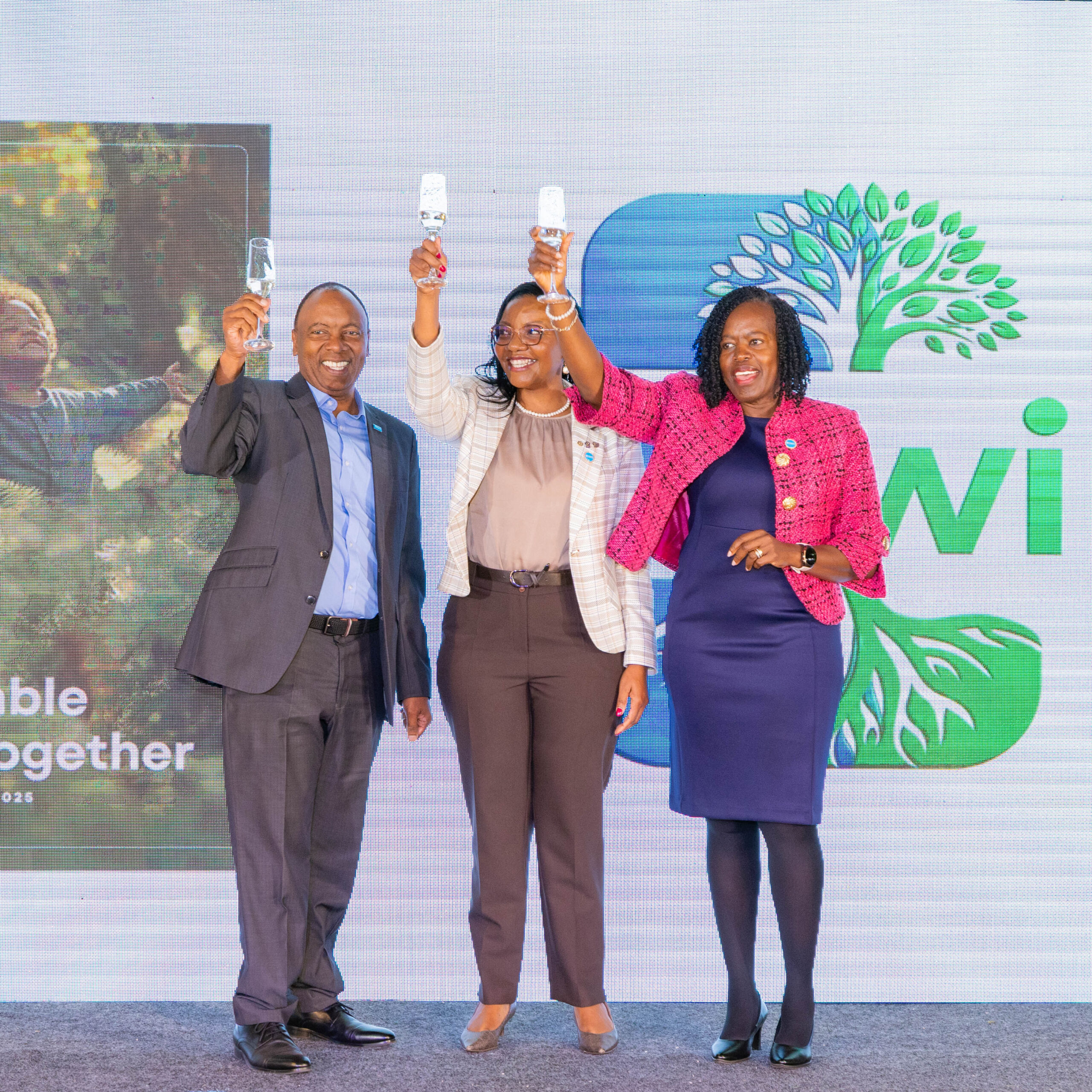
“Through inclusive, sustainable and innovative solutions, we are enabling recovery, stability, and continued productivity even in the face of increasing climate uncertainty,” said Group Managing Director and CEO Tom Gitogo. “Our focus is to ensure that farmers and pastoralists are not left exposed when climate shocks strike.”
The Carbon Numbers Tell Half the Story
Britam recorded total Scope 1 and Scope 2 greenhouse gas emissions of 221.96 tCO₂e in 2025, up from 210.62 tCO₂e the previous year. On the surface, that reads as regression. In 2024, the figure covered Kenya operations only. The 2025 figure now draws in Uganda, Rwanda, Mozambique, and South Sudan.
It also reveals that Britam published sustainability reports for years without accounting for a significant portion of its operational footprint. The group frames the expanded boundary as “building a wider baseline for a group-wide carbon reduction roadmap.” That framing holds up. It also marks how early the institution remains in the work of understanding what it actually emits.
The larger gap sits beyond Scope 2. Scope 3 emissions, the carbon embedded in a company’s investments, supply chain, and underwriting portfolio, typically account for between 70 and 90 percent of a financial institution’s total climate impact. Britam acknowledges the absence, noting it has not disclosed Scope 3 figures “due to data availability and quality constraints across our value chain.” For a group managing billions of shillings in assets across seven African markets, that is where the real climate accountability conversation starts and where this report goes silent.
| Emissions Category | 2024 (tCO₂e) | 2025 (tCO₂e) | Coverage |
|---|---|---|---|
| Scope 1 — Direct | 19.29 | 42.80 | Fleet and generators |
| Scope 2 — Indirect | 191.33 | 179.16 | Purchased electricity |
| Total Scope 1 + 2 | 210.62 | 221.96 | Kenya only (2024) vs. group-wide (2025) |
| Scope 3 | Not disclosed | Not disclosed | Value chain, investments, underwriting |
The Solar Installation Deserves Its Moment
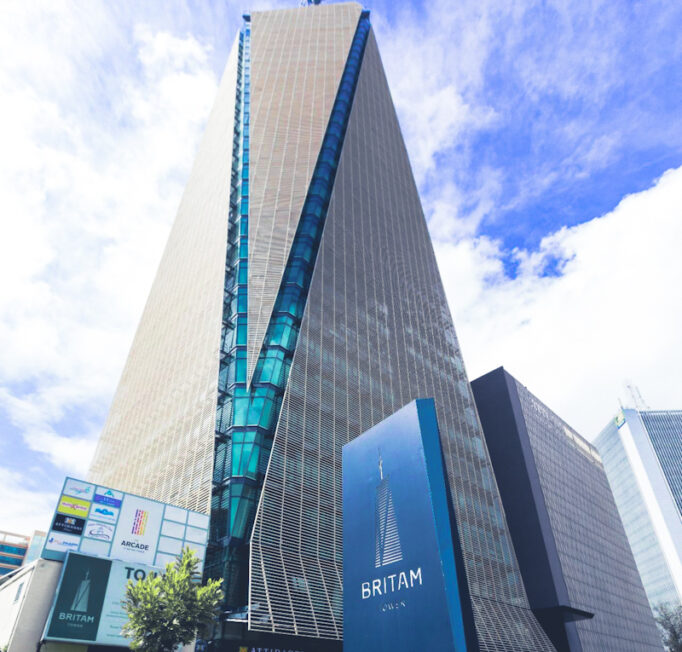
Britam’s most visible environmental achievement stands on firmer ground. In October 2025, the group commissioned a rooftop solar installation at Britam Tower, described in the report as one of Africa’s tallest green buildings. The project generates an estimated 390,000 kWh of clean energy annually, powers more than 50 percent of the building’s electricity requirements, and offsets 198 tonnes of CO₂ each year, the equivalent of planting 10,800 trees annually.
Britam Centre, a separate property, now draws 60 percent of its power from solar generation. In Rwanda, the subsidiary cut power consumption by 28 percent year on year.
Measured against total group electricity consumption — approximately 3.8 million kWh across the four subsidiaries that reported — solar currently covers roughly 10 percent of the group’s measured power draw. That is meaningful progress. It falls short of transformation.
EV charging stations at both Britam Centre and Britam Tower, accessible to employees, visitors, and the public, extend the signal of intent.
Climate Insurance
Across 2025, Britam paid KSh 80.4 million in crop insurance claims to 294,799 smallholder farmers, an 83 percent increase in coverage from 161,521 farmers the prior year. Payouts grew from KSh 4.5 million in 2024. That 18-fold rise in disbursements reflects both the expansion of the product and the acceleration of the climate events that triggered it.
For pastoralists, the group insured 107,882 individuals across Kenya, Uganda, and Tanzania against livestock loss, disbursing KSh 16.9 million in claims. In 2024, coverage reached 76,000 pastoralists.
Combined, the two programmes placed KSh 97.3 million into the hands of 402,681 farming and pastoral households whose economic survival depended on a payout arriving before the next planting season began.
| Programme | 2024 Coverage | 2025 Coverage | 2025 Claims Paid |
|---|---|---|---|
| Index-Based Crop Insurance | 161,521 farmers | 294,799 farmers | KSh 80.4 million |
| Livestock Insurance | 76,000 pastoralists | 107,882 pastoralists | KSh 16.9 million |
| Total | 237,521 | 402,681 | KSh 97.3 million |

The most technically ambitious product in the portfolio is the Mafuriko Index Insurance Policy, a parametric flood instrument developed in partnership with Oxfam, Swiss Re, and FSD Africa. Rather than requiring flood victims to file claims and wait for loss assessors, Mafuriko triggers payouts automatically when satellite rainfall data and river gauge readings cross pre-defined thresholds. In Uasin Gishu County, where flooding struck in 2024, the product disbursed KSh 2.1 million to affected farmers. Under the automatic payout model, a total of KSh 15 million reached over 300 households.
In communities where flooding displaces households within hours and the nearest assessor works three counties away, the speed and certainty of a payout can determine whether a family replants or walks away. Britam also applied ESG considerations directly into underwriting pricing: clients like Lake Turkana Wind Power and Malindi Solar received favourable terms because they generate clean energy.
“This reflects our understanding that sustainable growth requires strong governance and responsible leadership. Ultimately, sustainability is about thinking beyond the present and making decisions with the future in mind,” said Hilda Njeru, Director for Legal and Sustainability and Group Company Secretary.
Water Consumption Falls
Group water consumption dropped to 71,626 m³ in 2025, down from 88,120 m³ the prior year, a 19 percent reduction. Britam Tower’s Reverse Osmosis plant, which purifies and recycles water for secondary use, drives much of that efficiency.
60 Million Trees, and a New Digital Platform
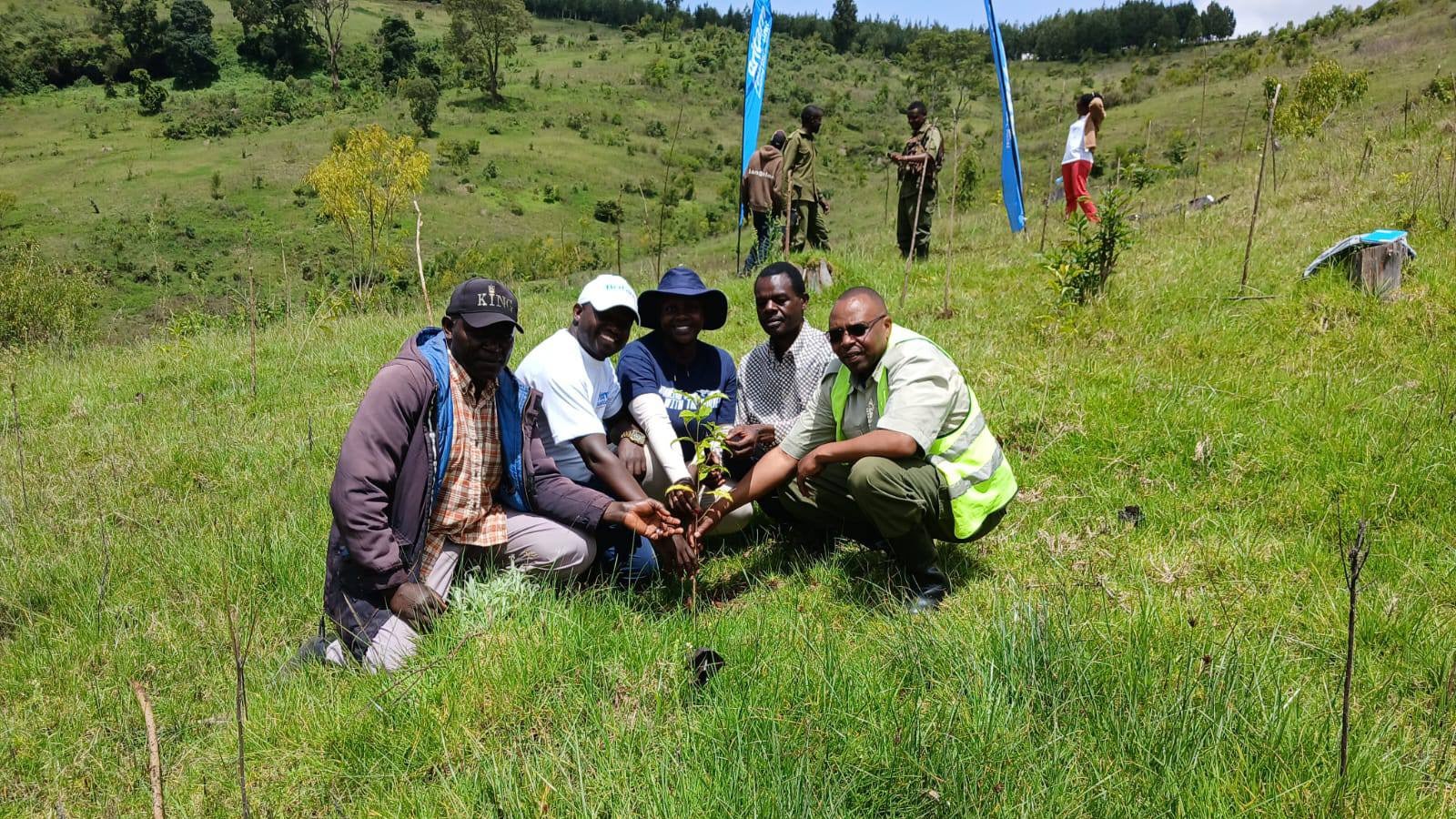
Britam Foundation targets 60 million trees planted by 2030. The 2025 progress report states 86,000 trees planted at the Mt. Elgon Water Tower, 10,000 trees in Rwanda, 5,700 trees across public schools, and 444 acres of degraded land restored, all of it generating 1,358 green jobs within host communities.
Mt. Elgon carries particular ecological weight. One of Kenya’s five major water towers, extending into Uganda, it currently holds under 5 percent forest cover. Britam Foundation’s reforestation work in partnership with Jumbo Charge Trust, involves growing 200,000 seedlings and mobilising Community Forest Associations, youth groups, and schools as long-term stewards rather than one-off recipients.
In May 2026, Britam introduced TAWI, a digital platform for real-time coordination, tracking, verification, and measurement of tree-planting activities. That addition addresses weakness in the previous reporting: the absence of a verifiable cumulative count and annual trajectory toward the 60-million target.
Women Lead the Pipeline. Pay Equity Data Does Not Follow.
Britam sustained female representation at 47 percent of its workforce in 2025. Women occupy 42 percent of executive leadership positions, and women comprise 51 percent of the succession bench, meaning the pipeline runs ahead of current senior representation.
For a financial group operating across seven African markets, the figures diverge significantly from an industry where female executive representation typically sits in the low twenties. The report does not disclose pay equity data alongside these numbers. That gap weakens the story. Representation without parity data describes who holds the title, not who receives the compensation attached to it.
Governance That Shows Up in the Numbers
On conduct, the report records zero corruption incidents disclosing that 95 percent of all employees completed anti-corruption training. 78 percent of the group’s board directors received training on anti-money laundering and data protection, and that the Code of Business Conduct underwent a full revision during the year. Britam contributed KSh 3.1 billion in taxes across its seven markets, a disclosure that places the group’s economic footprint in public view alongside its ESG claims.
The group received Top Employer certification in Africa for the second consecutive year, covering Kenya, Uganda, Rwanda, and Mozambique. The FiRe Financial Reporting Awards recognised Britam as first runners-up in the GRI reporting category.
This is the first edition to cover all seven operating markets under a single ESG framework, moving the group from fragmented national disclosures toward genuine group-level accountability.
