



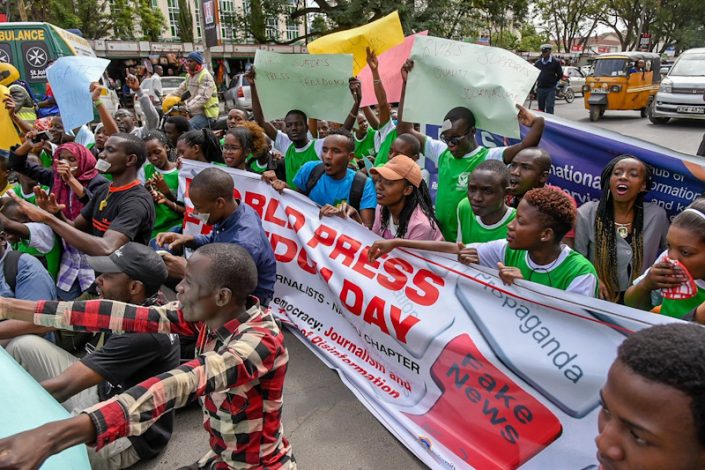
Killings of journalists rose worldwide in 2024 and 2025, and fewer of the killers face trial. Kenya logged 47 attacks on journalists between July and September 2026, up from 17 in the same quarter a year earlier.
Unions and press bodies marked the International Day to End Impunity for Crimes against Journalists with new data on violence, pay and safety.
UNESCO counts 189 journalists killed in two years
UNESCO confirmed 189 journalists and media workers killed in 2024 and 2025. The figure is 20 percent higher than in the previous two years and the highest since 2014 and 2015. The count appears in the Director-General’s Report on the Safety of Journalists and the Danger of Impunity, which UNESCO publishes every two years.
The share of killings that go unpunished reached 86 percent, the first rise since UNESCO began tracking it in 2012. Conflict zones accounted for 127 deaths, or 67 percent of the total.
“Journalists are increasingly paying with their lives for reporting from the frontlines of war and far too often those responsible for their killings are not held accountable,” said UNESCO Director-General Khaled El-Enany.
UN Secretary-General António Guterres said six of every seven killings go unpunished. “In conflict settings, the rate of impunity is close to 100 per cent,” he said.
Drones and online abuse add new risks
Drone strikes killed 50 journalists in conflict zones, or 40 percent of conflict deaths. The report documented seven attacks that killed several journalists at once, including strikes on newsrooms and temporary reporting centres. Fifteen journalists died while wearing press vests or travelling in vehicles marked “Press”.
Women face risk in war and online. Thirteen of the 14 women journalists killed in the period died in countries at war. A 2025 study by UN Women and the International Center for Journalists found that 75 percent of women journalists had experienced abuse or harassment. More than 40 percent reported offline violence linked to online attacks, up from 20 percent in a 2020 UNESCO survey.
Impunity in countries without conflict fell from 94 percent in 2012 to 77 percent. UNESCO said the decline shows that “when governments invest in investigations, prosecutions and protections for journalists, progress is possible.”
Africa: pay, fear and self censorship
The Federation of African Journalists (FAJ), with UNESCO support, surveyed 1,586 journalists in 45 countries for its 2026 report, Journalism Under Siege. FAJ describes the survey as an indicative assessment, not a statistical census, because conflict and surveillance limited who could respond.
The findings link money to press freedom:
- Income: 61 percent said journalism pay does not cover basic needs. Only 4 percent said it covers essential costs.
- Contracts: 62 percent work without a written contract, and 71 percent lack social protection.
- Safety: 65 percent faced threats or intimidation in the past three years. Only 17 percent always feel safe while reporting.
- Self censorship: 84 percent practise it, 45 percent of them frequently.
- Perpetrators: Respondents named police and security forces (34 percent) and politicians and officials (28 percent) as the main sources of attacks.
- Training and support: 83 percent have no safety training, and 72 percent have no mental health support at work.
- Leaving the job: 47 percent have considered quitting.
“You think carefully before publishing anything involving powerful people because you know the consequences may come immediately,” an investigative reporter from Eastern Africa told FAJ. A freelancer from West Africa said some months he survives “entirely on transport reimbursements.”
FAJ counts 18 media workers killed in Africa in 2025, citing the International Federation of Journalists. Women report added risk: 76 percent of respondents said women journalists face extra danger.
East Africa: detentions, exile and $20 salaries
FAJ’s Eastern Africa findings come from 301 respondents in 12 countries. The Sudan Journalists’ Union says more than 400 Sudanese journalists have gone into exile because of the war.
The Federation of Eastern Africa Journalists says more than 200 journalists have been detained under anti-terrorism and national security laws since 2019.
Pay in the region varies widely. Some Somali journalists earn as little as $20 a month. In Uganda, three quarters of surveyed journalists earn no more than UGX 1 million ($228) a month.
The 2026 World Press Freedom Index, cited by the Media Council of Kenya, ranks Kenya 106th. Tanzania is 117th, Burundi 119th, the Democratic Republic of Congo 130th, Uganda 131st and Rwanda 139th.
Kenya: Media Council counts 47 cases in one quarter
The Media Council of Kenya (MCK) documented 47 violations in the first quarter of the 2026/27 financial year, which runs from July to September. The count was 24 in the same quarter of 2024 and 17 in 2025. Rebecca Mutiso, MCK’s Manager for Press Freedom, Safety and Advocacy, presented the data.
Assault made up 34 cases. The rest were five threats, two arrests, two cases of intimidation, and one case each of abduction, harassment, combined threat and assault, and surveillance.
Nairobi recorded 13 cases, Homa Bay eight, Meru seven, Bungoma six and Nyandarua four. Embu, Nakuru and Mombasa each had two, and Garissa had one.
Criminal gangs and political activists carried out 17 of the cases. Police were responsible for 12 and politicians for eight. Six had unknown perpetrators. A bodyguard, a county government official and a bandit accounted for one case each.
Men were the victims in 36 cases and women in nine. MCK said the gap “does not imply that female journalists face a lower risk” and reflects newsroom assignment patterns, in which men more often cover high risk stories.
Kenya’s Women Journalists Are Entering the Newsroom and Leaving Too Soon
Kenya Union of Journalists links impunity to pay
The Kenya Union of Journalists (KUJ) used the day to press for fair pay. On Friday 30 October, KUJ released a survey on the terms under which journalists and media workers operate. The union says some work without written contracts, pension schemes or medical insurance.
KUJ Secretary General Erick Oduor called on media owners, editors, regulators and government to act.
“Economic injustice is a serious threat to the welfare, independence and sustainability of journalism,” the union said in its statement. It added that “protecting journalists requires more than condemning attacks; it also demands respect for their labour rights.”
FAJ’s Kenya data supports the union. Eighty percent of freelancers in Kenya lack formal agreements, and more than 70 percent of contracted journalists hold short term or insecure terms. FAJ also reports that cybercrime and anti-terror laws are used to restrict reporting in the country. Kenya contributed 62 respondents, the highest count in Eastern Africa after Somalia.
KUJ is asking for “practical, measurable commitments”: fair pay, timely salaries, written contracts and access to medical cover and pensions.
What comes next
Three sets of figures now point the same way. UNESCO shows killings and impunity rising worldwide. FAJ shows unpaid and unprotected journalists across Africa censoring their own work. MCK shows the Kenyan count nearly tripling in a year. UNESCO has called on states to respect UN Security Council Resolution 2222 on protecting journalists in conflict. FAJ has asked governments to reform labour laws and investigate attacks. KUJ wants media owners at the table.
