


Africa arrived in Glasgow with quiet ambition. It leaves with a medal haul that tells a louder story.
With the Games drawing to a close, three nations carried the continent’s flag into the top half of the table: Nigeria, South Africa and Kenya. Behind them, Cameroon, Mauritius, Uganda, Namibia, Ghana, Zambia, Lesotho, Gabon, Rwanda and The Gambia have each punched above their weight, proving that African sport now runs deeper than a handful of powerhouse programmes.
Nigeria Turns the Platform Into a Stage
No African nation has dominated a single discipline the way Nigeria has owned weightlifting and para powerlifting in Glasgow. The team sits seventh overall with ten gold, seven silver and seven bronze medals, and nearly every gold has come from the lifting platform.
Nigeria set the tone on the very first day of competition. Esther Nworgu and Esther Oyema delivered a pair of world breaking lifts in para powerlifting that put the country top of the early medal table before most nations had even opened their account. Nworgu’s winning lift of 119kg set a Games record and handed Nigeria its first gold. Edidiong Umoafia followed with a Commonwealth Games record total in the men’s 71kg category, while Onome Didih and Rafiatu Folashade Lawal swept their own weight classes with record breaking totals of their own. Lawal, the defending champion, left rivals fighting for silver.
Away from the platform, sprinter Kayinsola Ajayi delivered a milestone of his own, taking bronze in the men’s 100m. He became the first Nigerian man to medal in that event since Olusoji Fasuba’s silver back in 2006. Then, deep into the Games, Goodness Nwachukwu closed the loop with a world record throw in the women’s para discus, successfully defending the title she first won in Birmingham.
Team officials set a target of sixteen gold medals before the Games began. The final count of ten gold falls short of that ambition, but the platform’s dominance still carried Nigeria to Africa’s best showing in Glasgow.
South Africa Finds Its Voice in the Pool
If Nigeria’s story is written on the platform, South Africa’s is written in the water. Team South Africa closed out the Games with 28 medals, seven gold, eleven silver and ten bronze, and swimming has driven almost all of it.
Pieter Coetze, only twenty two years old, swept the backstroke events and broke Games records along the way, prompting South African officials to call him the sport’s next great name. His victory in the 100m backstroke doubled as an African record, underlining just how far ahead of the continent he now sits. Christian Sadie matched him for drama, winning gold and breaking the Games record twice in a single session. Erin Gallagher, competing at what she has confirmed is her final Commonwealth Games, added silver and bronze to close out a long and decorated career.
Then there is Chad le Clos. He sealed his place in history on the final night of the swimming programme, helping South Africa to bronze in the men’s 4x100m medley relay. That podium finish, his third medal of the meet, lifted his career total to twenty one across five Games and sixteen years, making him the most decorated athlete in Commonwealth Games history. He extended the record three times after first breaking it, a run that turned Tollcross into a celebration of longevity as much as speed.
Beyond the pool, South Africa’s netball side has already outperformed its sixth place finish from Birmingham. The Proteas finished third in their group after a narrow 58-54 loss to England, and the 3×3 basketball teams have added encouraging results of their own. With 28 medals in total, South Africa’s Glasgow campaign stands as one of the country’s strongest away from home.
Kenya Leans on Its Distance Running Roots
Kenya’s medal count grew steadily through the final week of competition, built on the back of its distance runners, and closed at three gold, four silver and five bronze — twelve medals in all. The men’s 3,000m steeplechase produced a full podium sweep, a result that underlined Kenya’s long standing grip on the event. Edmund Serem led the clean sweep home in 8:18.23, with Simon Koech and Leonard Bett completing an all Kenyan podium.
World champion Faith Cherotich backed that up on the women’s side, clocking a Games record 9:01.76 to take gold in her own steeplechase final. Uganda’s Peruth Chemutai claimed bronze in the same race, giving East Africa two nations on the podium in one final.
Mathew Kipsang times his attack perfectly 🇰🇪⚡️
He surges to 𝐆𝐎𝐋𝐃 for Team Kenya in a time of 13:28.81 ⏱️🔥
📺 Stream #Glasgow2026 on DStv: https://t.co/rM90YyQxaw#SSCommonwealthGames pic.twitter.com/VTBiVnkitl
— SuperSport 🏆 (@SuperSportTV) August 1, 2026
Saturday produced one of the campaign’s richest days. Mathew Kipchumba Kipsang won the men’s 5,000m in a dramatic finish, crossing the line in 13:23.61 to deliver Kenya’s third gold of the Games. He arrived in Glasgow as the national trials winner, having taken that title in 13:45.37. Wycliffe Kinyamal, the defending 800m champion, could not hold his crown after being overtaken late but fought back for bronze in 1:46.12, behind Jamaica’s Navasky Anderson (1:45.33) and Australia’s Luke Boyes (1:45.93). Timothy Cheruiyot added a third bronze in the men’s one mile, clocking 3:55.41 to hold off Wales’ Jake Hayward, as Scotland’s Josh Kerr thrilled the home crowd with gold in 3:54.12 and Australia’s Cameron Myers took silver in 3:55.26.
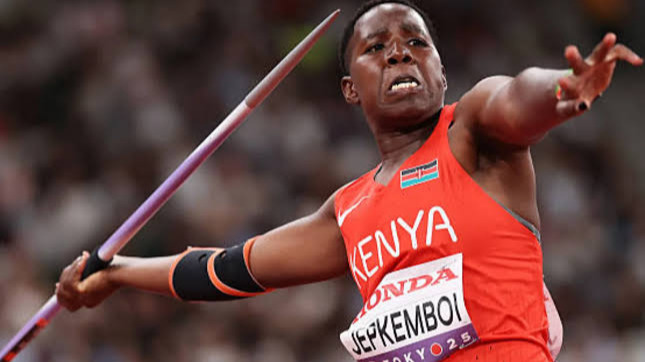
The same afternoon belonged to Irene Jepkemboi, who broke new ground in the field events. Her throw of 57.85m earned bronze in the women’s javelin, behind Australia’s Mackenzie Little, who won with a season’s best 61.88m, and New Zealand’s Tori Moorby, who took silver with 58.65m. The result made Jepkemboi the first Kenyan woman to win a Commonwealth Games medal in the event, a notable breakthrough for a nation whose reputation rests almost entirely on middle and long distance running. The 22 year old holds the Kenyan national record of 60.31m, set in Eugene in June 2025, and had already marked herself out as the country’s leading javelin talent before Glasgow. Her rise began with an African Under 20 silver in 2023 and continued under the guidance of former world champion Julius Yego, whose own career helped put Kenyan javelin on the map. Together, Saturday’s one gold and three bronze medals pushed Kenya’s tally further up the table and confirmed that its ambitions now stretch well beyond the track it built its name on.
Earlier in the Games, Diana Wanza took silver in the 10,000m, Lilian Odira claimed silver in the women’s 800m in 2:00.58, and Stephen Ndangiri added another silver with a national record of 38:46.57 in the men’s 10,000m race walk, finishing behind Australia’s Isaac Beacroft.
Joshua Amunga had opened Kenya’s account earlier in the Games with bronze in weightlifting’s 60kg category. With sprint favourite Ferdinand Omanyala also on the start list, Kenya used every discipline available to build one of its most well rounded campaigns in years, finishing thirteenth in the overall standings.
Smaller Teams Add Their Own Chapters
Medal tables rarely capture the full picture, and Glasgow has offered plenty of proof. Cameroon claimed a gold, a silver and two bronze medals, including a podium finish in judo. Mauritius quietly put together one of the continent’s tidier campaigns, finishing with a gold, two silver and a bronze. Uganda picked up two silver and a bronze across swimming and athletics, the bronze coming from Peruth Chemutai’s run in the women’s steeplechase. Namibia, Ghana, Zambia and Lesotho each returned home with medals of their own: Namibia with a silver and two bronze, Ghana with a silver and a bronze, and Zambia and Lesotho each with two bronze apiece. Zambia’s Edna Ng’Andula lined up in the women’s 100m heats as part of that campaign.
Rwanda and The Gambia broke through with their first podium finishes of the Games, a single bronze apiece. Gabon, making its Commonwealth Games debut in Glasgow, marked the occasion in style, walking away with a bronze medal of its own, a remarkable start for the continent’s newest flag bearer on this stage.
Africa’s Final Glasgow 2026 Medal Table
| Country | Gold | Silver | Bronze | Total |
|---|---|---|---|---|
| Nigeria | 10 | 7 | 7 | 24 |
| South Africa | 7 | 11 | 10 | 28 |
| Kenya | 3 | 4 | 5 | 12 |
| Cameroon | 1 | 1 | 3 | 5 |
| Mauritius | 1 | 2 | 1 | 4 |
| Uganda | 0 | 2 | 1 | 3 |
| Namibia | 0 | 1 | 2 | 3 |
| Ghana | 0 | 1 | 1 | 2 |
| Zambia | 0 | 0 | 2 | 2 |
| Lesotho | 0 | 0 | 2 | 2 |
| Gabon | 0 | 0 | 1 | 1 |
| Rwanda | 0 | 0 | 1 | 1 |
| The Gambia | 0 | 0 | 1 | 1 |
| Africa Total | 22 | 29 | 37 | 88 |
None of these totals will trouble the top of the overall table, which was dominated by Australia, England and Canada. All of them matter to the athletes who delivered them, and to the young competitors back home who now have a fresh reason to believe.
A Continent Building Momentum
Glasgow 2026 will be remembered for Australia’s record swimming haul and for Chad le Clos rewriting the record books. It should also be remembered as the Games where African sport pushed past its usual strongholds. Nigeria proved that a single discipline, built with intent, can carry a nation up the table. South Africa proved that a golden generation in the pool can outlast expectations. Kenya proved that heritage on the track still counts for something, even as the team widens its ambitions into new sports.
With the closing ceremony now here, the final numbers are in: thirteen African nations combined for 88 medals — 22 gold, 29 silver and 37 bronze — across the platform, the pool and the track. One trend already looks settled: African nations were no longer content to compete in Glasgow. They came to win, and by the time the flame went out, they had done exactly that.
