



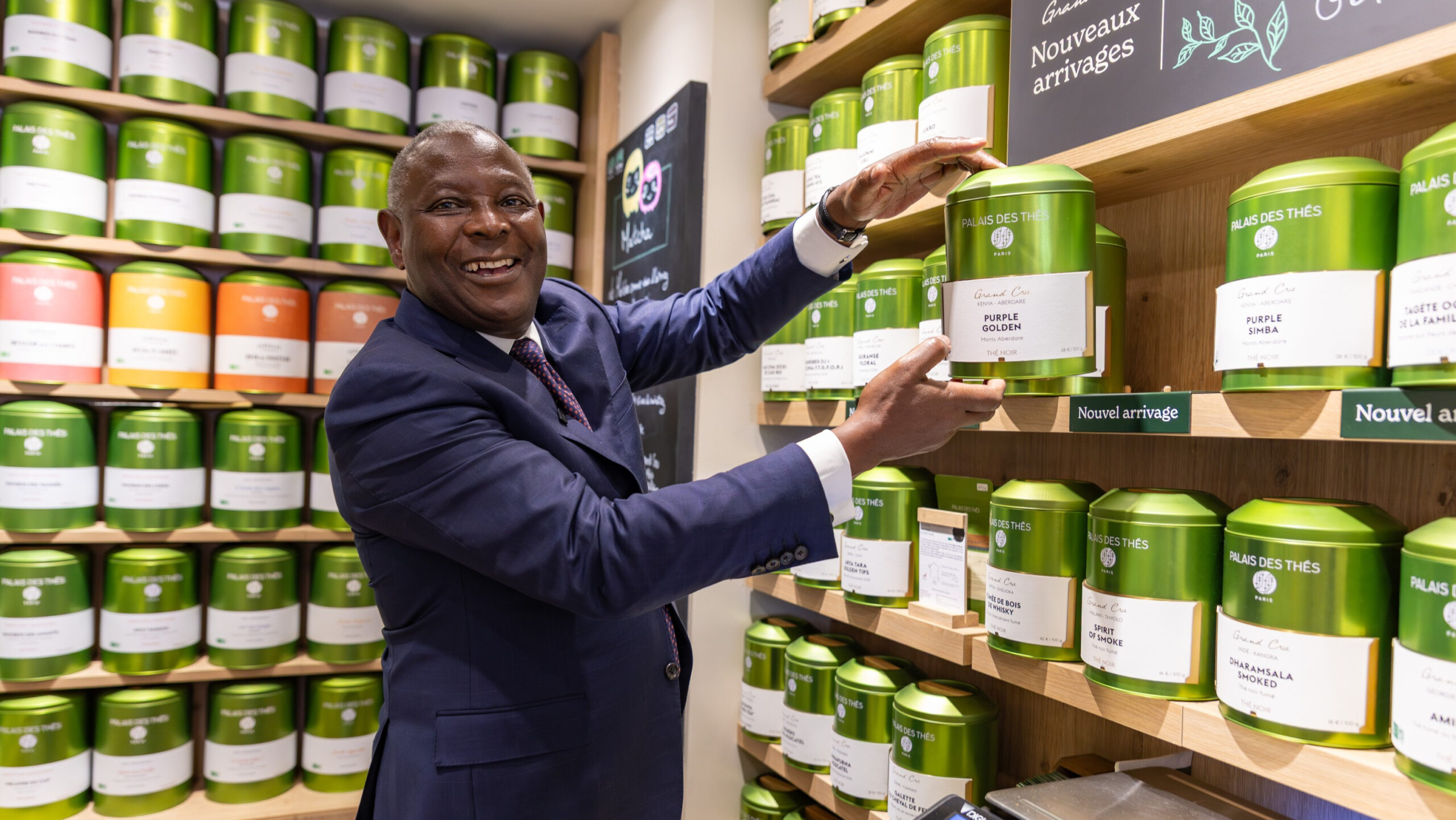
Murang’a County’s purple tea landed in Paris on June 23, 2026, when Gatanga Industries, French tea house Palais des Thés and Equity Group Holdings unveiled the product at the Hôtel de Crillon.
The launch marked the first time Kenyan specialty purple tea entered the French retail market through a formal commercial arrangement, opening a route that producers hope will deliver prices well above what the Mombasa auction typically generates for bulk black tea.
The partnership traces its origins to May 11, 2026, when the three parties signed an offtake and promotional agreement in Nairobi on the sidelines of the Africa Forward: Africa–France Partnerships for Innovation and Growth Summit, witnessed by President William Ruto and French President Emmanuel Macron. Under the arrangement, Palais des Thés will purchase and promote four Kenyan specialty varieties: Purple White, Purple Golden, Purple Simba and Purple Black. The French company, which operates more than 140 stores internationally, will also market the teas through its retail and educational platforms.
Gatanga Industries chairman Karanja Kinyanjui described the deal as a turning point for growers who have long cultivated a product without access to buyers who understand its worth. “For a long time, our farmers have been growing a unique crop without clear access to buyers who fully understand its value. This agreement changes that. It tells the farmer that what they grow belongs in the highest-value markets,” he said.
From Commodity to Product: The Case for Premium Positioning
Kenya earns more tea export revenue than most countries realise for the volume it ships. In 2024, Kenya exported 625,558 tonnes, 67% more than China and more than twice the volume of Sri Lanka, yet earned $1.4 billion, roughly matching Sri Lanka’s revenue and falling slightly below China’s $1.41 billion. The gap between volume and value points directly at the structural problem the purple tea strategy attempts to solve. Kenya’s exports are overwhelmingly dominated by CTC black tea, which accounts for 99% of production and exports, while specialty teas make up barely 1% of the export mix.
Equity Group CEO James Mwangi, speaking at the Paris launch, said. “Kenyan tea needs a distinct sub-identity and strong geographical identity. What we are witnessing is the beginning of a journey to transform tea from a commodity into a premium product. Moving from commodity pricing to premium value demonstrates the scale of opportunity for farmers,” he said.
Palais des Thés founder and chairman François-Xavier Delmas said the company’s role extended beyond procurement. “Kenyan purple tea is not only an exceptional product in terms of quality, but also a compelling expression of origin, climate, and craftsmanship. Our role goes beyond procurement; it is about elevating its story on the global stage and positioning it within a category of teas that consumers value for authenticity and distinction,” he said.
The Paris launch received additional exposure when chefs at the recent G7 Summit in Évian used a Kenyan Grand Cru tea selected by Palais des Thés to develop a dark chocolate product, demonstrating that Kenyan tea can enter premium food categories beyond the cup.
Equity Group Holdings Non-Executive Chairman Isaac Macharia reinforced the wider ambition. “By positioning Kenyan specialty tea in premium global markets, we are not only enhancing the value of our agricultural products but also creating sustainable economic opportunities that can transform rural communities and strengthen Kenya’s competitiveness on the global stage,” he said.
Equity Group: Transforming Africa’s Livestock and Leather Economy
Geographical Indication: Protecting What Makes Purple Tea Kenyan
Alongside the commercial push, Kenya is pursuing Geographical Indication status for purple tea. GI certification legally links a product to its place of origin, in the same way that Champagne can only come from a specific region of France or Darjeeling from a defined area of India. For purple tea, which the Tea Research Institute of Kenya developed specifically for the country’s central highlands, GI status would protect the product’s identity from imitation and support pricing power in markets where origin matters to buyers.
Delmas noted that certification would play a role in building consumer trust. “We have been working to increase the visibility and value of Kenyan tea, promoting and marketing it in France and across other European markets. In this effort, geographical indications are an extremely valuable tool, helping consumers identify and appreciate the unique origin and quality of the product,” he said.
Kenya’s Ambassador to France Betty Chebet Cherwon described the launch as a step toward a more balanced trading relationship. “What we are witnessing today is an important step towards a more balanced trade relationship by promoting value addition, branding and market access for Kenyan specialty teas,” she said.
The Numbers Behind the Sector
The Paris debut arrives as Kenya’s tea industry records consecutive years of earnings growth following a difficult 2024 when a supply glut drove prices down. Kenya’s export earnings from tea rose 2.87% to KSh 186.91 billion ($1.44 billion) in 2025, up from KSh 181.69 billion the previous year, driven by increased volumes. The total marketed value of tea, including domestic sales and committed stocks, reached KSh 218.79 billion in 2025, up from KSh 215.21 billion in 2024.
Export volumes rose 9.81% to 652.80 million kilograms from 594.50 million kilograms in 2024, partly driven by high volumes of unsold stocks carried over from 2023 and 2024. Kenya expanded its export reach to 100 countries in 2025, up from 96 in 2024, with Pakistan, Egypt, the United Kingdom, the United Arab Emirates and Russia among the leading markets. Emerging destinations posted strong growth: Ireland rose 454%, Japan 287% and Kazakhstan 186%, signalling that European and Central Asian consumers are open to Kenyan tea in ways that the sector has yet to fully capitalise on.
Tea exports grew 6% in the first quarter of 2026 to 144.46 million kilograms, with Pakistan absorbing a record 56.47 million kilograms, accounting for 39% of total exports. However, Sudan’s exports collapsed 69% to 1.79 million kilograms following a trade ban Khartoum imposed in March 2025 after Nairobi hosted the Rapid Support Forces, and Jordan fell 71%, underscoring how dependent the sector remains on bulk sales to markets vulnerable to geopolitical disruption.
That concentration risk sharpens the argument for specialty products. The Tea Board of Kenya’s reforms aim to increase smallholder earnings from KSh 59 per kilogram in 2022 to KSh 100 by 2027, benefiting more than 834,000 farmers.
Agriculture Cabinet Secretary Mutahi Kagwe, speaking at the release of the 2025 performance report, said the trajectory was deliberate. “This performance is not accidental but the result of deliberate reforms, market expansion, and a renewed focus on quality and value addition under the Bottom-Up Economic Transformation Agenda,” he said.
Purple tea’s entry into France will not shift the aggregate numbers immediately. What it does is establish a commercial proof of concept: that Kenyan tea, presented with provenance and purpose, can reach the shelves of one of the world’s most demanding tea markets and command prices that bulk exports never will.
How Stanbic Bank’s Chai Loan Is Giving Kenyan Tea Farmers A New Green Leaf Of Life
