


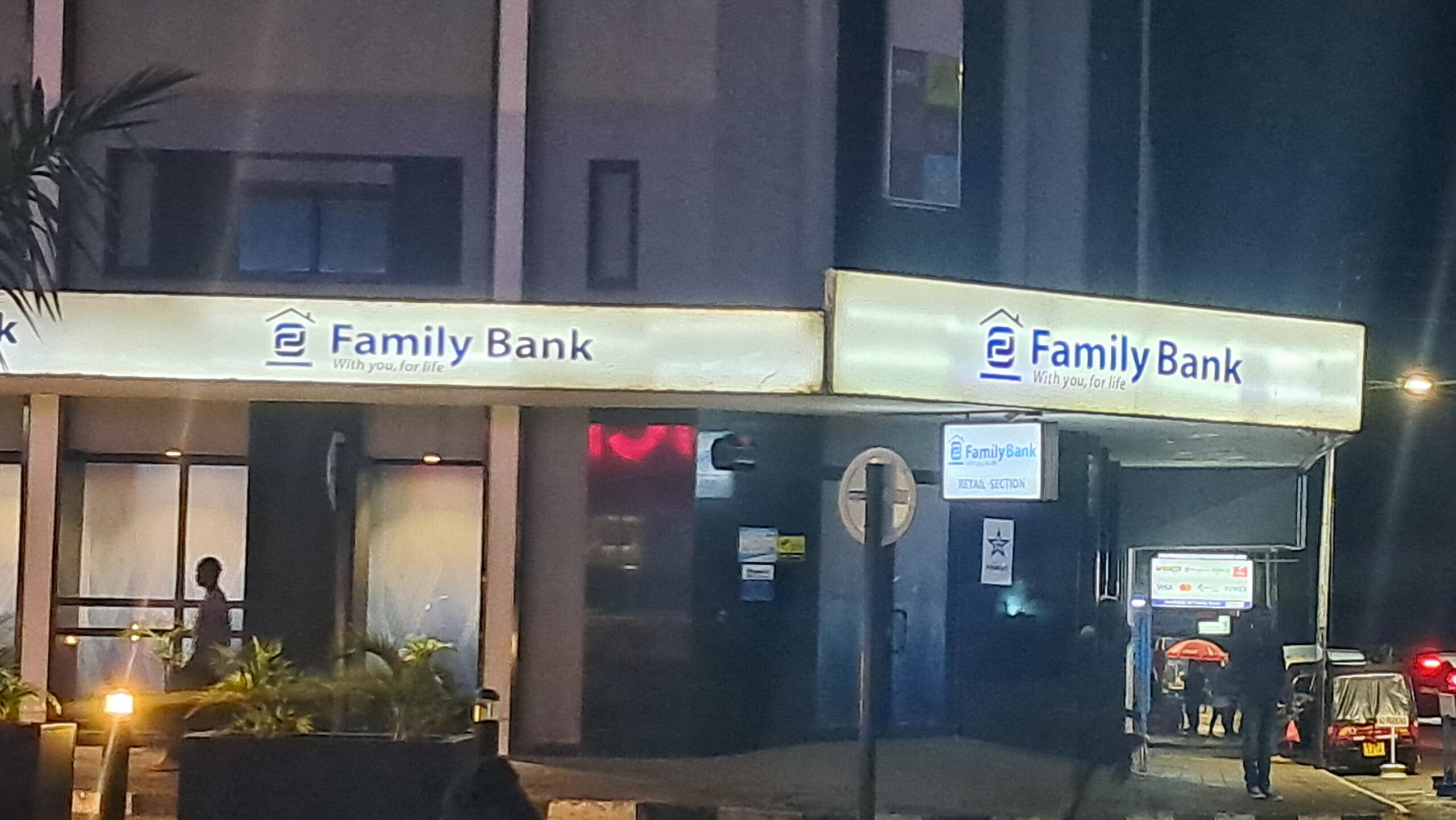
Family Bank steps onto the Nairobi Securities Exchange on 23 June 2026 at a reference price of KES 18.00 per share, ending a five-year journey to go public and completing its transformation from a building society founded in 1984 into one of Kenya’s largest mid-tier lenders.
The listing will not raise new capital. Instead, existing shareholders gain a regulated public market to trade their holdings, giving them liquidity while protecting current investors from the ownership dilution that a fresh share sale would trigger.
What the Listing Price Implies
At KES 18.00 per share across 1,662,654,760 issued and fully paid-up ordinary shares, the bank enters the market with a capitalisation of roughly KES 29.9 billion. Based on FY2025 earnings per share of KES 3.93, the listing prices the stock at about 4.6 times earnings. Book value per share stood at KES 19.62 at year-end, placing the entry price at a slight discount to book at 0.9 times.
According to the Information Memorandum, the listing price was benchmarked against sector median multiples as at 30 March 2026 and calibrated against live NSE peer comparisons. Five distinct valuation methods were applied: the Dividend Discount Model, Residual Income Valuation, Price-to-Book, Price-to-Earnings, and Precedent Transactions analysis. The results were instructive. Residual income yielded the highest valuation at KES 43.06 per share and the Dividend Discount Model placed fair value at KES 33.05. Applying equal weightings across all five methods produced a blended fair value estimate of KES 29.62 per share. The KES 18.00 listing price sits at a meaningful discount to that figure, structured, as the document states, “to ensure that Family Bank enters the market with a credible valuation discount that rewards subscribers and supports post-listing price stability.”
Over the six months to March 2026, average traded prices on the over-the-counter market moved from KES 15.21 in October 2025 to KES 20.28 in March 2026, with December already touching KES 17.94.
The dividend picture adds further context. By FY2025, dividends per share reached KES 1.20, putting the dividend yield at 6.7% at the listing price. The payout ratio stood at roughly 30.5%, consistent with the bank’s stated policy of distributing 30% of audited net profit annually, though the board retains discretion to vary this. In FY2025, the actual payout came to 41%, with KES 2.23 billion distributed to shareholders — the largest dividend in the bank’s history.
A Bank in Sustained Growth
The financials behind this listing are hard to overlook. Profit after tax reached KES 5.37 billion in FY2025, up from KES 2.31 billion in FY2021 — growth of more than 130% over four years. Total assets expanded from KES 111.7 billion to KES 208.7 billion over the same period. The bank now serves over 1.3 million customers through 96 branches across 32 counties, supported by 5,000 banking agents and over 103,000 merchants countrywide.
The financial ratios in the table above underline the momentum. Net interest margin widened from 7.6% in FY2024 to 8.6% in FY2025, driven by total interest income rising to KES 25.2 billion. Cost-to-income ratio fell from 74.8% to 69.4%, reflecting tighter operational efficiency — and the bank’s 2025–2029 strategic plan targets a further reduction to 60%. Capital strength improved across the board, with core capital to risk-weighted assets rising from 13.5% to 16.9%, and liquidity climbing sharply from 43.9% to 60.9%. All capital ratios remain within regulatory thresholds.
Q1 2026 delivered a 52.6% increase in profit after tax to KES 1.6 billion, up from KES 1.0 billion, driven by growth in interest-earning assets and diversified income streams. Assets rose 32.3% to KES 230.2 billion, customer deposits grew 27.0% to KES 168.9 billion, shareholders’ funds increased 42.2% to KES 34.7 billion, and net interest income surged 45.5% to KES 4.7 billion in Q1 2026 alone.
Capital Raised Before the Listing
The bank pursued a phased and disciplined capital strategy over several years. In 2021, it returned to the debt market and raised KES 4.42 billion against a KES 3 billion target — a subscription rate of 147%. A rights issue in 2023 raised an additional KES 252 million. Then in 2025, a private placement raised KES 8 billion, exceeding its KES 6.09 billion target by 31%. The Information Memorandum notes the bank is also on course to retire its 2021 corporate bond this year.
Strategy: The Preferred Bank for Biashara
The 2025–2029 strategic plan, developed in collaboration with McKinsey and Company, targets total assets of KES 321 billion and profit before tax of KES 13 billion by the end of the strategy period. The plan rests on three pillars: compelling customer propositions, productivity and efficiency, and digitisation and data utilisation. By 2029, the bank targets 98% of all customer transactions conducted through digital channels, up from 92% today. Family Bank was also the first bank in Africa to launch the mVisa service and the first to introduce paperless banking through smart card technology.
The bank’s main ambition is Tier One status by balance sheet and market size, with plans to grow its branch network to over 100 by 2026, complemented by agency banking and digital channels.
The Shareholder Structure
Kenya Tea Development Agency Holdings is the single largest shareholder with a stake of 18.98%. The estate of the late Rachael Njeri Muya holds 10.05%, and Daykio Plantations — majority-owned by founder Titus Muya — holds 9.53%. Titus Muya and associates collectively control 35.67% of the bank. As at March 2026, shareholders’ funds stood at KES 34.77 billion, translating to a book value of approximately KES 20.91 per share based on issued shares ahead of the NSE debut.
Notably, the CMA granted Family Bank an exemption from the standard requirement that controlling shareholders restrict sales of their holdings for 24 months following a listing by introduction. No lock-in undertaking will apply to any shareholder in connection with this listing.
Standard Investment Bank serves as lead transaction adviser, with PwC Kenya as reporting accountant and Mboya Wangong’u and Waiyaki Advocates as legal adviser.
What This Means for the Market
This listing is the second on the NSE in 2026, following Kenya Pipeline Company’s IPO in March, and brings the number of listed banks on the bourse to 12. For investors who have watched Kenya’s stock market struggle through years of thin listings, Family Bank’s arrival offers something concrete — a growing, profitable lender trading at a steep discount to its blended fair value, with a credible dividend track record and improving returns on both assets and equity.
Investors should note the risks the bank itself flags. The free float at launch is limited, with only 34.5% of shares immobilised and eligible to trade from day one. Concentrated shareholding — the top ten shareholders control roughly 59.1% of issued shares — means price discovery may take time to settle. The bank also acknowledges that the listing price may not reflect open market levels once trading begins.
Board Chairman Lazarus Muema framed the moment plainly in the Information Memorandum: “As a Board, we have taken time to prepare, to build value and to ensure that when we list, it is from a position of strength. This listing is not just about prestige but about creating long-term value for our shareholders and positioning the Bank for sustainable growth.”
Managing Director Nancy Njau added: “Our vision to positively transform people’s lives in Africa has remained unchanged, and this listing will accelerate the realisation of that vision.”
Trading opens on 23 June 2026.
