



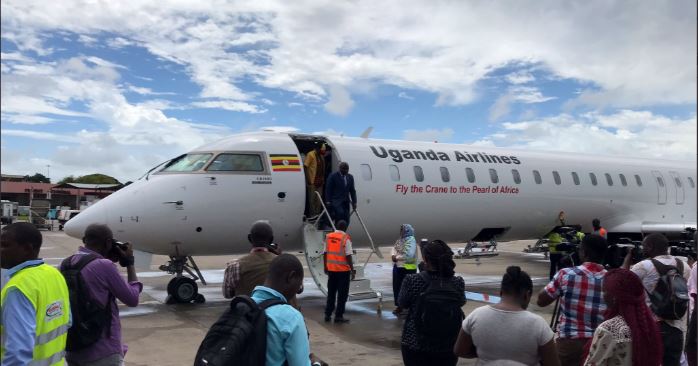
Uganda Airlines has signed a $982 million agreement with Boeing for 10 new aircraft, the most significant fleet commitment in the carrier’s short history and a direct statement of intent in one of Africa’s most contested aviation markets.
President Yoweri Museveni witnessed the signing at State House Entebbe on Tuesday. The deal, valued at approximately Shs 3.7 trillion, covers both passenger and cargo aircraft and forms the centrepiece of the government’s strategy to use aviation as a lever for trade, tourism and inward investment. Officials drew attention to the first four aircraft due under the contract, building on last year’s government funding that brought Boeing Dreamliners, freighters and Airbus jets into the fleet.
President @KagutaMuseveni today witnessed the signing of a landmark agreement between @UG_Airlines and @Boeing for the acquisition of 10 new aircraft, a major step in expanding Uganda’s aviation capacity and global connectivity.
The fleet expansion, which includes passenger and… pic.twitter.com/XuI5VQ5Vns
— State House Uganda (@StateHouseUg) June 10, 2026
What Uganda Airlines Is Buying and Why It Matters
The mix of passenger and cargo capacity in this order reflects a deliberate commercial calculation. Uganda’s export economy — anchored by coffee, cut flowers, fish and manufactured goods — moves on air freight. Belly cargo on passenger routes has never been sufficient to meet that demand. Dedicated freighter capacity changes the economics for exporters and opens Uganda Airlines to revenue streams that pure passenger carriers cannot access.
On the passenger side, larger and longer-range aircraft give the airline the ability to open or deepen routes that its current fleet cannot sustain profitably. The Boeing 787 Dreamliner, which Uganda Airlines already operates, offers the fuel efficiency needed to make thinner long-haul routes viable — a critical advantage for a carrier still building its network from a landlocked base.
Aviation analyst Derek Nseko described the Boeing choice as pragmatic. The existing relationship between Uganda Airlines and Boeing reduces transition costs, simplifies maintenance and keeps training requirements manageable for a carrier that cannot yet afford the complexity of a fragmented fleet.
The Competition Uganda Airlines Cannot Afford to Ignore
Entebbe International Airport currently processes around four million passengers annually, a fraction of what Nairobi’s Jomo Kenyatta International Airport handles. But the gap is closing, and the competitive dynamics in East African aviation are shifting fast.
Ethiopian Airlines remains the dominant force on the continent, operating one of the youngest and most fuel-efficient fleets in the world and connecting Addis Ababa to more African destinations than any other carrier. Kenya Airways, despite years of financial difficulty, still commands strong regional loyalty and controls key slots at JKIA. RwandAir has built a surprisingly coherent network out of Kigali, backed by government investment and a clear hub strategy.
Against that backdrop, Uganda Airlines has moved with more urgency than most observers expected. The carrier resumed operations in 2019 after a 17-year absence and has since built a route network that reaches London, Dubai, Guangzhou and a growing list of African cities. The $982 million Boeing order accelerates that trajectory and signals that Kampala is serious about competing for the transfer traffic that currently flows through Nairobi, Addis Ababa and Kigali.
Entebbe’s Case as a Hub
Geography works in Uganda’s favour. Entebbe sits at the centre of a region that includes South Sudan, the Democratic Republic of Congo, Rwanda, Burundi and Tanzania — markets that generate significant passenger and freight demand but lack the domestic aviation infrastructure to serve it independently. A well-connected hub at Entebbe could capture that traffic rather than surrendering it to competitors further east.
The Ugandan government has invested in expanding Entebbe International Airport alongside the fleet growth, including terminal upgrades and runway improvements designed to handle heavier widebody aircraft and increased traffic volumes. The infrastructure and fleet investments are moving in the same direction at the same time, which is precisely the sequencing that a hub strategy requires.
The Financial Weight Behind the Ambition
A $982 million aircraft order is a serious financial commitment for any carrier, and Uganda Airlines enters this agreement as a state-owned airline that has not yet turned a profit. The government’s willingness to back the deal reflects a conviction that aviation infrastructure generates returns that extend well beyond the airline’s own balance sheet, in tourism arrivals, export competitiveness and foreign direct investment attraction.
Whether Uganda Airlines can translate fleet growth into financial sustainability depends on factors the aircraft themselves cannot resolve: yield management, route discipline, on-time performance and the ability to attract connecting passengers away from established hubs. The Boeing deal builds the tool. Using it well is the harder task and the one that will determine whether Entebbe becomes the regional hub its backers believe it can be.
