



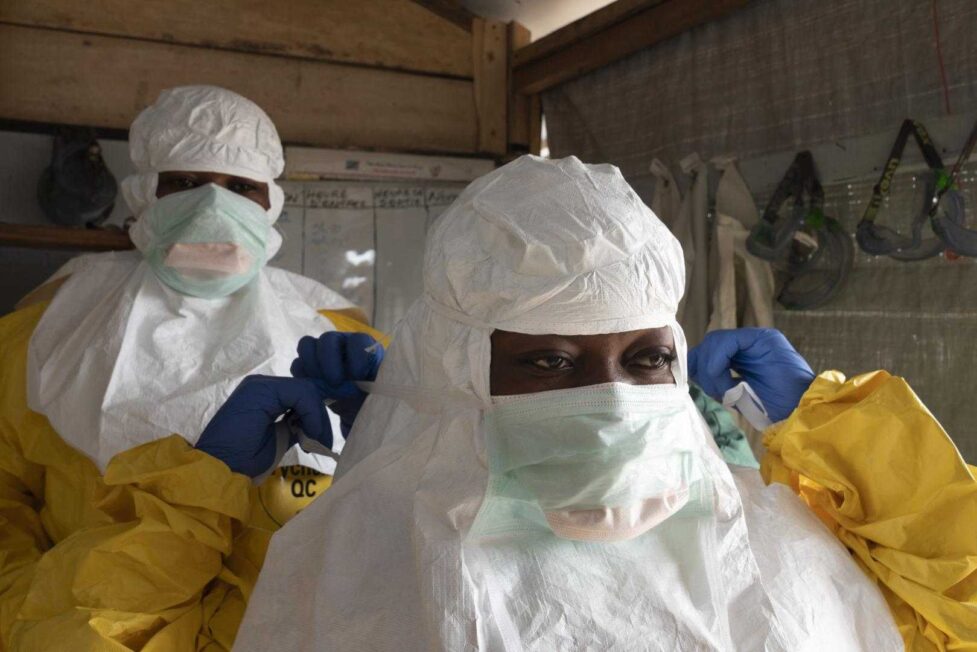
A Nairobi-based constitutional rights organisation has rushed to court to block the establishment of an Ebola quarantine and treatment facility for American citizens on Kenyan soil, arguing that the government agreed to the arrangement without public participation, parliamentary oversight, or any transparent legal framework.
A facility agreed to in secret
The White House confirmed on Wednesday that the United States plans to build a treatment centre in Kenya for Americans exposed to the Ebola virus in the Democratic Republic of Congo. According to a US administration official, the facility would allow infected Americans to receive care close to the outbreak zone, cutting out the risk of a 12-hour-plus medevac flight back to the United States.
“Time is of the essence for Ebola patients, and this facility will enable Americans in the region who contract Ebola to receive lifesaving care as quickly as possible,” the official said. The Wall Street Journal first reported the plan.
Secretary of State Marco Rubio, speaking at a Cabinet meeting, said the administration “will not allow any cases of Ebola to enter the United States,” and described ongoing tracking efforts across multiple agencies to ensure no infected person enters the country.
“The number one priority of our foreign policy is to protect the American people. We can not and will not allow any cases of Ebola to enter the United States” ~ Marco Rubio, US Secretary of Statepic.twitter.com/IRfMe56Tax
— Waihiga Mwaura (@WaihigaMwaura) May 27, 2026
Kenya’s government has not publicly confirmed the arrangement. That silence is precisely what triggered the legal action.
Katiba Institute files under urgent certificate
The Katiba Institute filed a petition this week in the High Court, through counsel Joshua Malidzo, under a certificate of urgency. The petition names the Attorney General as the first respondent and the Cabinet Secretary for Health as the second.
The organisation is asking the court to act immediately on four fronts.
First, it wants the court to halt any steps toward establishing or operationalising the facility until the matter is fully heard. Second, it seeks an order barring the government from receiving or facilitating the entry of any person exposed to or infected with Ebola under the proposed arrangement.
Third, the petition demands that the Cabinet Secretary for Health present a detailed contingency plan to the court within 24 hours, covering Kenya’s preparedness measures for surveillance, control, and outbreak response. Fourth, Katiba Institute wants full disclosure of the terms of any negotiations or agreements with the United States, including biosafety assessments, regulatory approvals, and treatment protocols.
“KI is asking the Court to determine whether the Executive can expose the public to such significant risks without complying with constitutional safeguards,” said Nora Mbagathi, Executive Director of the Katiba Institute. “At its core, the case is about preserving constitutional accountability, protecting public health, and ensuring that no government may place expediency above the lives and safety of the people of Kenya.”
The constitutional argument
The legal challenge rests on Kenya’s constitution, which the Katiba Institute argues binds all state organs, including in matters of foreign policy and public health diplomacy. The petition raises concerns about the right to life, the right to health, fair administrative action, public participation, and parliamentary oversight.
The institute argues that the Executive cannot unilaterally agree to host a foreign government’s Ebola patients on Kenyan soil without going through proper constitutional channels. Whether or not the facility would carry genuine public health risks, the process by which the decision was reached, it argues, was fundamentally flawed.
The outbreak driving the urgency
The legal battle unfolds against a rapidly deteriorating situation in central and east Africa, one that health officials now describe as a potential continental emergency.
Africa CDC has approved a $319 million emergency response plan to fund treatment centres, surveillance operations, laboratory testing, and border screening across the DRC and Uganda over the next six months. Officials warn the outbreak spreads through insecure and resource-poor regions, and that financing delays could accelerate cross-border transmission across at least 11 high-risk African countries. Nearly $500 million has already been pledged by governments, humanitarian agencies, and international partners, though some commitments are still being verified.
Africa CDC Director General Dr Jean Kaseya met with DRC President Félix Tshisekedi on 27 May, alongside the Prime Minister and senior ministers, to review the response. In a LinkedIn post, Dr Kaseya said he was “greatly encouraged by the President’s leadership” and noted that the DRC has already committed $20 million, with a further $30 million expected within days. Two government ministers have been deployed to the field alongside Africa CDC, the WHO, and other partners. The next phase of the response, Dr Kaseya said, will focus on ensuring pledged funds move rapidly through the agency’s Incident Management Support Team.
On Wednesday, 27 May, I had the honour of meeting H.E. Félix Tshisekedi, President of the DRC, together with the Prime Minister and senior government ministers, to review the evolving Ebola outbreak situation.
I was greatly encouraged by the President’s leadership in guiding the… pic.twitter.com/FfhjDlUxZt
— Dr Jean Kaseya (@Dr_JeanKaseya) May 28, 2026
WHO Director General Tedros Adhanom Ghebreyesus acknowledged that delayed detection in eastern Congo allowed infections to spread further before containment measures took hold. “We know this virus, and we know how to stop it,” Tedros said, while cautioning that conditions could deteriorate before improving. The WHO has released $3.9 million from its emergency contingency fund to support frontline operations.

African Union Commission Chairperson Mahmoud Ali Youssouf said the outbreak has exposed deep weaknesses in Africa’s disease surveillance systems, laboratory capacity, emergency response infrastructure, and local vaccine manufacturing. Those weaknesses matter here because the Bundibugyo strain driving this outbreak has no approved vaccine and no targeted treatment, making early detection and swift containment the only tools available to responders.
The latest Africa CDC figures show 129 confirmed cases in the DRC across 14 affected health zones in Ituri, North Kivu, and South Kivu provinces, with 18 confirmed deaths. The DRC also recorded 1,077 suspected cases and 246 deaths among suspected cases. Uganda has recorded 8 confirmed cases and 1 death, with an imported case confirmed in Kampala District. Across both countries, 2,746 contacts are being traced, and 19 confirmed cases involve health workers, with 6 health worker deaths.
Africa CDC declared a Public Health Emergency of Continental Security on 18 May 2026, one day after the WHO declared a Public Health Emergency of International Concern. A continental response structure, established on 24 May in Entebbe, Uganda, places the WHO’s Africa Regional Office and Africa CDC at the top of a joint Incident Management Support Team, operating under a unified framework: one team, one plan, one budget, and one monitoring and evaluation system.
Armed insecurity, mass displacement, and repeated attacks on health facilities in eastern Congo continue to complicate containment, limiting access to testing and treatment in the communities that need it most. The International Rescue Committee warned this week that the outbreak spreads faster than responders can contain it, with over 900 suspected cases and at least 223 deaths already recorded. Without urgent international action, it cautioned, this outbreak risks becoming the deadliest Africa has recorded since the 2014 West Africa epidemic.
What the US is doing
The United States has responded with travel restrictions under Title 42, barring non-citizens who visited the DRC, Uganda, or South Sudan within the previous 21 days from entering the US. That order was recently extended to cover green card holders. American citizens returning from those countries must pass through specific airports for health screening: Dulles, JFK, Atlanta Hartsfield-Jackson, and Houston’s George Bush Intercontinental.
The proposed Kenya facility sits within that broader containment strategy. But for Kenyans watching the arrangement take shape without public debate, the legal challenge before the High Court raises a question that goes well beyond this outbreak: who decides when Kenya becomes part of another country’s emergency plan?
What happens next
The Katiba Institute petition now sits before the High Court, awaiting a hearing date. Whether the court grants emergency orders, and how the government responds to the disclosure demands, will determine not only the fate of this facility but also the broader question of how Kenya handles its obligations when foreign governments seek to use its territory to manage their own public health emergencies.
The outbreak, meanwhile, does not wait for legal proceedings to conclude.
