


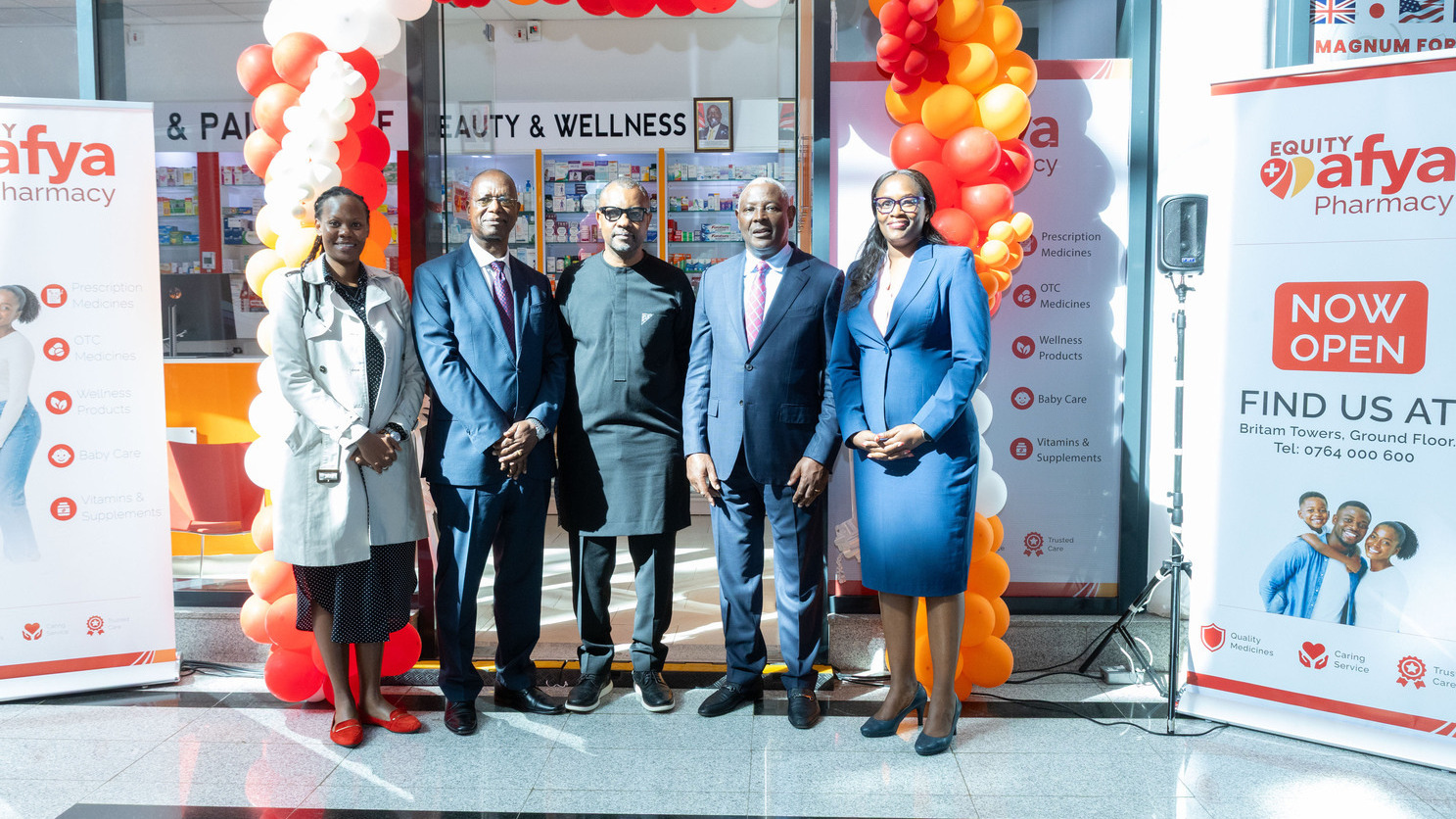
Most Kenyans live beyond walking distance of a licensed pharmacy. That access gap drives delayed treatment, counterfeit medicine purchases, and preventable deterioration in conditions that a timely prescription would have resolved.
Equity Afya, the primary healthcare franchise founded by Equity Group Holdings in 2015, is now moving directly at that problem.
The Upper Hill outlet is the first in a planned regional network of dedicated community pharmacies, extending a model that already operates 154 medical centres across Kenya and the Democratic Republic of Congo and serves an average of 130,000 patients every month.
What the pharmacy offers from day one
Beyond dispensing medicines, the Britam Towers outlet provides complimentary blood pressure and blood sugar screening, connecting patients directly to Equity Afya clinics through a structured referral pathway. Wellness and nutrition guidance form part of the service, positioning the outlet as a point of preventive care rather than a medicine counter alone.
The pricing ambition is the headline number. Equity Group Foundation Executive Chairman Dr James Mwangi set out the case plainly at the opening:
“Today, very few Kenyans have convenient access to a licensed pharmacy, underscoring deep inequalities that leave vast populations underserved and excluded from essential care. Our strategic objective is to enhance access to high-quality, affordable medicine and integrated healthcare, with the goal of reducing the cost of medicine by 50% to 80% while significantly expanding access to safe and effective pharmaceutical care for all Kenyans.”Dr James Mwangi, Executive Chairman, Equity Group Foundation.
A 50 to 80 percent price reduction on medicines would represent a material shift in household health spending for millions of Kenyans, particularly those managing chronic conditions such as hypertension and diabetes, precisely the two conditions the outlet screens for at no charge.
The franchise model: ELP graduates run the network
Equity Afya does not own and operate its medical centres directly. It franchises them, and the people running those franchises come from within. Equity Group Foundation’s Equity Leaders Program (ELP) has awarded more than 60,009 scholarships, supported 35,353 university scholars in gaining admission to local and international universities, and produced a pipeline of medical professionals who now own and manage Equity Afya centres.
The pharmacy network follows the same design. Equity Group Holdings Chairman Professor Isaac Macharia confirmed the target of 1,000 pharmacies, all to be run by ELP alumni entrepreneurs. The logic is structural: the network scales through people trained within the system, who carry both clinical qualification and institutional trust.
“This pharmacy is a demonstration of our integrated approach to healthcare. By connecting patients to a reliable source of medicine and preventive health services, we are creating a seamless journey from diagnosis to recovery, ensuring they receive the treatments they need, at a price that is fair, from people they can trust.”Dr Joanne Korir, Director of Operations, Equity Group Foundation
Gates Foundation: catalytic capital, not charity
The Gates Foundation backed the launch as a strategic partner. Paulin Basinga, the foundation’s Regional Director for Africa, described the Equity Afya pharmacy model as a template for private-sector solutions to public health failures, and positioned the Gates Foundation’s role as risk capital designed to unlock scale rather than sustain operations.
“We are thrilled to partner with Equity Group Foundation because this initiative is a perfect example of our core belief: harnessing private-sector know-how to solve the biggest social problems. Our support is catalytic, designed to help unlock this scalable model. Our shared goal is to see these Equity Afya pharmacies expand into rural areas, not only here in Kenya but across the continent.”Paulin Basinga, Regional Director for Africa, Gates Foundation
Catalytic capital in this context means the Gates Foundation absorbs early-stage risk to demonstrate that the franchise economics work, after which commercial capital can follow at scale. That structure has driven healthcare network expansion elsewhere on the continent, and Equity Afya’s existing 154-clinic footprint gives the pharmacy rollout a distribution base most new entrants would take years to build.
What the expansion covers: services at a glance
| Service | Detail | Cost to patient |
|---|---|---|
| Medicine dispensing | Quality-assured pharmaceuticals at franchise pricing | 50 to 80% below current market rates (target) |
| Blood pressure screening | Walk-in, no appointment required | Complimentary |
| Blood sugar screening | Walk-in, no appointment required | Complimentary |
| Wellness and nutrition guidance | Preventive health counselling at point of dispensing | Complimentary |
| Clinic referral | Direct pathway to nearest Equity Afya medical centre | Standard clinic fees apply |
The wider picture: primary care and the pharmacy gap
Equity Afya has operated as one of Africa’s largest franchised primary healthcare networks since its founding a decade ago. Its mission centres on providing access to inclusive quality healthcare to enable people to lead productive lives, with clinics strategically located in urban centres, peri-urban areas, and remote locations to serve populations facing both geographical and financial barriers.
The community pharmacy fills a gap the clinic network could not reach. A medical centre treats patients who walk through the door. A pharmacy sits where people already go, inside commercial buildings, along market streets, and eventually, if the Gates Foundation’s stated goal is realised, in rural areas where the nearest licensed outlet may currently be an hour’s journey away.
Kenya’s universal health coverage agenda, running through the government’s 2014 to 2030 Health Policy, depends on strengthening primary care as its foundation. A franchise pharmacy network run by medically qualified entrepreneurs, priced below current market rates and linked to an existing clinical referral system, does not sit outside that agenda. It runs directly through the middle of it.
