


Safaricom group net income rose 35.9% to Sh58.2 billion in the six months to September 2026, as Ethiopia’s loss before interest, tax, depreciation and amortisation (EBITDA) narrowed to Sh0.4 billion. Kenya customers used 9.4% more data a month while the rate per megabyte fell 10.8%, and M-Pesa app users move to the One App in the coming months.
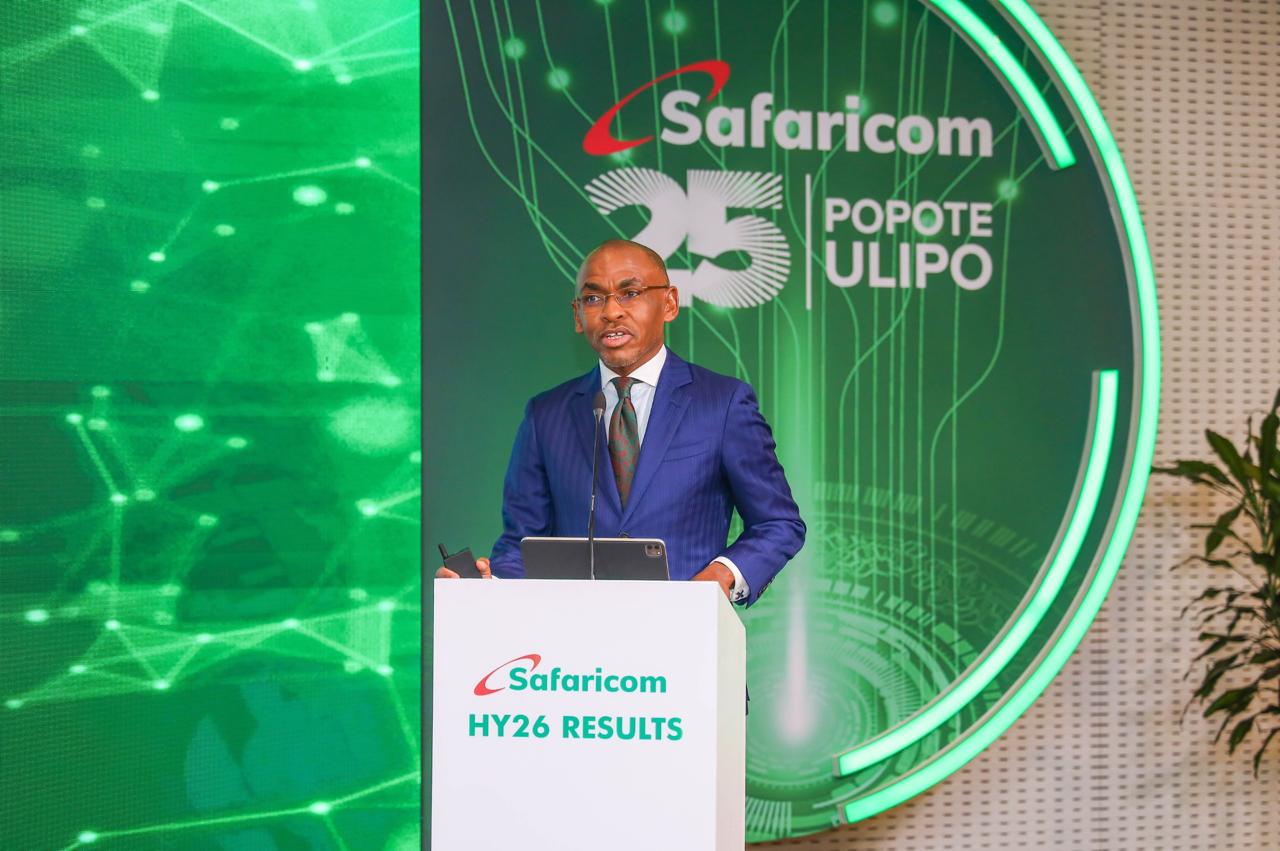
Chief executive Peter Ndegwa and chief financial officer Dilip Pal presented the results at the company’s half year briefing. Ndegwa said Safaricom keeps its guidance for the financial year ending March 2027. Group net income excludes minority interest, the stake held by outside shareholders in a subsidiary.
Safaricom group net income rose 35.9% as Ethiopia losses narrowed
Group EBITDA grew 27.5% to Sh129.2 billion and earnings before interest and tax (EBIT) grew 39.8% to Sh91.1 billion. Group service revenue rose 13.1% to Sh226.1 billion, and Ethiopia supplied 17% of the added revenue, Pal said.
The group EBITDA margin rose to 55.3% from 49.5% a year earlier. Kenya’s margin stands at 57.7%.
| Six months to September 2026 | Kenya | Ethiopia | Group |
|---|---|---|---|
| Service revenue | Sh216.0 billion (+11.3%) | Sh10.6 billion (+71.6%) | Sh226.1 billion (+13.1%) |
| EBITDA | Sh128.9 billion (+13.3%) | Loss of Sh0.4 billion (loss down 96.5%) | Sh129.2 billion (+27.5%) |
| EBIT | Sh101.8 billion (+13.7%) | Loss of Sh11.4 billion (loss down 53.4%) | Sh91.1 billion (+39.8%) |
| Net income | Sh66.3 billion (+13.8%) | Loss of Sh8.8 billion (loss down 43.2%) | Sh58.2 billion (+35.9%) |
Ethiopia revenue rose 71.6% while its EBITDA loss shrank to Sh0.4 billion
Ethiopia service revenue grew 71.6% to Sh10.6 billion. In Ethiopian birr, it doubled to 13.1 billion, Pal said. Mobile data revenue rose 90% to Sh7.9 billion and now makes up 74% of the total.
The EBITDA loss fell from about Sh12.6 billion a year earlier, Pal said. Safaricom serves 15.4 million customers there. “I know it has been hard work, but the results are starting to show,” Ndegwa said.
Pal said Ethiopia’s funding stands at US$2.8 billion, up US$193 million since March 2026. Debt now equals 20% of equity. “For the longest time we only had equity; there was no debt,” he said.
The Middle East conflict disrupted fuel supply and raised transport costs in Ethiopia, Ndegwa said. That hit customer affordability and slowed network rollout. Safaricom wants further regulator action on cost based minimum pricing.
Kenya net income rose 13.8% and operating free cash flow rose 19.6%
Kenya profit grew faster than revenue. Pal said the results show Safaricom turning revenue growth into faster profit growth and cash generation. Ndegwa said Kenya is on course for a fourth straight year of double digit growth.
| Safaricom Kenya (Sh billion) | Six months to Sept 2026 | Year earlier | Change |
|---|---|---|---|
| Service revenue | 216.0 | 194.0 | +11.3% |
| EBITDA | 128.9 | 113.8 | +13.3% |
| EBIT | 101.8 | 89.5 | +13.7% |
| Net income | 66.3 | 58.2 | +13.8% |
| Operating free cash flow (cash left after capital spending) | 85.3 | 71.3 | +19.6% |
The Kenya EBITDA margin reached 57.7%, from 55.1% in the first half of 2024/25 and 52.2% in the first half of 2022/23, company slides show. Net debt to EBITDA stands at 0.50, from 0.44 in 2024/25.
M-Pesa passed Sh100 billion in half year revenue
M-Pesa revenue rose 13.6% and crossed Sh100 billion in a half year for the first time, Pal said. It supplied 55% of the added service revenue and makes up 46.3% of the total. Customers made 51 chargeable transactions a month on average, up 31.5%.
Merchants reached 4.5 million, made up of 1.3 million formal and 3.2 million informal merchants. About 80% of merchant transactions now carry no charge, Ndegwa said.
| M-Pesa and financial services | Figure | Change on a year earlier |
|---|---|---|
| M-Pesa revenue | Above Sh100 billion | +13.6% |
| Chargeable transactions per customer a month | 51 | +31.5% |
| Transaction volume | Not given | +25% |
| Transaction value | Not given | About +17% |
| Merchant transaction volume | Not given | +53% |
| Financial services revenue | Not given | +55% |
| Credit customers | 17.5 million | +84% |
| Credit disbursed | Sh1.3 trillion | +70% |
| Wealth customers | 3.4 million | More than doubled |
M-Pesa app users move to the One App in the coming months
Safaricom will retire the M-Pesa app and a second legacy app and move customers to the One App, Ndegwa said. The app launched at the start of the financial year. It has 7.3 million downloads and 4.5 million monthly active users, who made 800 million transactions worth Sh2 trillion.
Data rate per megabyte fell 10.8% while use rose 9.4%
Customers use more data for less per megabyte. Average use reached 5.3 GB a month, and the rate fell to 5.0 cents from 5.6 cents. “We are growing customers, we are growing usage, and we are actually reducing price,” Ndegwa said.
Voice revenue grew 6.2%, against a 2.1% fall a year earlier. Fixed and IoT revenue (IoT means connected devices) rose 25.5% to Sh12.5 billion. Public sector digital work added Sh0.8 billion, up 331.8%.
| Connectivity, fixed and IoT | Figure | Change on a year earlier |
|---|---|---|
| Mobile data revenue | Sh45.2 billion | +12.2% |
| Data use per customer | 5.3 GB a month | +9.4% |
| Customers using more than 1 GB | 15.2 million | +17.7% |
| Rate per megabyte | 5.0 cents | Down 10.8% |
| 4G and 5G devices | 34.3 million | +33.5% |
| Voice revenue | Sh42.2 billion | +6.2% |
| Voice use per customer | 231.8 minutes | +11.9% |
| Fixed customers | 569,900 | +31.8% |
| Homes passed (homes the fixed network can reach) | 907,600 | +13.6% |
| IoT customers | 2.4 million | +32.8% |
Energy costs rose 22% and operating costs rose 9.3%
Kenya operating costs rose 9.3% to Sh38.0 billion, mainly because energy costs rose 22% after the Middle East conflict, Pal said. “Energy costs remain firmly on our watch list,” he said. Operating costs equal 17.0% of revenue, down 0.5 percentage points.
Direct costs rose 12.4% to Sh53.5 billion, or 3.8% after a one time change in how Safaricom accounts for SIM cards. Interest costs fell 19.3% to Sh3.1 billion. Long term debt makes up two thirds of group debt.
Safaricom keeps guidance and sets second half priorities
Ndegwa said guidance holds because of Kenya growth, lower Ethiopia losses and stronger group profitability. Capital spending guidance is unchanged as Ethiopia moves to a more normal investment level. The company did not state the guidance figures.
Second half priorities are connectivity and financial services, fixed broadband, enterprise and public sector work, and wider use of artificial intelligence. Higher food, fuel and transport costs squeeze Kenyan households, Ndegwa said, so Safaricom must stay affordable. “It’s half time and you have to remain humble,” he said. “You still have the second half to go.”
