


IFAD and Equity Group have launched a $200 million mechanism to move climate adaptation loans to smallholder farmers and rural businesses across East Africa, where capital has struggled to reach the people who need it.
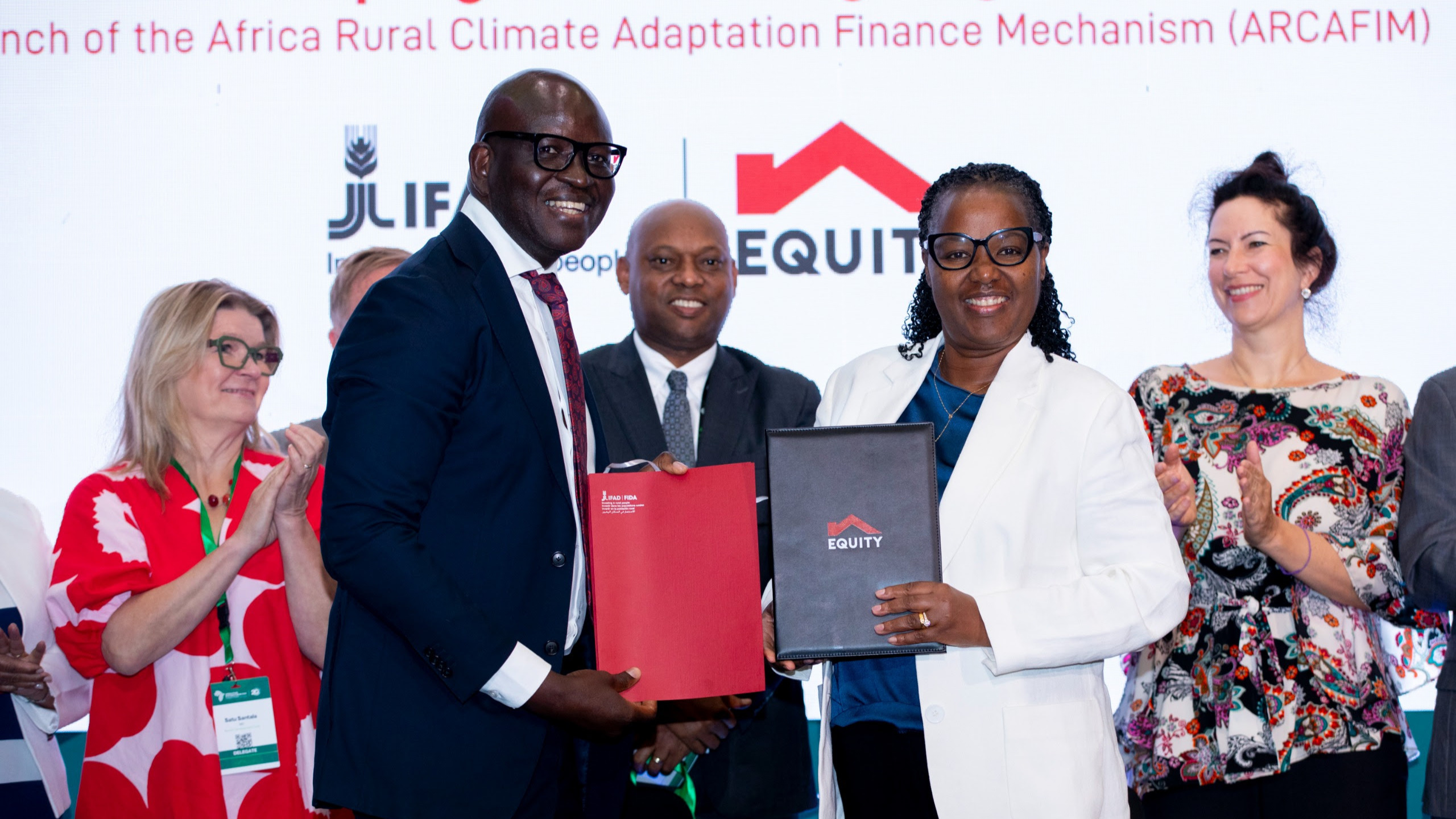
The two organisations launched the Africa Rural Climate Adaptation Finance Mechanism, or ARCAFIM, at the Africa Food Systems Forum 2026 in Kigali. The mechanism pairs the International Fund for Agricultural Development with Equity Group, which has spent years building a climate finance book across the region.
The Green Climate Fund, Finland’s Ministry for Foreign Affairs and the Nordic Development Fund are co financing the mechanism. The Government of Denmark and the European Union are also contributing.
How the money works
ARCAFIM runs for twelve years. It splits into $180 million in lending capital and about $20 million for technical assistance. The lending capital will revolve through roughly four investment cycles, which IFAD and Equity expect will generate close to $266 million in loans to micro, small and medium sized enterprises and smallholder farmers.
Equity Group is putting up $90 million of the $180 million lending base from its own balance sheet, matching the concessional contribution dollar for dollar. Credit protection sits in tranches: international financing partners absorb the first losses, Equity shares a middle layer of risk with them, and Equity carries the senior risk on top.
That structure departs from how many blended finance deals get built. Instead of a bank administering donor money on the side, Equity holds its own capital in the deal alongside the concessional funds. A climate adaptation taxonomy accompanies the mechanism and transfers knowledge about adaptation investments to the banks, microfinance institutions, SACCOs and farmers taking part, in a format similar to the one KCB Bank Kenya used when the Green Climate Fund approved a $96.9 million facility for it last year.
Who the programme targets
ARCAFIM will operate in Kenya, Uganda, Tanzania and Rwanda. IFAD and Equity aim to reach 260,000 smallholder producers and 500 rural MSMEs. Women will make up at least half of intended beneficiaries; youth will make up 30 percent.
IFAD and Equity project the programme will strengthen food security for about 1.2 million people and reach an estimated 1.5 million people in total, directly and indirectly. The technical assistance component sits inside the financial architecture rather than running alongside it. It builds the capacity of microfinance institutions and SACCOs to originate adaptation loans, and it gives farmers and rural enterprises the knowledge to identify investments that protect them: irrigation and water harvesting, dairy and livestock resilience, post harvest storage, renewable energy and agro processing.
Equity’s climate finance record
The launch extends work Equity Group has built up over several years. In 2023, the bank signed a $165 million partnership with the International Finance Corporation, committed to zero lending for coal projects, and allocated $80 million in equity toward climate interventions across its subsidiaries over five years. Equity has also partnered with the World Food Programme to move farming communities away from food aid, and has built financing for farmers investing in boreholes, water harvesting and irrigation during recent droughts.
Group CEO Dr James Mwangi framed ARCAFIM as an extension of that work rather than a standalone project. “Africa’s smallholder farmers are not waiting to be rescued,” he said at the launch. “They are entrepreneurs operating in the most demanding risk environment on earth, and what they have lacked is a financial system built to back them.” He said committing Equity’s own balance sheet alongside concessional capital builds a market where climate resilience lending becomes an ordinary banking business rather than an act of charity.
Moses Nyabanda, Managing Director of Equity Bank Kenya, said the bank will lend directly to farmers and agricultural producers, and through microfinance institutions, SACCOs and value chain companies, while building capacity around climate adaptation finance and sustainable farming practices.
What partners say
IFAD Vice President Gérardine Mukeshimana said the mechanism aims to make rural climate adaptation a recognizable, viable business line for African financial institutions, and that IFAD designed it to be replicated beyond East Africa.
Catherine Koffman, Director of the Africa Region department at the Green Climate Fund, said GCF’s $55 million commitment helped structure a mechanism that mobilises commercial investment from Equity Group. Finland’s Ministry for Foreign Affairs and the Nordic Development Fund made similar points, framing the deal as a case where public and private capital share risk to reach farmers that finance has otherwise missed.
Mukeshimana signed for IFAD and Nyabanda signed for Equity Bank Kenya. Hannington Namara, Managing Director of Equity Bank Rwanda, presided over the ceremony. Government representatives from Kenya, Uganda, Tanzania and Rwanda attended, along with private investors and development partners.
What comes next
IFAD and Equity Group will measure ARCAFIM’s success by whether climate resilience lending survives as an ordinary line of business once the concessional capital runs out, years after the mechanism itself ends. Both organisations have identified Southern and West Africa as the next regions for the model, and plan to apply lessons from East Africa to how they structure blended climate finance elsewhere on the continent.
