


Kenya attracted $936 million in venture capital last year, the highest figure recorded on the continent. Ambassador Philip Thigo, Kenya’s Tech Envoy, stood before a room of digital policy professionals this week and asked the startup founders among them to raise their hands if they received any of it.
Few did.
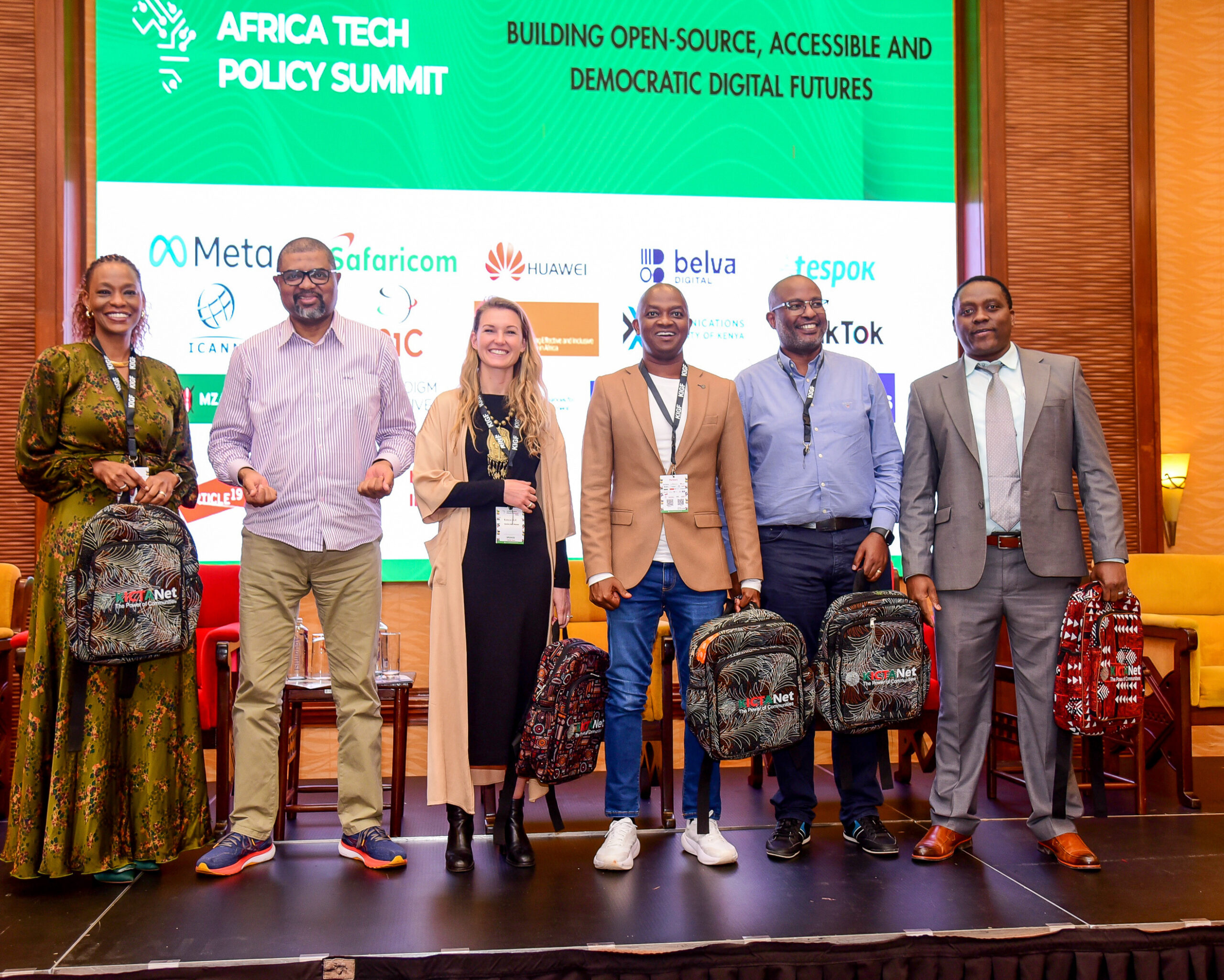
That moment, more than any panel or policy paper, defined what the second Africa Tech Policy Summit and the nineteenth Kenya Internet Governance Forum were actually about. The two events ran together in Nairobi under the theme “Building Open-Source, Accessible and Democratic Digital Futures,” drawing governments, industry, civil society, and technical experts into the same rooms for five days. Kenya hosts the Global Internet Governance Forum in December 2026, the first time since 2011, and the pressure to arrive in December with something concrete to show shaped every session.
The week produced a single argument across multiple conversations: Kenya has built the infrastructure. The question it has not yet answered is who that infrastructure serves.
Connectivity numbers hide a participation gap
KICTANet CEO Dr Grace Githaiga opened the forum by naming a contradiction that Kenya carries into every global negotiation. The country records over 23 million internet users, 97 percent 4G population coverage, and some of the highest mobile money adoption rates in the world. It also advocates loudly for data sovereignty while operating with very few data centres per capita.
“If we go to global spaces empty-handed,” Githaiga said, “someone else’s agenda will fill the gap.”
KICTANet Chairman Ali Hussein Kassim put a sharper frame on it. “The internet and our digital ecosystems are core infrastructure for our economies and our democracies,” he said. “How we govern them is no longer a technical question. It is a question of power, rights, and opportunities.”
Thigo’s venture capital question was not rhetorical. It named the gap between Kenya’s reputation as a startup ecosystem and the lived experience of founders trying to build within it. “We negotiated outcomes that could let that money flow to you,” he said. “If it doesn’t, our work was wasted. We cannot be building for others.”
A 25 percent tax that charges for nothing
The digital inclusion panel moved the conversation from statistics to specifics. Gitungo Wamere, Head of Programs at Mzalendo Trust, reported that most users of the organisation’s civic monitoring platform come from Nairobi, Kisumu, or Mombasa. “People living in rural areas simply cannot access it,” he said. Three barriers compound each other in those communities: infrastructure gaps, the cost of data, and low digital literacy. When a household must choose between buying data and buying food, the choice is not digital.
Dr Fiona Asonga, CEO of the Technology Service Providers of Kenya, directed the sharpest intervention at Kenya’s 25 percent excise duty on airtime. Excise duty applies when a product is transformed and value is added. No transformation occurs when airtime moves from a network operator to a customer. “We are being charged excise duty for nothing,” Asonga said. “That is one of the biggest barriers to access, and we are doing it to ourselves.” TESPOK has submitted proposals to Treasury calling for the duty’s removal ahead of the June 2026 Finance Bill.
‘Gbenga Sesan, Executive Director of Paradigm Initiative, widened the affordability argument beyond individual transactions. Young people who finish school without adequate digital access compete for jobs against peers who spent those same years building skills and networks online. “That is double jeopardy,” he said.
On disability, the numbers reoriented the room. Only 11.4 percent of differently-abled Kenyans use the internet, roughly half the rate of the general population. Five percent of digital content produced in Kenya meets accessibility standards for visually impaired users. The panel called for immediate adoption of the Web Content Accessibility Guidelines across every organisation represented.
Sesan also addressed internet shutdowns directly. Technical institutions that monitor internet observatory data documented a disruption during the 2024 protests in Kenya. “There was a shutdown in Kenya,” he said. “I stake my reputation on that.” He called for civil society organisations and internet service providers to build formal mechanisms for gathering and sharing evidence when disruptions occur, before the next election cycle arrives.
IGF at 21: from talking shop to legal mandate
A high-level panel examined what two decades of the Internet Governance Forum produced and what its new permanent legal mandate now demands. The Global Digital Compact, negotiated at the UN Summit of the Future in 2024, formally established the IGF as the primary multi-stakeholder platform for internet governance discussion under United Nations auspices. That change matters because, for the first time, the forum’s outputs feed directly into binding international processes.
Chengetai Masango, Head of the UN IGF Secretariat, noted that the IGF community identified artificial intelligence as a cross-cutting governance issue in 2016, years before its social and economic consequences became visible to the broader policy world. “What started as an idea at the IGF has seeped into other processes and given real strength to multi-stakeholder systems globally,” he said.
Barrack Otieno, General Manager of the Africa Top Level Domains Organisation, tied the Kenya IGF’s growth from 60 attendees to more than 300 directly to one practice: documentation. “Go back home and grow the movement,” he recalled being told during the IGF’s early capacity-building programme. “Number one, through documenting. Number two, through training. Number three, through mentorship. That is the journey of the Kenya IGF in summary.” He closed with a sustainability warning the room needed to hear. “We cannot get support from our partners if we are not accountable and trustworthy.”
Thigo described Kenya’s approach to global digital negotiations as one of deliberate restraint. “A lot of people will do it for themselves and that becomes the ceiling of what they achieve,” he said. “For us, it is an act of sacrifice for the broader targets. That is what has built this country’s credibility.”
Mercy Ndegwa, Director of Public Policy for East and Horn of Africa at Meta Platforms, named three reasons large technology companies participate in national and regional IGF processes: collaboration with governments and civil society in the same room, influence over frameworks that affect their products, and learning that a global headquarters cannot generate from within itself. “We learn from coming to these forums,” she said. “Local representation in terms of language, culture, and how people want to use our platforms — that is something we can only understand by engaging.”
FinTech’s trust problem is not abstract
The AfTPS fireside chat on financial technology produced the week’s most direct conversation about consumer harm. Moderated by KICTANet Chairman Ali Hussein, the session opened with a statement that set the terms for everything that followed. “Predatory lending apps, punishing interest rates, data harvesting, loan shaming,” Hussein said. “The people most hurt are the ones the industry claims to serve.”
The panel did not dispute it.
Esther Waititu, Chief Financial Services Officer at Safaricom, disclosed that Fuliza — the overdraft product used by tens of millions of Kenyans — originated as a Capital Markets Authority regulatory sandbox experiment. The product works, she argued, because users do not experience it as borrowing. “When you use Fuliza, are you imagining that you’re borrowing? You’re just completing a transaction.”
She also confirmed that Safaricom has masked sender phone numbers on all M-Pesa transactions since February 2026, closing a gap that social engineering fraudsters had exploited. A dedicated app and support line now serve 1.6 million diaspora users.
Ambassador Bitange Ndemo, who served in government when Kenya made the regulatory decisions that allowed M-Pesa to operate before a formal framework existed, drew a direct line from that experience to the current AI debate. “Innovation always precedes regulation,” he said. Legislating for technologies that regulators do not yet understand pushes innovation offshore. He pointed to the European Union’s AI Act as evidence. “We cannot accept that we have an AI Act when we don’t even know what we’re regulating.”
Kamau Kunyiha, Regional Managing Director for Creditinfo Group across Southern and Eastern Africa, reported that Kenya grew from approximately 700,000 reported loans before the credit bureau was regulated in 2010 to more than 25 million active credit profiles today. That growth demonstrates what data infrastructure makes possible. His prescription for what comes next was precise: “We need to regulate the activity, not just the entity — because this data crosses all boundaries.”
Caroline Hane-Weijman, Managing Director for Paystack Kenya, named access to affordable working capital — not regulatory complexity — as the single largest constraint on African FinTech growth. “I need to buy goods today to sell tomorrow,” she said. “Getting access to cheap capital is one of the most expensive things on the continent.” She also named the consumer risk embedded in the embedded finance model: when multiple platforms each extend invisible credit simultaneously, a borrower can commit most of their income across several obligations without a consolidated view of what they owe. “Without knowing it, you earn 100 shillings and you have already committed 80 of it to six different platforms,” she said.
A startup founder in the audience, who runs African Jalen Lab, put the week’s central tension into a single question. “We have solutions on our laptops. We have ideas in our offices. But we cannot scale them. Who do we run to in Kenya right now?”
Hussein closed by observing that Kenya can name only one FinTech operating successfully across 25 African countries. “Africa is our playground,” he said. “Let’s go.”
Government commits to act on the resolutions
The forum closed with Alphonse Kanunga, Secretary for Telecommunications at Kenya’s Ministry of ICT, delivering a commitment on behalf of the government: the resolutions of KeIGF 2026 will be formally transmitted to the Ministry for consideration in policy, strategy, and legal frameworks.
Two legislative processes give that commitment structure. The Ministry is reviewing the Kenya Information and Communications Act — 15 laws and regulations governing the ICT sector — with a new framework expected within six months. The National AI Strategy, launched in 2025, is being translated into a National AI Policy and AI Act.
The forum’s closing themes reflected where the national conversation now sits. On digital inclusion, structural barriers from device taxes to rural infrastructure gaps keep millions of Kenyans from participating meaningfully online, not just technically. On AI and data sovereignty, only one percent of global AI datasets originate from Africa. On digital safety, technology-facilitated gender-based violence requires responses built into platforms and policies from the start, not appended after harm occurs. On platform governance, harmonised regional policies and stronger civil society engagement remain incomplete work.
After 19 years, the Kenya IGF’s multi-stakeholder model brings government, industry, civil society, youth, and the technical community to the table on equal terms. That model is not common. It took sustained effort to build and it requires sustained effort to maintain.
The shift this forum named is precise. The national conversation has moved from whether Kenyans can get online to what they get from being there. December’s Global IGF is where Kenya must demonstrate, before the world watching, that the answer has changed.
