


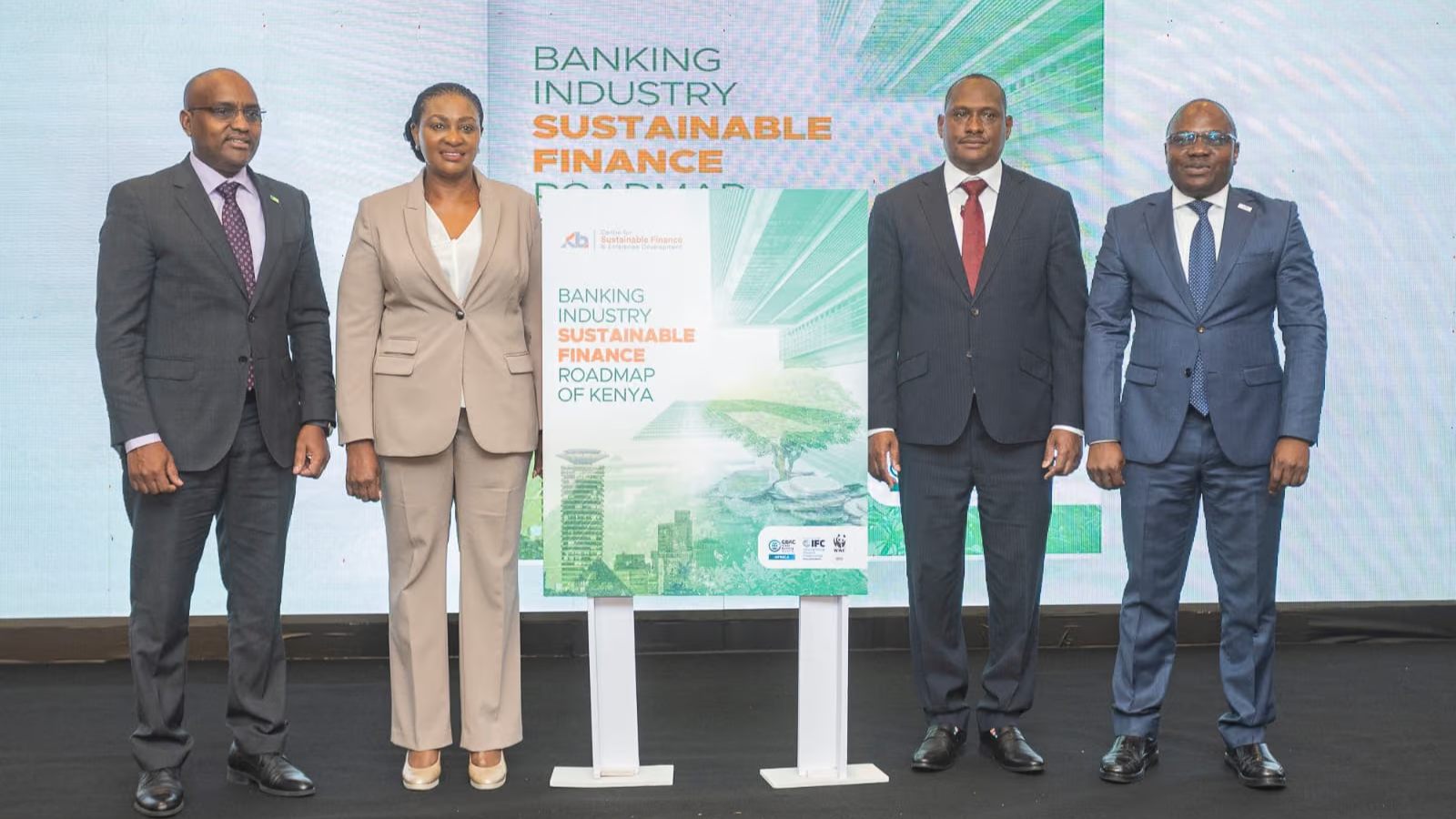
The Kenya Bankers Association (KBA) has launched a roadmap that directs bank lending toward climate and nature projects between 2027 and 2037. The plan asks banks to change how they lend and assess climate risk.
It also asks the National Treasury, the Central Bank of Kenya (CBK) and other regulators to change rules and incentives.
The Banking Industry Sustainable Finance Roadmap came out of KBA’s Centre for Sustainable Finance and Enterprise Development, with the International Finance Corporation (IFC) and WWF Kenya as partners. It aims to move banks from voluntary sustainability commitments to measurable changes in financing and risk management.
Roadmap runs in three phases to 2037
| Phase | Period | Focus |
|---|---|---|
| Foundation | 2027 to 2032 | Governance, data, disclosure and risk systems |
| Scale up | 2032 to 2035 | Wider lending and product rollout |
| Consolidation and review | 2035 to 2037 | Assessment and adjustment |
The roadmap states that its inception, refinement and validation stages ended in October 2026 and that the rollout phase starts in November 2026. By 2037 it expects Kenya to move from an “advanced” to a “maturing” stage on the progression matrix of the Sustainable Banking and Finance Network across three pillars.
Kenya needs US$56 billion for climate goals from 2031 to 2035
Kenya’s Second Nationally Determined Contribution (NDC 3.0), submitted in 2025, puts the climate financing need for 2031 to 2035 at about US$56 billion. The roadmap splits that figure into US$22.5 billion for mitigation, US$17.7 billion for adaptation and loss and damage, and US$15.8 billion for actions that serve both goals. Kenya expects to raise about 19% at home. The other 81% depends on international support and carbon markets.
The third National Climate Change Action Plan (NCCAP III) carries a cost of about KES 4.18 trillion for 2023 to 2027. Across national frameworks, the roadmap puts financing needs between US$29 billion and US$170 billion, depending on the period and policy horizon.
Banks hold over 90% of assets but lend little to climate sectors
Commercial banks account for more than 90% of financial sector assets. Even so, the roadmap says climate and nature aligned lending is a small share of bank portfolios, and the pipeline of bankable projects is weak. The loan book at December 2022 shows where the money sits.
| Sector | Gross loans (KES million) | Share of total |
|---|---|---|
| Personal and household | 984,116 | 27.1% |
| Trade | 652,574 | 18.0% |
| Manufacturing | 530,637 | 14.6% |
| Real estate | 467,171 | 12.9% |
| Energy and water | 142,689 | 3.9% |
| Agriculture | 126,463 | 3.5% |
| Total loan book | 3,630,251 | 100% |
Source: KBA roadmap
Personal and household lending, trade and manufacturing take nearly 60% of the KES 3.63 trillion book. Agriculture takes 3.5%. The roadmap also reports that about 79% of green finance flows go to mitigation projects, while adaptation sectors such as agriculture, water and health receive less.
The roadmap names data as a core constraint. Banks, development finance institutions and bond issuers do not publish consistent figures on the pricing and sector split of sustainable finance. Without them, lenders cannot price risk on evidence. The roadmap proposes a Sustainable Finance Pricing and Volumes Dashboard and a shared risk and performance data facility to fill the gap.
A 2024 study by KBA and WWF Kenya, cited in the roadmap, found that all commercial banks had adopted sustainable finance guiding principles. It found 83% used disclosure templates aligned with the Task Force on Climate related Financial Disclosures, and 73% complied with CBK’s climate risk guidelines. CBK issued those guidelines on 15 October 2021, as Governor Patrick Njoroge wrote for Khusoko.
Informality keeps MSMEs and smallholders out of sustainable finance
Many micro, small and medium sized enterprises (MSMEs) and smallholder farmers operate outside formal systems and hold no conventional credit history. That blocks them from sustainability linked products, which carry heavy documentation. Commercial lenders also stay cautious about climate smart agriculture and nature based solutions because of perceived risk.
The roadmap proposes simplified, digital products for these borrowers, delivered through microfinance institutions, cooperatives and pay as you go models. It also proposes alternative evidence such as satellite data and community monitoring, and financial literacy training for MSMEs.
Four pillars guide the plan
The roadmap rests on four pillars: environmental, social and governance (ESG) integration, climate and nature risk management, financing sustainability, and emerging issues. The fourth pillar covers carbon markets, transition finance, nature related risk, and trade standards such as the European Union’s carbon border adjustment mechanism, which can affect Kenyan exports.
Five objectives sit across the pillars. They are to strengthen policy and regulatory alignment, align lending with national development and climate goals, drive inclusive product innovation, address risk perception and mobilise capital, and build a monitoring and learning framework.
Treasury, CBK and ICPAK receive specific requests
Several actions sit outside the banking industry’s control. The roadmap presents them as recommendations, and each authority decides on its own.
The National Treasury is asked to assess a coordinated set of fiscal incentives. These include tax treatment for verified green financial instruments and budget funded concessional financing windows. The roadmap also proposes a guarantee or subsidy facility to cut issuance costs for green bonds. It says development finance institutions and partners should fund such a facility first, with Treasury involvement only if public money or a government guarantee is proposed.
CBK is asked to phase climate scenario analysis and stress testing into supervision. The roadmap also asks CBK to consider whether differentiated reserve requirements could support verified sustainable lending to MSMEs. It states that any such step sits entirely at CBK’s discretion and within its price stability mandate.
On disclosure, the roadmap asks the Institute of Certified Public Accountants of Kenya (ICPAK), the Capital Markets Authority (CMA) and CBK to develop one national ESG reporting protocol aligned with IFRS S1 and S2. Listed banks now report to the Nairobi Securities Exchange, CBK and, soon, under the IFRS standards. The roadmap calls for a “report once, use many” approach to end the duplication. It also proposes an Assurance Capacity Program to accredit local providers, since a few international firms dominate sustainability assurance and charge fees that SMEs and local institutions struggle to pay.
Banks already lend on sustainability terms
The roadmap cites existing deals as proof of demand. Safaricom closed two sustainability linked loans of KES 15 billion each, after its first facility in 2023, which carried an option to rise to KES 20 billion. Co-operative Bank of Kenya lent US$80 million for the Two Rivers Lifestyle Centre in Nairobi, with a rooftop solar system and river conservation measures. Acorn Holdings issued a KES 4.3 billion green bond in 2020 to fund student housing.
KBA’s Sustainable Finance Initiative, launched in 2015, laid the base for these deals. Khusoko tracks that history on its Sustainable Finance Initiative tag page, including Co-operative Bank’s win at the 2019 Sustainable Finance Catalyst Awards.
Steering Committee and KBA secretariat start the rollout
The first task is to set up a Roadmap Steering Committee with KBA as secretariat. The roadmap uses two tracks. KBA coordinates industry led actions and joint actions, and it takes no decisions on matters within a public authority’s mandate. Each public body handles its own recommendations through its own processes, such as the budget and Finance Bill cycle for the Treasury and the Monetary Policy Committee for CBK. The committee will review progress each year. Next steps include validating the implementation plan with public authorities, picking early priorities and raising money and technical support for monitoring.
Speakers link the plan to practice
Environment and Climate Change Principal Secretary Festus Ng’eno, in remarks delivered by National Environment Trust Fund chief executive Samson Toniok, said environmental protection is an economic priority that needs cooperation across sectors.
KBA Chairman Paul Russo said the roadmap moves the industry from sustainability commitments to practical implementation. WWF Kenya chief executive Jackson Kiplagat said voluntary policies must become measurable institutional decisions.
IFC Regional Director Mary Porter Peschka and KBA chief executive Raimond Molenje pointed to the roadmap’s role in mobilising capital and embedding sustainability in governance and risk management.
