



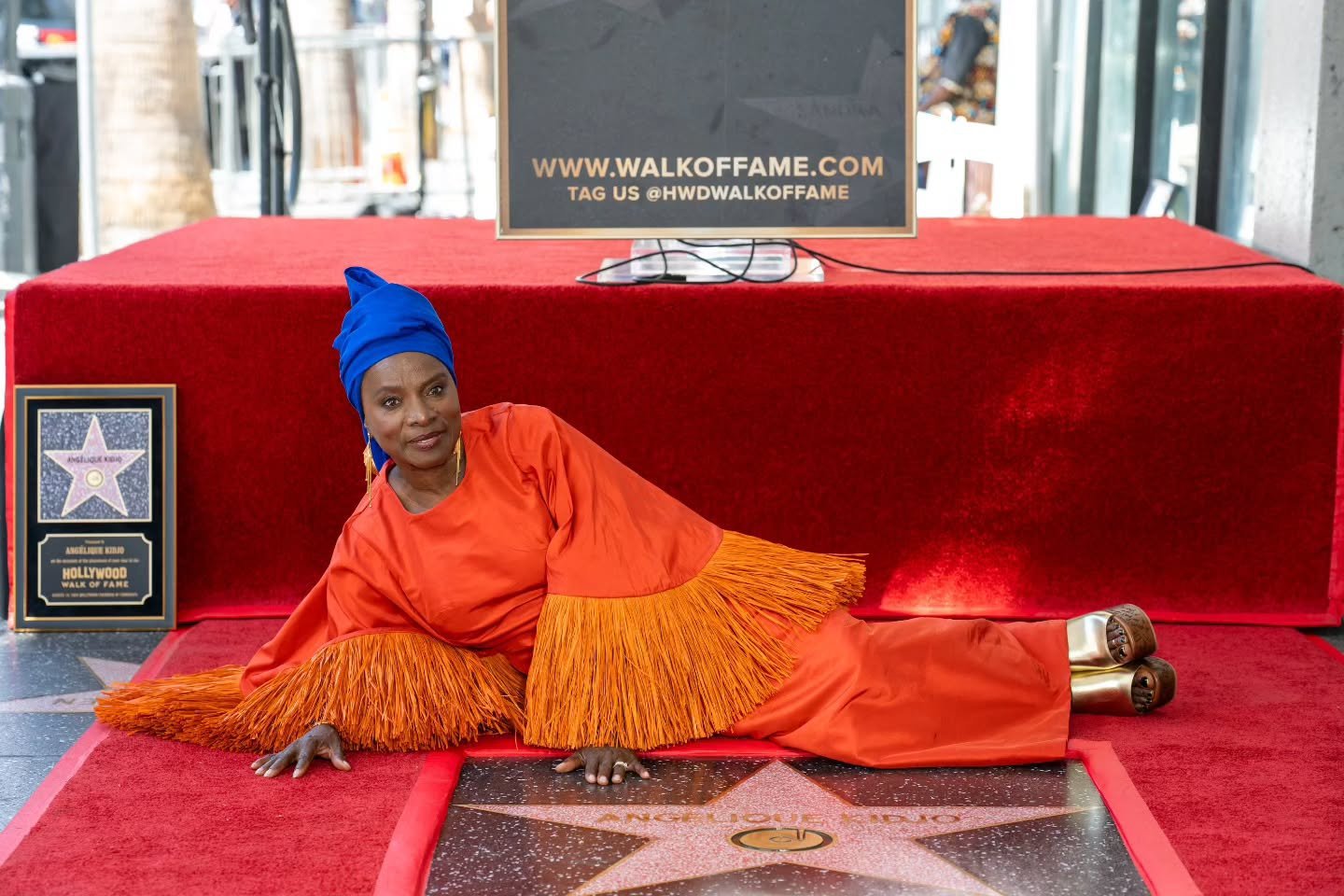
Angélique Kidjo made history on Tuesday, becoming the first African musician and the first Black African to receive a star on the Hollywood Walk of Fame.
The five time Grammy winner was honoured with the 2,854th star, placed in the Recording category at 7011 Hollywood Boulevard in Los Angeles.
Hollywood Chamber of Commerce officially declared August 18 “Angélique Kidjo Day” to mark the occasion.
A Career Spanning Four Decades
Kidjo, 66, left Benin for Paris in 1983 to escape political repression and went on to build a career that fused the West African sounds of her childhood with funk, jazz, gospel and R&B. She has released 18 albums, earned five Grammy Awards from 16 nominations, and performed at the 2024 reopening of Notre Dame Cathedral in Paris.
Her honours before Tuesday already included the 2023 Polar Music Prize, the Vilcek Prize in Music, the 2016 Amnesty International Ambassador of Conscience Award and the 2015 World Economic Forum Crystal Award. She also serves as a UNICEF Goodwill Ambassador and was named a spokesperson for the Affirmative Finance Action for Women in Africa initiative at the 2019 G7 Summit.
Actor Willem Dafoe and Recording Academy chief executive Harvey Mason Jr. attended the ceremony, alongside fellow Beninese star Djimon Hounsou and Nigerian singer Adekunle Gold. Variety correspondent Angelique Jackson hosted the event.
Hollywood Walk of Fame producer Ana Martinez said Kidjo’s artistry and global influence have shaped audiences across generations and continents, and that the star recognises her contribution to music and culture around the world.
In Her Own Words
Kidjo shared her gratitude on Instagram shortly after the ceremony, thanking the people who shaped her journey. She wrote that the honour belongs to everyone who supported her, from the artists who inspired her early career to the young African musicians inspiring her now. She singled out her family, her team and her collaborators, and thanked her fans directly for their loyalty over the years.
Above all, she credited Benin and the wider African continent, saying they have “fed her with an incredible culture that the world doesn’t know about.”
What It Means For African Music
Kidjo used her acceptance speech to make the moment about more than her own career. She told the crowd that Africans have never fully reckoned with what the continent has given global music, adding that, “without us, there’s no music possible on this planet.” She traced that lineage directly to America’s musical backbone, arguing that the blues brought by enslaved Africans gave rise to jazz, soul, rock and roll and R&B, and that all of it comes from Africa.
Angélique Kidjo🗣️
“We Africans just don’t know what we’ve given to the world, and what we continue giving to the world for the music to exist. Without us, there’s no music possible on this planet.”
pic.twitter.com/SI4EgGYVPw— Kennedy Wandera (@KennedyWandera_) August 19, 2026
She also framed the star as belonging to the continent rather than to her alone, asking the crowd rhetorically whether she would have reached that stage at all had she not been African, and closed her remarks by telling the audience it was not just her star but theirs. In a later interview with the BBC, she pushed African nations to build that same recognition at home, urging listeners to celebrate homegrown artists in their own right rather than wait for validation abroad.
Speaking to RFI after the ceremony, Kidjo called the honour a door opening at a moment of global division, and said gatherings built on cooperation rather than hostility are what allow people to create beauty together.
Kidjo’s star lands at a moment when African genres are reshaping global pop. Afrobeats streams on Spotify grew more than 550% between 2017 and 2022, and the platform’s Journey of a Billion Streams initiative has tracked the genre’s rise from West Africa to charts in the United States, United Kingdom, France and beyond. Wizkid, Rema and Burna Boy have each landed songs in Spotify’s Billions Club, while Billboard launched a dedicated Africa platform in June 2025 to track the continent’s growing chart presence and give its artists the infrastructure that older genres like Afrobeats, amapiano and Afro-jazz had long lacked.
Kidjo’s career predates that boom by decades, and her Walk of Fame star gives the wave of younger stars now breaking internationally, among them Tyla, Ayra Starr and Burna Boy, a symbolic marker that African music has earned a permanent place on one of the industry’s most visible stages. Her recent album, HOPE!!, released earlier this year, featured collaborations with Pharrell Williams, Ayra Starr and Quavo, a pairing of generations that mirrors the handoff she described in her own tribute. Recording Academy chief executive Harvey Mason Jr. told the ceremony the star itself is permanent, but that Kidjo’s real legacy lives in the people she has touched and the barriers she has broken.
Kidjo now joins the thousands of names embedded along Hollywood Boulevard, and with her, a marker that the continent’s music has arrived on a stage it helped shape from the outside for decades.
