


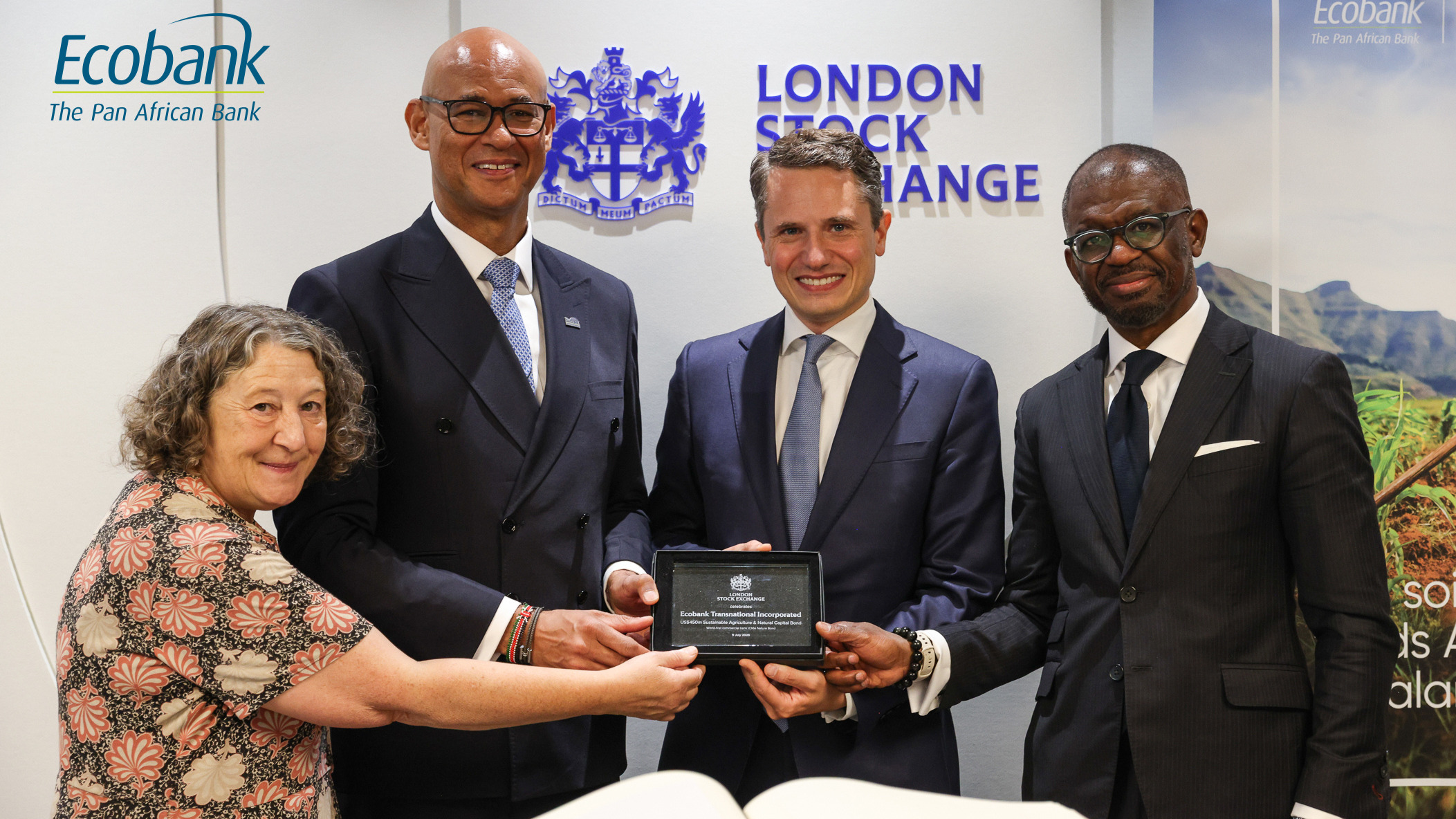
Ecobank Transnational Incorporated marked a milestone for African sustainable finance on July 9, 2026, ringing the opening bell at the London Stock Exchange to celebrate the listing of its US$450 million Sustainable Agriculture and Natural Capital Bond. The bond had priced in May and settled that month, but the ceremony formally recognized what the market had already confirmed: Ecobank had pulled off the first ICMA designated Nature Bond ever issued by a commercial bank.
The designation matters because it separates marketing language from measurable commitment. The Notes carry the ICMA Nature Bond secondary designation under the ICMA Sustainable Bonds for Nature practitioner guide published in June 2025, and align with the four core components of the ICMA Green Bond Principles. That makes Ecobank the first commercial bank globally to issue a use of proceeds green bond carrying this designation, and the first ICMA aligned nature bond from any African commercial bank.
Investors Demanded More Than Ecobank Offered
The bond’s real story shows up in the numbers investors put behind it. Ecobank set out to raise US$350 million. Orders came in at over US$1.36 billion, nearly four times what the bank asked for. That demand let Ecobank upsize the deal by US$100 million to its final US$450 million and tighten pricing by 50 basis points from initial guidance, a move that reflects what the market calls a greenium, where credible sustainability structuring earns cheaper funding. Notably, the eligible loan portfolio backing the bond covered it 2.58 times over before pricing even closed, evidence that Ecobank had already originated the underlying loans rather than scrambling to find assets after the fact.
Moody’s Ratings recognized that rigor with an SQS1 Excellent score, its highest possible Sustainability Quality Score, and a first for any pan-African commercial bank.
Where the Money Comes From, and Where It Goes
Investors from the United Kingdom and continental Europe supplied roughly 55 percent of the final book, with Africa contributing about 38 percent. The Middle East, the United States, and Asia rounded out the remainder in smaller shares. FMO, the Dutch entrepreneurial development bank, anchored the transaction with a US$50 million order, marking the second consecutive Ecobank Tier 2 deal in which FMO has taken that role.
Proceeds flow into three categories: sustainable primary production, sustainable agri-processing, and water supply and sanitation. Eligible lending spans 24 countries within Ecobank’s broader 38 country footprint, concentrated deliberately in markets where agricultural land use change drives biodiversity loss most acutely. Part of the proceeds also funds a concurrent tender offer for Ecobank’s outstanding US$350 million 8.750% Tier 2 Sustainability Notes due 2031, letting the bank refinance ahead of that note’s June 2026 call date while expanding its sustainable finance book in the same transaction.
Structurally, the Notes sit as Tier 2 capital instruments with a 10.25 year tenor, callable after 5.25 years.
Why Agriculture and Nature Share One Balance Sheet
Ecobank frames the bond around a simple premise for the African context: financing a farmer is financing the ecosystem beneath the farm. African agriculture depends on rain, pollinators, and soil health, so when nature degrades, yields collapse. Agriculture also drives most habitat loss on the continent, which means lending decisions determine whether forests, wetlands, and savannahs get converted or protected. Smallholder farmers, in this framing, function as stewards of natural resources across hundreds of millions of hectares.
That logic lets a single loan deliver outcomes across five dimensions at once, nature, environmental, social, economic, and climate, because the same farmland that feeds a household also anchors a watershed, and the same agri-processor that creates rural jobs also determines whether a supply chain avoids deforestation.
Leadership Marks a Defining Moment
Group Chief Executive Officer Jeremy Awori called the bond a defining moment for Ecobank and for African sustainable finance, noting that investors did more than accept the deal. Group Chief Financial Officer Ayo Adepoju pointed to the clean execution of refinancing the 2021 notes and upsizing in the same transaction as balance sheet discipline shareholders expect. Group Head of Sustainability Rachael Antwi framed the deal as proof that nature can be priced and funded as an asset class rather than appealed to as a cause.
Papa Madiaw Ndiaye, Chairman of Ecobank Transnational Incorporated, joined Awori, Adepoju, and Antwi at the Market Open Ceremony in London.
The Deal Team Behind the Transaction
Ecobank Transnational Incorporated served as issuer, originator, and sole sustainability structuring adviser. Standard Chartered Bank and Renaissance Capital Africa acted as joint lead managers and joint bookrunners, with Ecobank Development Corporation as co-manager. Africa Finance Corporation served as financial adviser, while Norton Rose Fulbright and ZOTCHI Avocats provided legal counsel.
A Signal for African Capital Markets
The ceremony did more than celebrate one transaction. It signaled that African financial institutions can mobilize international capital at scale and under credible standards for the sectors that define the continent’s future, food systems, water security, and the natural capital underpinning both. For Ecobank, a bank that has spent four years building the governance and infrastructure behind nature finance, the bond represents proof of concept rather than a one-off label. For African capital markets more broadly, it offers a template other issuers may now look to follow.
