



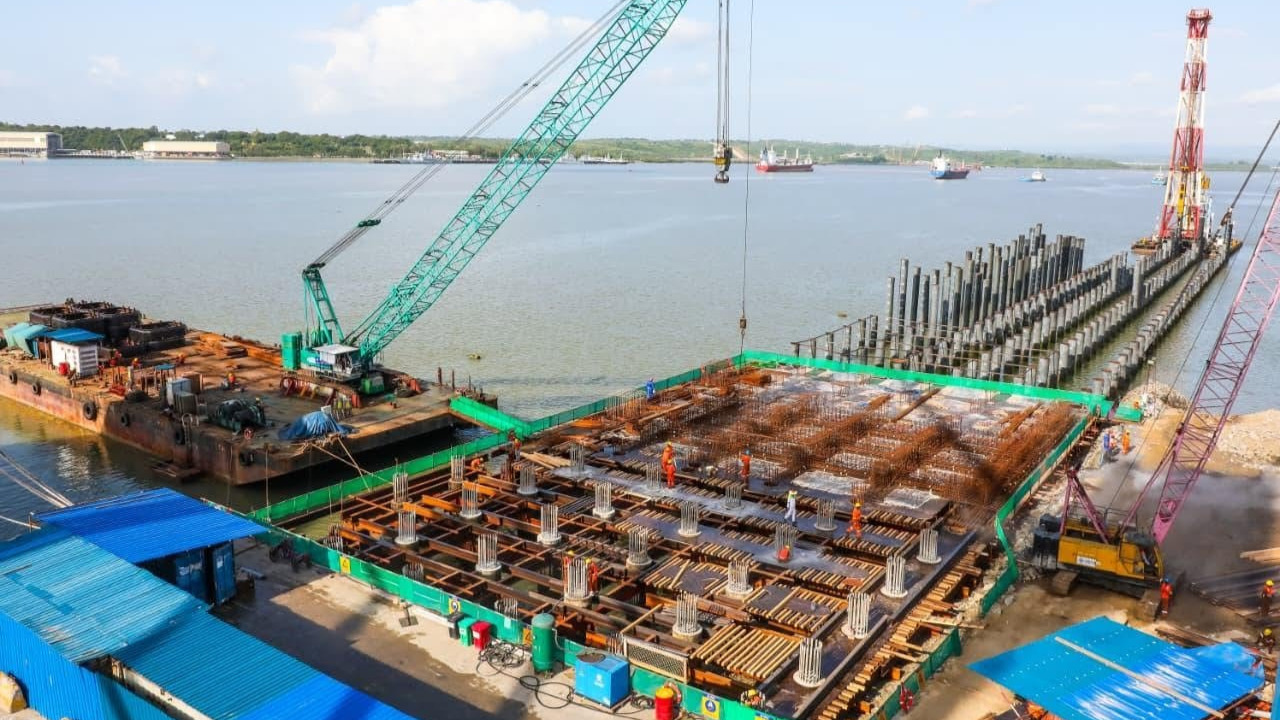
Construction at the Port of Mombasa is moving. Berth 19B, the Ksh 19 billion quay extension contracted to China Communications Construction Company (CCCC) in March 2025, has now reached 30 percent completion.
Berth 19B is already under construction at 30 percent progress, while plans are also underway to construct Berths 23 and 24, whose combined completion will increase Mombasa’s capacity by 1.4 million TEUs.
What the New Berth Adds
The project involves a major quay extension. The new berth will add 240 metres of quay length and provide a 15-metre draft, allowing the port to receive container ships of up to 45,000 deadweight tonnage. Once complete, Berth 19B will boost the port’s annual handling capacity by about 300,000 TEUs. Port officials say this additional space will ease congestion at existing berths, cut vessel waiting times, and support quicker cargo evacuation.
The berth extends Berth 19, which KPA built in 2016. The project scope covers construction of the quay wall, dredging of the channel to the required depth, expansion of the container yard, and integration with existing terminal operations. The design includes crane rail systems for 980-tonne gantry cranes and five hectares of stacking area.
KPA Managing Director Captain William Ruto says, “This investment will ease congestion and improve turnaround times for vessels. The new berth will increase the port’s annual handling capacity by an additional 300,000 TEUs, further strengthening Mombasa’s position as a leading maritime hub in East and Central Africa,” he said.
A Port That Has Outgrown Its Own Footprint
The pressure driving the construction is visible in the numbers. In 2024, the port handled 41.1 million tons of cargo — up 14.1 percent from 35.98 million tons in 2023. Container traffic crossed 2 million TEUs for the first time, reaching 2,005,076 TEUs, a 23.5 percent jump on the year before. Then 2025 went further, with cargo volumes hitting a record 45.45 million metric tons, up 10.9 percent. Container traffic rose to 2.11 million TEUs and transit cargo surged 19.5 percent to 15.88 million tons.
The port serves eight landlocked and coastal hinterland economies — Uganda, Rwanda, Burundi, Eastern DRC, Northern Tanzania, South Sudan, Somalia, and Ethiopia — through a multi-modal transport network, and connects to over 80 ports worldwide. Its 22 berths span container terminals, conventional cargo, bulk grain, petroleum products, and a cruise terminal. The two container terminals currently carry a combined annual capacity of 2.3 million TEUs. Berths 19B and 23 together will push that to 3.1 million TEUs.
Kenya Allocates KSh 41 Billion to Expand Mombasa Port Throughput
Other Construction Running Alongside Berth 19B
Construction of the Dongo Kundu Berth 1 — which will serve the Dongo Kundu Special Economic Zone — is 15 percent complete. KPA has also begun a programme to deepen and upgrade Berths 1 to 10 and Berths 11 to 14 to accommodate larger ships. The Terminal Operating System upgrade stands at 40 percent completion, while smart gate automation at Gates 23 and 24 has reached 60 percent.
In March 2026, Captain Ruto hosted CCCC Chairman Song Hailiang at an inspection tour of the Berth 19B construction site, where he pointed to the long-standing partnership between KPA and CCCC. Previous projects delivered under the same arrangement include the original Berth 19, the Kipevu Oil Terminal, and the Port of Lamu.
What the Freight Sector Says
The Federation of East African Freight Forwarders Associations (FEAFFA) welcomed the project when construction began. Executive Director Mr Elias Baluku described Berth 19B as aligned with the trade demands of the region.
“This development will greatly improve cargo handling, reducing congestion and turnaround times at the port,” Baluku said. “We look forward to continued collaboration with stakeholders to maximize the benefits of this expansion for the freight-forwarding community and the broader economy.”
For freight forwarders, the stakes are direct. Port delays translate into demurrage costs, extended haulage timelines, and supply chain disruption for importers and exporters across the region. At 30 percent completion, Berth 19B still has ground to cover, but the construction is moving, and for a port that has now twice broken its own records, the pace matters.
Kenya’s SMEs Are Losing the AfCFTA Race, Not on Tariffs, But on Logistics
