



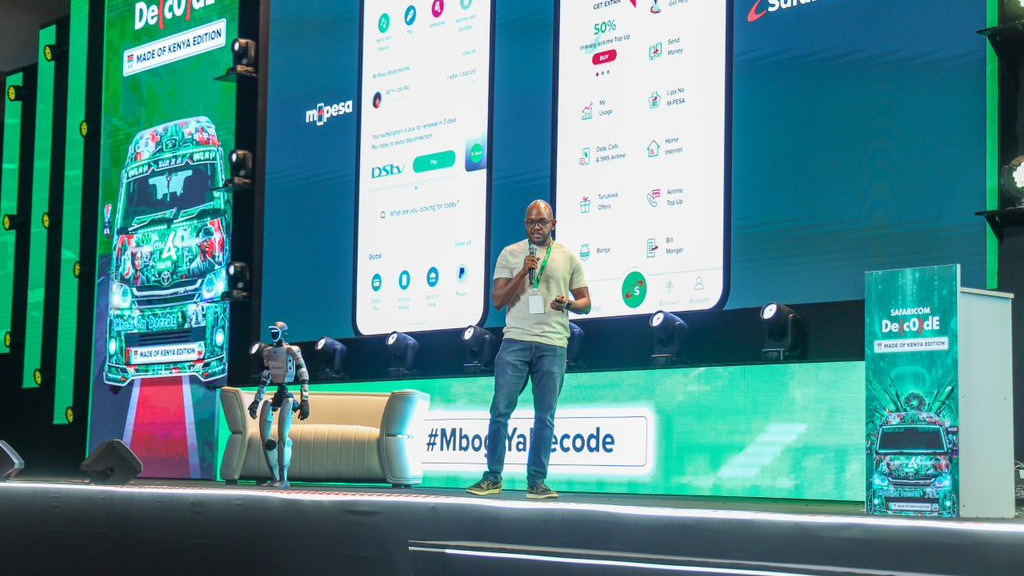
M-PESA no longer lives in a separate app. At Decode 4.0 in Nairobi, Safaricom unveiled My OneApp, a single platform that folds the standalone M-PESA app and the MySafaricom app into one experience, marking the most significant product shift the company has made since M-PESA launched eighteen years ago.
Esther Waititu, Safaricom’s Chief Financial Services Officer, had opened by introducing Sarah, the company’s AI humanoid robot, to a room packed with developers. Sarah danced. Sarah waved. Sarah later walked Waititu to the edge of the stage before the session ended. The moment was deliberate. The day before had been full of conversation about artificial intelligence as a concept. Sarah was what it looks like in practice. My OneApp is what it looks like in a product.
𝐎𝐩𝐞𝐧𝐢𝐧𝐠 𝐑𝐞𝐦𝐚𝐫𝐤𝐬 𝐁𝐲 𝐎𝐮𝐫 𝐂𝐡𝐢𝐞𝐟 𝐅𝐢𝐧𝐚𝐧𝐜𝐢𝐚𝐥 𝐒𝐞𝐫𝐯𝐢𝐜𝐞𝐬 𝐎𝐟𝐟𝐢𝐜𝐞𝐫 @E_Waititu 𝐎𝐧 𝐃𝐚𝐲 𝟐 𝐨𝐟 𝐃𝐞{𝐜𝐎}𝐝𝐞 𝟒.𝟎
As Safaricom marks 25 years of purpose-driven innovation, we are reminded of a uniquely Kenyan truth: our greatest… pic.twitter.com/1F2znNR5hH
— Safaricom PLC (@SafaricomPLC) April 1, 2026
CEO Peter Ndegwa set the frame before Waititu took over the detail.
“We are no longer just a telco. We are becoming a technology company building the intelligent digital infrastructure that will power Kenya’s future.”
Safaricom built its first two decades on connectivity. My OneApp signals that the next two will be built on what runs through that connectivity once it exists.
Eighteen Years Led to This Moment
To understand what My OneApp represents, it helps to understand where M-PESA started. When the service launched in 2007, financial inclusion in Kenya sat at 23 percent. Most Kenyans had no access to formal banking, no credit history, no savings instrument beyond cash kept at home.
M-PESA changed that. Not slowly and not partially. Today, financial inclusion stands at 84 percent. The platform became so embedded in daily life that it stopped being a product and became a verb.
“M-PESA is not just a product,” Waititu told the room. “It’s a doing word. How many of you have M-Pesad today?”
Every hand went up.
Waititu herself no longer carries a wallet. Her bag holds lip balm, wipes, and tissue. Her phone holds everything else.
“If I leave my phone at home, it is a crisis. Life cannot move.”
That behavioural reality — the phone as financial infrastructure — is the foundation My OneApp builds on. The question Safaricom asked itself was not how to build another app. It was how to make the phone that Kenyans already depend on do significantly more, more intelligently, with less effort from the user.
One App, One Dashboard, One Ecosystem
Before My OneApp, a Safaricom customer who wanted to check their data bundle, send money, pay a bill, and check their investment balance needed to move between multiple apps or dial multiple USSD codes. Each action lived in a separate place.
That separation is gone.
“For the first time, customers can see their M-Pesa balance, GSM balance, bills, bundles and financial services in one place,” Waititu said.
Currently live on Android, My OneApp serves over 6.5 million active monthly users and carries more than 80 mini-applications within its ecosystem. Biometric authentication, fraud reporting, PIN recovery, and network diagnostics all sit inside the platform. None of them require a USSD string or a call to the contact centre.
Peter Gichangi, who leads super apps at Safaricom, described the consolidation as a starting point rather than a destination.
“The app we have unveiled today has certain elements of AI. But what an agentic version of My OneApp will look like is fundamentally different. The version we are showing you today is the foundation.”
The App Learns as You Use It
The intelligence inside My OneApp operates on a straightforward principle: the more a user interacts with the platform, the more the platform understands what that user actually needs.
Transaction frequency, preferred contacts, recurring payments, and commonly used services all feed a personalisation layer that reshapes the home screen over time. A user who pays rent at the start of every month, invests weekly, and regularly orders food through a merchant partner will encounter a home screen that reflects those habits without any manual setup.
“The more you use the app, the more it learns you,” Waititu said. “It is not just convergence. It is personal.”
Users retain full control. Quick actions can be customised, bill payments automated, favourite services pinned, and bundles accessed from a single dashboard. The intelligence works alongside user preferences, not instead of them.
Gichangi described where this personalisation leads when it reaches its next stage.
“Think of an app that tells you, when you wake up on Wednesday the first of April, that you have rent to pay and it is paying it for you. It tells you your route to work. We are taking Bolt today, not Uber, because Bolt has a deal specific for you today. When you get to the office, breakfast has been ordered from Java because the loyalty points you will earn today are double what you would normally get.”
He was not describing a concept. He was describing the roadmap.
“If we deploy agentics properly, the app will gather your behaviour and the opportunities around you from other agents and what is happening in your environment based on your interests. Then it curates that and removes the friction of you having to go and search for the best deal.”
Henry Thuku, Senior Director at Visa, who joined the panel discussion at Decode 4.0, explained why this shift in how apps work requires a corresponding shift in how payments work.
“Agentic commerce moves away from human-initiated transactions to intent. The question becomes: how do you ensure that intent is linked to a specific user? You need personalisation. You need tokenisation. You need domain restriction so that an agent authorised to do certain transactions is restricted to exactly those transactions.”

A Full Financial Services Suite in One Place
My OneApp does not simply display financial products. It embeds them into the moments where they are most relevant, removing the steps between a financial need and the action that addresses it.
Ziidi allows users to earn daily interest on M-PESA wallet balances. Waititu explained the personal logic simply.
“A portion of my salary goes into Ziidi and then I am transacting on my wallet. It does not matter what else I am spending on, but at least I am earning interest every day. If there is one thing you need to know about finance, it is the power of compounding. When interest earns interest on top of the interest you have already earned, that is a pathway to wealth.”
Ziidi Trader, launched in February 2025, extends that pathway. Any M-Pesa user can now buy shares in companies listed on the Nairobi Securities Exchange, starting with as little as one share. Some shares on the exchange are priced as low as five shillings.
“We have simplified the process and made it convenient so that you as a customer, as an investor, have the confidence to transact and know you do not need a thousand shillings. You can start with as little as one share,” Waititu said.
One audience member, a young woman who identified herself as a Ziidi user, asked how AI could help first-time investors understand the risks of buying individual stocks. Gishangi acknowledged the gap directly.
“What you are describing is a robo-advisor. What we have on Ziidi Trader today is simple trading. It assumes you know what you want to buy. The recommendation you are making, that AI should tell you which investment is best for your situation, is something we are actively looking at as we continue deploying AI into the platform.”
Fuliza provides instant credit within the app, covering transactions that run ahead of a user’s wallet balance. The lending platform also received an infrastructure upgrade under Fintech 2.0, increasing processing capacity to support more users accessing credit to grow their businesses.
Pochi la Biashara solves a problem that over two million micro-entrepreneurs know intimately: the difficulty of separating business income from personal spending when both flow through the same number. Pochi creates a dedicated wallet for business proceeds.
“If you are a micro-entrepreneur or just an entrepreneur and you want to separate your income from your business proceeds, that is the empowerment we have given you today,” Waititu said.
Tunza Mapato brings insurance into the same ecosystem. It covers devices, provides up to 30 days of income protection for those unable to work due to illness or injury, and includes life cover.
“Not everything in life goes up. Sometimes we have challenges. Those challenges need us to be resilient. Insurance gives you the confidence that you can deliver on your life goals. If in the unfortunate event your life moves on to its next chapter, your family is not left with nothing,” Waititu said.
Together, these products reflect a deliberate shift in what financial inclusion means. Reaching 84 percent was the first chapter. Building products that move people from access to genuine financial health is the second.
“While digital inclusion is a foundation, financial health is our destination,” Waititu said. “As we open smarter and more inclusive rails, we are not just moving money. We are creating certainty where there has been uncertainty. We are moving from survival to creating opportunities and from poverty to prosperity.”
The Infrastructure Running Underneath
The product experience that users see rests on an infrastructure overhaul completed in September 2024. Safaricom rebuilt its financial core as a multi-tenant, AI-first platform. The result: My OneApp can now process up to 6,000 transactions per second.
To appreciate that number, consider where M-PESA started. At launch, the system processed roughly 100 transactions per second. The platform now handles 60 times that volume, reliably, at scale.
Mike Maruki, Chief Product and Technology Officer at Cellulant, explained to developers in the room what that kind of infrastructure enables at the agent level, using a practical example they could build on immediately.
“Say I want to build a simple agent that finds me the best deal on NSE shares and auto-invests when a specific price is hit. At the top you have your intent layer, which is what the user wants to do. Below that sits the agent system, which translates intent into tasks. Then you have your policies, which are the guardrails that stop the agent from running your account dry. And at the settlement layer, that is where the actual payment happens across whichever payment methods are available.”
He then identified the technical piece that ties it together.
“The Model Context Protocol, MCP, allows the agent to take specific actions. In Cellulant’s case, that means providing the tools that allow an agent to initiate a payment, complete a transaction, query a balance, verify a merchant. That is the MCP layer. And on top of that, you need cryptographic proof that the agent buying stocks on the NSE is irrefutably acting on behalf of that specific user.”
Daraja 3.0, the developer API bridge, now carries intelligence inside it rather than alongside it. More than 66,000 developer integrations run through Daraja. When Waititu asked the room at Decode 4.0 how many had built on the platform, almost every hand went up.
“Daraja is a bridge,” Waititu said. “And today we are here to make sure that bridge grows stronger. That bridge is between what you as developers do and the platforms we have that solve customer problems.”
What Developers Can Build on Top
My OneApp is not a closed product. Baze, Safaricom’s entertainment platform, sits inside it alongside gaming, news, and third-party mini-applications. More than 66,000 businesses already integrate through Daraja. Safaricom connects over three million merchants across Kenya.
Gichangi described what that merchant network makes possible once personalisation reaches its full depth.
“We have over three million businesses that we connect today. I can bet most of the places you go are part of those three million businesses. Picture how powerful it would be if we took the hyperpersonalisation we already do for Safaricom services and extended it to the full merchant ecosystem. If you go to Kisumu and we know you like fish prepared a certain way, we recommend the places where you can find it exactly like that. That is what I want our super app to do.”
For developers building products in this ecosystem, Gichangi’s guidance was direct.
“Start with your passion but look at the environment around you. Look at the sectors of the economy. Pick one. Start. Do not stop. The best innovators do not stop with one but always hold one to its success and scale, then move to the next.”
Maruki added a caution that developers at any stage of building would recognise.
“We tend to get very excited about the tool and forget the problem and who we are solving it for. Go back and look at what problem you are trying to solve. Why is it valuable for the user? Put the user’s need first, all the way from the security concerns to the risk to the protection, and build something genuinely great. Clarity comes from action. Start small, iterate. The space is evolving very quickly.”
Building With the Consumer in Mind, Not Against Them
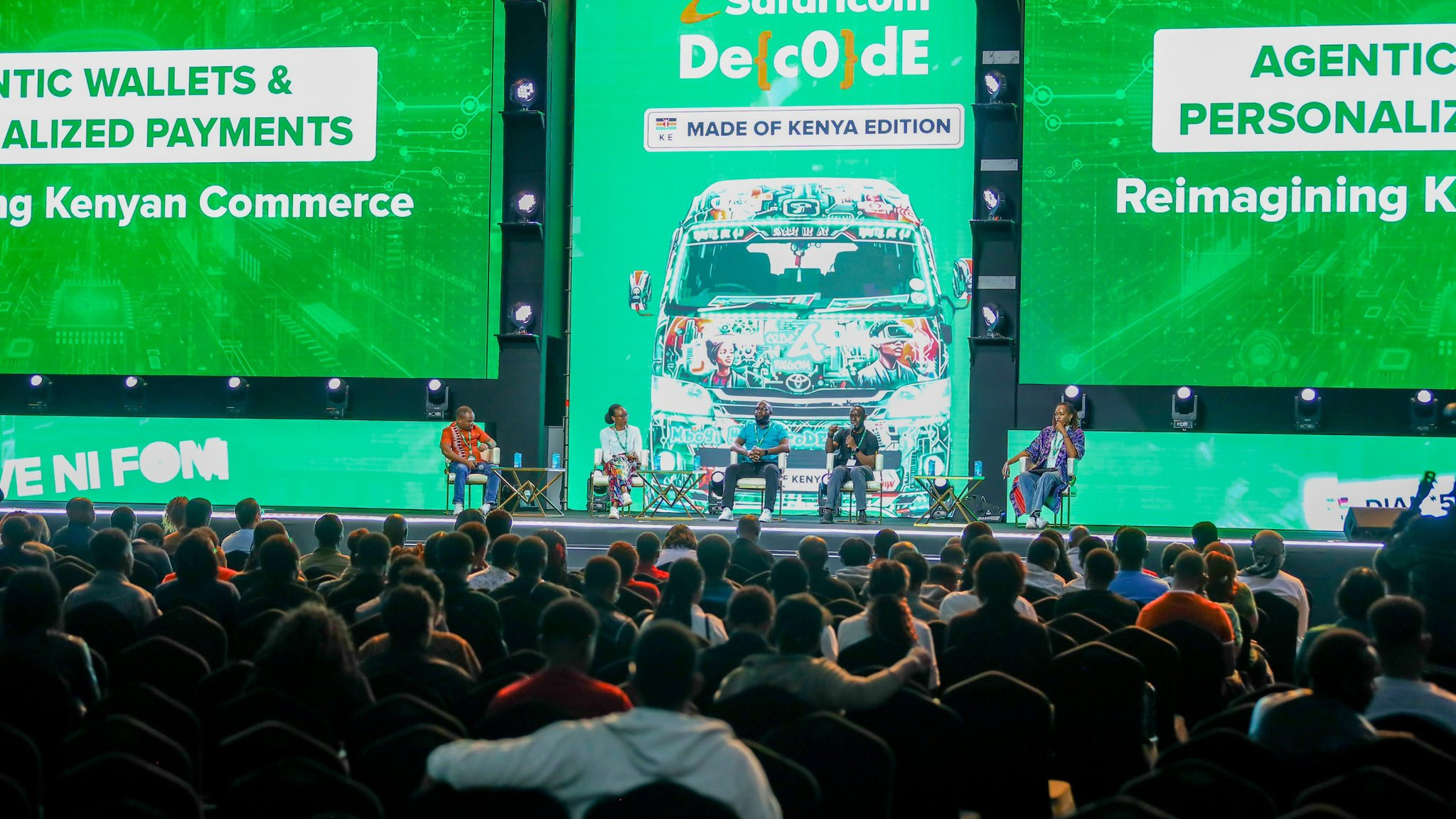
The panel discussion at Decode 4.0 surfaced one tension that no product announcement can resolve on its own: how do you build systems that act on behalf of users without exposing those same users to new categories of risk?
Stella Muraguri, Managing Partner at MMW Advocates and an advocate of the High Court of Kenya, rejected the framing before it could take hold.
“I am averse to the framing of consumer protection versus innovation, as if they work against each other. It should be innovation with the consumer in mind. What is the purpose of creating faster, more convenient solutions if you do not have the trust and safety of the consumer at heart?”
She pointed to Kenya’s Data Protection Act as the framework that governs what agentic systems can and cannot do with user information. When an AI books a hotel, locks a calendar entry, communicates with the property, and processes an advance payment, it touches a significant number of data points. Purpose limitation means those data points cannot then be used for anything beyond that specific transaction.
“Just because you have access to all these data points does not mean you can use them for other purposes. Consent must be informed. Consent must be specific. You cannot have an app that says pay all my electricity bill. It should specify how much, to which account, so that if a random number is presented and paid, the user is not left responsible for that.”
She warned developers directly about the risks of building without these foundations in place.
“As you scale automation, guess what else scales? Fraud scales. Bad design scales. We should not be building at scale irresponsibly. We should be building with the consumer in mind.”
On Kenya’s incoming AI bill, she was equally clear.
“Please take time and read it. It introduces risk classification. If you are building an AI system that falls under high-risk categories, health, finance, education, agriculture, the guardrails on your end will be much higher. Currently you can launch and deploy an AI system. Once that act passes, there will be an AI officer who must test and approve your system before it goes live. The window to operate in a relatively open environment is closing. Engage with the public participation process now.”
Gichangi, responding to a question about a user’s data being used beyond its original purpose, was direct about where Safaricom draws that line.
“The customer will always be in control. My OneApp is not one that will present risk or have your data shared with third parties without your knowledge. When we think about our super app, the customer controls it.”
On data minimisation specifically, Safaricom recently updated its send money feature so that the recipient of a payment no longer receives the sender’s full phone number. Bandari, moderating the panel, described why the feature matters in practice.
“As ladies, when you go to a restaurant and tip someone, and in the evening someone messages you saying hi, how was I today — that for me was the most relatable case for why data minimisation matters. The moment that tip was received, your number should not have been accessible beyond that transaction.”
What Comes After My OneApp
The version of My OneApp that went live at Decode 4.0 is the foundation. What Safaricom is building toward is a platform where agents handle the routine decisions of daily financial life so that users do not have to.
Gichangi acknowledged the gap between where the platform is today and where it is going.
“We are not there yet on agent-to-agent commerce. But the opportunity is enormous. We have over seven million registered businesses in Kenya. If I am running a business and you tell me I do not need to worry whether it will run at night while I am sleeping, because an agent will speak to another agent and sell on my behalf, I will wake up and find it has made ten thousand shillings in sales I would have missed. That is where the opportunity lies.”
Thuku from Visa framed the trust architecture that agent-to-agent commerce requires.
“We are looking at a trusted agent protocol that ensures the agent transacting has been given consent by the consumer, is authorised on a specific token issued to a specific user, and is limited to a defined use case. It is not just agents operating by themselves. They are trusted by the institutions where they come from.”
For now, My OneApp is live. The financial products are embedded. The learning layer is running. Daraja connects tens of thousands of developers to the infrastructure underneath.
Ndegwa’s words from the stage at Decode 4.0 captured what all of it points toward.
“Our role is to bring businesses and consumers together so that we can solve problems and enable a fantastic lifestyle.”
Eighteen years after M-PESA changed what a phone could do for a Kenyan, Safaricom is asking what an intelligent, unified platform can do for the 84 percent it has already reached, and the work left to do for the 16 percent it has not.
