



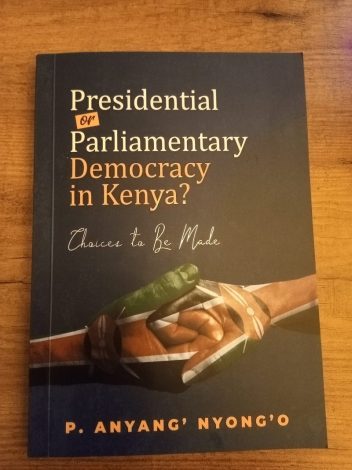
Kisumu Governor Peter Anyang’ Nyong’o has thrown his weight behind one of Kenya’s oldest constitutional debates, publishing a book that argues the country would govern itself better under a parliamentary system than the presidential one it has now.
Titled “Presidential or Parliamentary in Kenya?” and published by Booktalk Africa, the book opens with two questions that frame Nyong’o’s entire argument: does democracy actually drive development, and which system, presidential or parliamentary, gives a country like Kenya the better shot at achieving it.
Nyong’o answers that question early and does not hedge. The book sets out to persuade Kenyans to consider a parliamentary model just as the country continues wrestling with what kind of constitutional order actually serves it best.
“The book seeks to persuade Kenyans to adopt a parliamentary democracy as we engage in intense debates regarding a suitable and desirable constitutional dispensation for the nation,” he writes in the preface.
The Core Argument
At the heart of the book sits a critique of presidentialism itself. Nyong’o examines how the presidential system, in his view, weakens democratic norms and tends to produce the kind of post-election conflict Kenya has experienced repeatedly since multiparty politics returned in the 1990s. His central claim rests on election quality. Both systems rely on elections to produce what he calls governments of the people, by the people and for the people, he argues, but parliamentary systems have historically delivered freer and fairer elections than presidential ones.
That is a testable claim, and it does not hold universally. Presidential democracies such as the United States, Chile and Costa Rica have long track records of credible elections, while several parliamentary systems, including some in South Asia and post-Soviet Europe, have struggled with electoral integrity.
What Nyong’o is more likely pointing to is a narrower pattern common to many African presidential systems: winner-take-all contests concentrated around a single, powerful office tend to raise the stakes of losing, which can fuel exactly the kind of disputed outcomes and violence Kenya saw after its 2007 and 2017 elections.
Dedication; To all Kenyan patriots who have struggled for democracy and good governance before and after independence. To all heroes of the Second Liberation some of whom lost their lives in the process championing democracy, human rights and social justice.#NyongoBookLaunch pic.twitter.com/EWX6PfMNJi
— Gov. Anyang' Nyong'o (@AnyangNyongo) September 24, 2019
A More Cautious Voice on Devolution
The book carries a foreword from Professor Michael Chege of the University of Nairobi, who chairs Kenya’s NEPAD and African Peer Review Mechanism Governing Council. Chege’s contribution adds a note of restraint to Nyong’o’s argument.
He writes that Nyong’o treats deeper devolution through regional economic blocs as necessary, but stops short of calling it urgent, a distinction that matters given how central devolution has become to Kenya’s post-2010 political settlement.
That framing places the book inside a live debate rather than outside it. Regional blocs such as the Lake Region Economic Bloc, which Nyong’o himself has helped champion as Kisumu governor, have pushed for counties to pool resources and coordinate development across shared borders. Chege’s foreword suggests the book treats that push as worth pursuing carefully rather than rushing.
How Kenya’s Presidential System Actually Works
Kenya’s current structure, set out in the 2010 Constitution, concentrates executive power in a directly elected president who serves as both head of state and head of government. The president appoints a deputy president and cabinet secretaries from outside Parliament, keeping the executive and legislative branches formally separate even though Parliament retains oversight and vetting powers over executive appointments.
Winning the presidency itself is deliberately difficult by design. A candidate must secure more than 50% of the national vote and at least 25% of the vote in no fewer than 24 of Kenya’s 47 counties, a threshold meant to force broad national appeal rather than regional or ethnic bloc voting alone. Nyong’o’s book argues that this same design, built to prevent narrow victories, has instead concentrated enough power in one office to make every election an existential contest, and that a parliamentary system, where executive authority flows from a legislative majority rather than a single nationwide vote, would lower those stakes.
Why the Debate Persists
Kenya has revisited this question repeatedly since 2010, most notably through the Building Bridges Initiative, which floated a hybrid model with an expanded executive before courts struck down the process on procedural grounds in 2021.
Nyong’o’s book does not end that debate, but it does sharpen one side of it, arguing that Kenya’s repeated cycles of electoral tension trace back to the structure of the presidency itself rather than to any single leader or election. Whether Kenyans agree will likely depend less on the book’s constitutional theory and more on how convincingly it speaks to a public still living with the aftermath of the elections it references.
Khusoko is now on Telegram. Click here to join our channel and stay updated with the latest East African business news and updates.
