


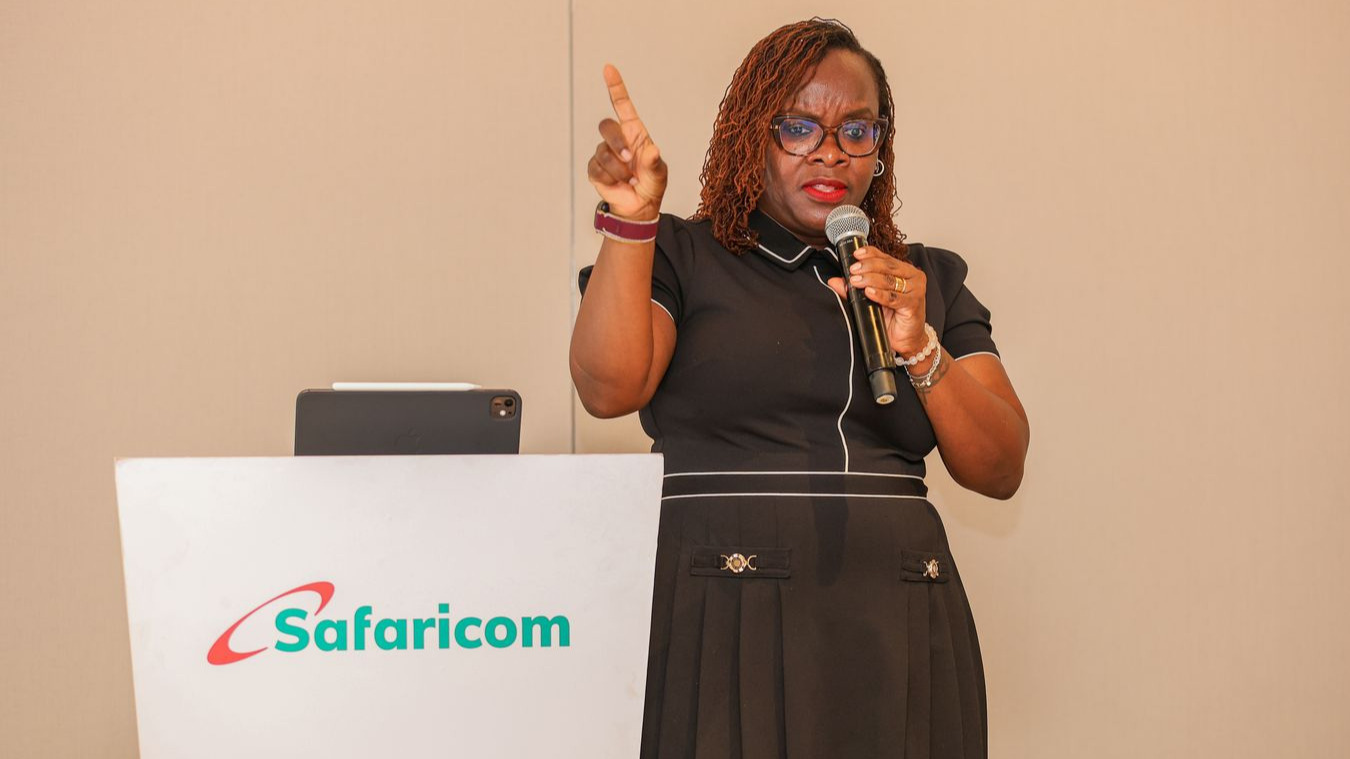
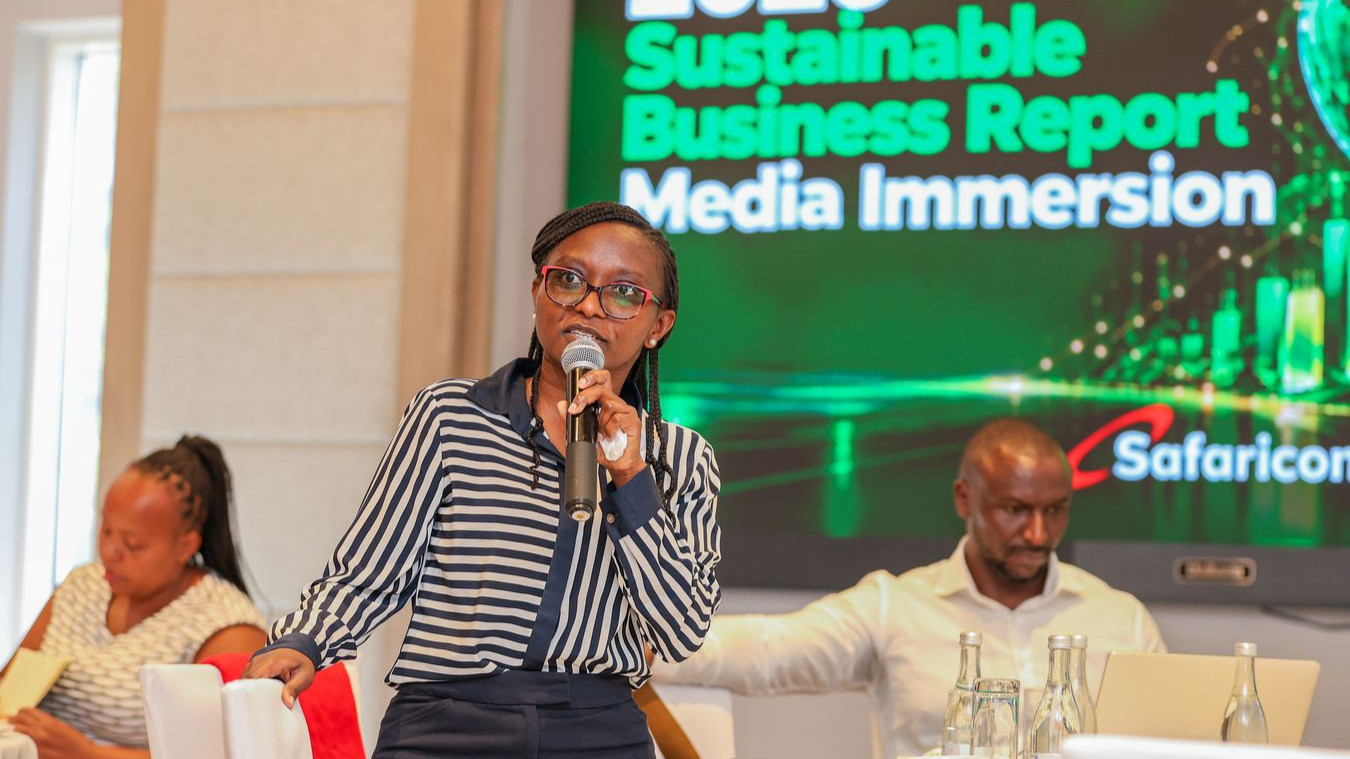
Safaricom will measure its impact with a new method and report how sustainability issues affect its own finances, the company told journalists at a briefing ahead of the public launch of its 15th Sustainable Business Report.
Karen Basiye, Director Sustainable Business and Social Impact, Safaricom Foundation, led the briefing with senior manager Samson Kanae and Agnes Kariuki of the sustainability team. Basiye joined Safaricom in October 2008 from the National Environment Management Authority.
Key facts
- The 15th report adds double materiality, which weighs how issues affect Safaricom as well as how Safaricom affects others.
- Safaricom is replacing the True Value method with the Value Balancing Alliance method.
- Kenyan public interest entities, including NSE listed companies, must publish IFRS S1 and S2 disclosures for accounting periods beginning on or after January 1, 2027.
- Safaricom’s first green bond took up Sh20 billion in its first tranche.
From a six page note to 15 reports
Basiye traced the reports to 2008, when former chief executive Michael Joseph signed Safaricom to the UN Global Compact. Staff learned of the commitment only after they arrived. “So our first report was a six page report,” she said, filed so the Global Compact would not remove the company.
Sustainability now sits inside corporate strategy.
“Sustainability is the roof of Safaricom,” Basiye said. She rejected the idea that it is philanthropy. “Sustainability is a business imperative.”
Safaricom swaps True Value for a new impact method
Kanae said Safaricom used the True Value method with KPMG for about 10 years, starting in 2015, to quantify its impact. It now moves to the Value Balancing Alliance method, which companies in pharmaceuticals and technology in Europe use. The metrics stay close to the old ones, he said, but “you will see a lot of transparency.”
The change lets Safaricom benchmark against other firms and explain how it reaches each figure. The report covers dealer and agency networks, corporate social investment, and capital and operating spending.
Double materiality adds a second test. Kanae said Safaricom now examines how the issues it focuses on “affect us as a business.” Since 2016 the company has prioritised nine of the 17 Sustainable Development Goals.
IFRS deadline arrives in January 2027
Kanae said Safaricom set its net zero ambition years ago and has been “an early adopter” of IFRS S1 and S2. Khusoko reported that Safaricom held a place on CDP’s A List for a second consecutive year and CEO Peter Ndegwa said the company adheres to IFRS S1 and S2.
Sustainability becomes a source of funding
Agnes said the team aims to turn sustainability from a cost centre into a business enabler. Safaricom’s green bond drew applications worth Sh41.4 billion, a 175% oversubscription, with individual investors making 96% of applications. Proceeds fund the 5G rollout, solarisation of network sites and replacement of legacy technology.
“You are able to access cheap capital,” Agnes said, and that capital speeds up the next round of green projects. She also named technology as the next step, from artificial intelligence that flags fraud before it happens to tools that confirm where trees were grown.
Solar wins on cost, and targets lag
Basiye said a life cycle assessment settled the case for solar over diesel generators. Generators need fuel, servicing and security, and fuel deliveries once fell short, with suppliers billing 10,000 litres and delivering 1,000. A solar installation serves 10 to 15 years. “Ideally, if we had a reliable and stable grid, Safaricom would never be a carbon emitting company,” she said.
Safaricom targets net zero by 2050, and Basiye said the team is “chasing 2035.” Khusoko reported that Safaricom added 570 solar powered sites in FY26, bringing the total to 2,002 against a target of 5,000 by 2030.
Trees grown through community forest groups
Safaricom targets 5 million trees. Its 2025 report recorded 2.3 million trees planted. “We don’t plant trees; we grow trees,” Basiye said. Community forest associations receive funds and plots under the shamba system, where families grow crops until the trees mature. Groups that miss 85% to 90% survival leave the programme.
On carbon trading, Basiye separated two sets of trees. Trees for water tower restoration stay outside Safaricom’s offsets, and any trading benefit goes to communities. Trees grown to offset its emissions count only against what Safaricom emits, because the forests belong to the government and people of Kenya. Safaricom does not plan to buy credits soon. “Let’s not take the shortcut to these things,” she said.
She also drew a line between giving and investing. “CSR, we give, we go. Sustainability, we invest.”
Women in leadership and supplier spend
Women held 24% of leadership roles when Ndegwa joined, Basiye said, and will hold about 44% by the end of the year.
The target is 50% by 2030. Women make up 49.5% of Safaricom’s Group workforce. Spend with women led firms and special interest groups stands near 5%, with a goal of 10%. Basiye said Safaricom talks to banks so women vendors can borrow against a purchase order to lay fibre.
M-PESA Foundation screens applicants as demand grows
Citizens of the Future commits about Sh30 billion over five years to upgrade over 600 institutions and award more than 10,000 scholarships. Basiye said the CEO set a target of 100 schools built or refurbished each year and that almost 70 are approved so far this year.
The Foundation awarded 400 learners secondary school scholarships. Basiye said the foundation has “only 500 scholarship slots” this year, and staff check every household. They request M-PESA statements, speak to head teachers, compare village maps drawn at application and interview, and visit without notice. Families that misstate poverty lose the place.
Branding stays in place. “Branding is a must,” she said, though uniforms and gift bags carry no logo, to protect recipients. In technical colleges, courses follow local trade, with mineralogy in Taita Taveta and boat building in Lamu.
Trust, data and waste
Building trust in a digital economy ranks first among Safaricom’s material matters. Basiye said the company anonymises data and limits access to staff who need it. Safaricom has collected electronic waste since 2014 and turns old banners into school bags. A second phase of Capture the Good, a storytelling programme for young content creators, is planned.
