


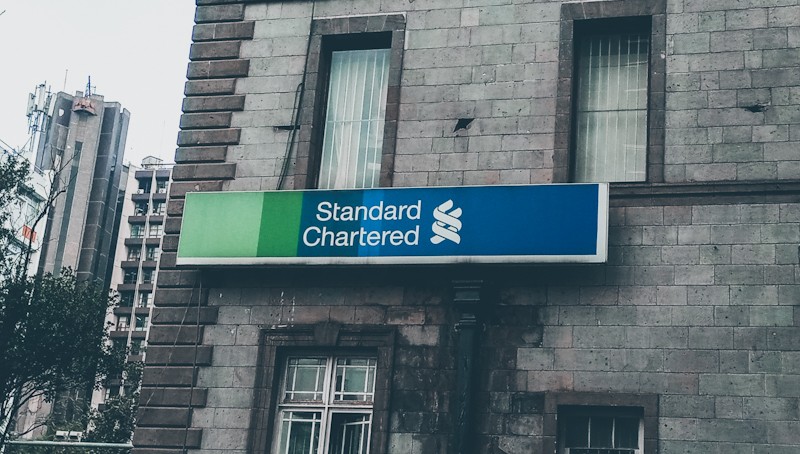
Standard Chartered Bank Kenya has dropped out of the country’s Tier One banking group for the first time in years, according to the Central Bank of Kenya’s 2025 annual report. The lender’s market size index fell to 4.5 percent in 2025, down from 5.4 percent in 2024, pushing it below the 5 percent threshold that separates large banks from medium sized ones.
The bank now ranks ninth overall, a drop from eighth position, and sits at the top of CBK’s Medium Peer Group rather than among the large lenders that dominate the sector.
What The Numbers Show
CBK classifies banks using a weighted index built from net assets, deposits, shareholders’ funds, deposit accounts and loan accounts. Standard Chartered lost ground across nearly every measure that feeds into that score.
Net assets fell 5.4 percent to KES 364.5 billion. Deposits declined 3.8 percent to KES 284.7 billion. Shareholders’ funds dropped 7.4 percent to KES 66.2 billion. Customer deposit accounts fell 7.0 percent to 295,821, while loan accounts declined 11.1 percent to 60,608.
Those declines trimmed the bank’s share of the market across the three metrics that carry the heaviest weighting in CBK’s classification system: net assets, deposits and shareholders’ funds each account for 33 percent of the index.
It is worth noting what this shift does not mean. The move reflects a contraction relative to peers, not a regulatory action, a solvency concern or a capital adequacy downgrade. Standard Chartered remains a well capitalised institution; it has simply grown more slowly than the banks around it.
KCB Extends Its Lead At The Top
KCB Bank Kenya kept its position as the country’s largest lender and widened the gap with its closest rival. Its market size index climbed to 17.3 percent from 16.6 percent the previous year.
Equity Bank held second place at 11.8 percent. Co-operative Bank of Kenya followed at 9.4 percent, with NCBA Group close behind at 7.9 percent. Absa Bank Kenya and Stanbic Bank Kenya rounded out the top six, at 6.4 percent and 5.8 percent respectively.
I&M Bank and Diamond Trust Bank tied for the final places among the large banks, each holding a 5.6 percent share. With Standard Chartered’s exit, Kenya’s Tier One group now counts eight banks instead of nine.
Kenya’s Listed Banks Post Strongest Profit Growth in Two Years, Cytonn Report Shows
Full 2025 Market Share Rankings
Tier I — Large Banks (5% and above)
- KCB — 17.3%
- Equity — 11.8%
- Co-operative Bank — 9.4%
- NCBA — 7.9%
- Absa — 6.4%
- Stanbic — 5.8%
- I&M — 5.6%
- DTB — 5.6%
Tier II — Medium Banks (1% to under 5%)
- Standard Chartered — 4.5%
- Prime Bank — 4.3%
- Bank of Baroda — 2.6%
- Family Bank — 2.4%
- Citibank — 2.1%
- Bank of India — 1.6%
- National Bank of Kenya — 1.5%
- SBM Bank — 1.1%
- Sidian Bank — 1.1%
- Ecobank — 1.0%
- HFC — 1.0%
Tier III — Small Banks (under 1%)
- Victoria Commercial Bank — 0.8%
- Gulf African Bank — 0.6%
- Bank of Africa — 0.5%
- GTBank — 0.5%
- ABC Bank — 0.5%
- Kingdom Bank — 0.5%
- Habib Bank AG Zurich — 0.4%
- Dubai Islamic Bank — 0.4%
- Premier Bank — 0.4%
- CIB Kenya — 0.3%
- Credit Bank — 0.3%
- Development Bank of Kenya — 0.3%
- Middle East Bank — 0.3%
- Guardian Bank — 0.2%
- Paramount Bank — 0.2%
- M-Oriental Bank — 0.2%
- UBA Kenya — 0.2%
- Access Bank Kenya — 0.2%
- Consolidated Bank — 0.2%
- Spire Bank — 0.0%
Why This Matters
CBK’s peer group classification shapes how banks are supervised, compared and benchmarked against one another, so a shift in tier carries weight beyond bragging rights.
Standard Chartered’s slide shows how quickly rankings can move in a sector where a handful of large banks keep growing their asset bases and deposit books faster than mid sized rivals.
Standard Chartered Kenya pays KSh 31 dividend despite 38% profit drop
