


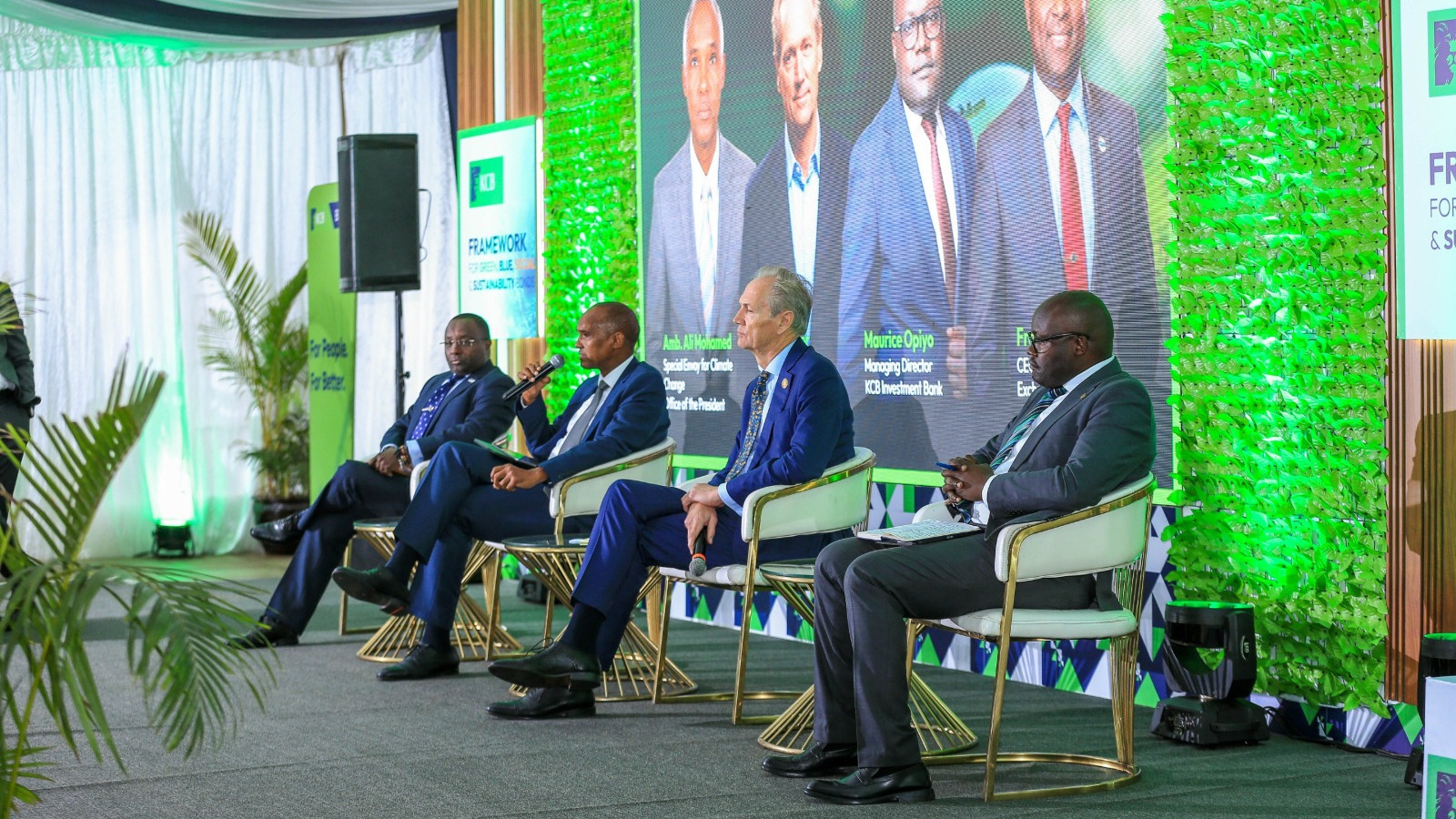
KCB Group launched its Sustainability Bond Framework on Wednesday at the KCB Leadership Centre in Karen, setting a ceiling of Sh300 billion for a five-year medium-term note programme. During the panel discussion that followed, Group CEO Paul Russo said the figure understates what the market can absorb.
“I actually think 300 is not ambitious,” Russo said. Frank Mwiti, CEO of the Nairobi Securities Exchange, agreed: “Yeah, I frankly believe… the moment you start splitting local currency and foreign currency, you start realising why the 300 billion is actually short.”
Khusoko’s coverage of the launch and its explainer set out the framework’s mechanics: the Sh100 billion first tranche, the Moody’s SQS2 rating, the eligibility criteria across green, blue and social categories.
The framework document does not record the disagreement among panellists over whether the target matches what Kenya’s capital market can deliver.
Evidence for demand
Mwiti cited three recent transactions. Safaricom’s green bond sought Sh15 billion in December and received offers of Sh41 billion. KCB Tanzania’s second sukuk bond was oversubscribed by 300 percent. CMLC’s sustainability-linked note sought Sh3 billion and drew Sh9 billion without a tax incentive attached.
“Now 300 billion in my view, if I look for example at the number of particularly Nordic and Scandinavian investors that have come to NSE asking for where are these instruments… the issue won’t be whether 300 billion in local currency or foreign currencies is an issue,” Mwiti said.
“The issue will be where are these investable projects that the use of proceeds will go into, that will be 80 percent of the heavy lifting.”
Kenya has led most African markets on sustainable debt since Acorn Holdings listed the first corporate green bond in East and Central Africa on the Nairobi Securities Exchange in January 2020. That bond was also admitted to the London Stock Exchange’s International Securities Market the same month.
KCB became the first bank accredited by the UN Green Climate Fund as a financial intermediary in East Africa later that year. The Kenya Bankers Association’s Sustainable Finance Initiative, launched in 2015, has trained more than 30,000 bankers across 38 member banks since.
Continental comparison
Africa accounted for 23 percent of what the UN Economic Commission for Africa classifies as official climate finance need, yet held less than 1 percent of global green bond issuance as of 2022, according to figures ECA director Jean-Paul Adam cited at a 2022 World Bank workshop on the subject.
Climate Bonds Initiative data put South Africa’s Nedbank, FirstRand and Standard Bank as the continent’s top three financial-sector issuers by volume, with Nedbank’s cumulative issuance at roughly $674 million as of late 2021, an amount smaller than a single Sh100 billion KCB tranche at current exchange rates.
The African Development Bank has issued its own green bonds since 2013 and partnered with the Global Green Bond Initiative in 2023 to build issuance capacity elsewhere on the continent.
At a 2024 US-Africa Green and Sustainable Finance Workshop in Abidjan, African Securities Exchanges Association president Thapelo Tsheole described the same constraint Mwiti raised at KCB’s launch: “There is a general lack of communication concerning green bonds. This is a pipeline that needs to be developed for the African continent.”
KCB’s framework document states the bank screened Sh587.78 billion in loan facilities against environmental and social risk criteria in 2025, roughly double the size of the bond programme.
Whether that volume converts into loans meeting the framework’s specific eligibility thresholds, including the 20 percent energy intensity improvement required for energy efficiency projects, determines how much of that screened book can actually back the bond.
Origination named as the constraint
Mwiti said the NSE set up a Sustainable Finance Centre of Excellence, run by colleague Josephine, to address two recurring problems.
“We know this is not a capital issue. The market is awash with capital, as well as outside the country,” he said. “There are two issues that need to be solved, and KCB is very well placed to solve them. The first one is deal origination, project origination. This is a big, big, big challenge, originating projects that can actually absorb capital… The second issue is structuring these projects properly.” He added: “The beauty is KCB is superbly well placed to solve for the two. Of course, they’re only able to solve up to a point. The rest of the point, they need NSE.”
Maurice Opiyo, Managing Director of KCB Investment Bank, said the pipeline behind the Sh300 billion figure has already been quantified internally. “I can assure you that the pipeline is great. We have worked with the various heads of business and we have quantified that number. So the 300 billion is not just a random number. It is a number that is backed by the opportunities which we see and which we’ll be delivering.”
Debt-equity imbalance
Mark Napier, CEO of FSD Africa, framed the target as a continental structural issue rather than a Kenya-specific one. “We know that on the continent there is actually a surfeit of debt, and most climate finance in Africa is in the form of debt,” Napier said.
“Actually, even most finance for adaptation, bizarrely, is in the form of debt as well. So we need to look at other ways to crowd in… we need to look at other instruments, and equity is obviously the only other instrument that there is. There’s only two forms of finance, debt and equity, when it all comes down to it.”
FSD Africa holds junior equity in a South Africa-based fund managed by AIIM that absorbs early-stage development risk in clean infrastructure projects, on the basis that pension capital follows later at lower risk once projects clear that stage. “So what we’re providing is junior equity to a fund that’s going to take that early-stage infrastructure investment risk in order that at the later stages you can then bring in the pension fund money, which has a much higher risk, much lower risk appetite,” Napier said.
He asked KCB how it would use leverage, given its existing access to Green Climate Fund financing, to turn its first tranche into a multiple of its face value.
Domestic pension allocation
Mwiti raised a third constraint tied to domestic institutional capital. Principal Secretary Cyrell Wagunda Odede had referenced a pension fund pool of roughly Sh2.8 trillion earlier in the launch. Mwiti returned to the figure directly. “PS made reference to 2.8 trillion sitting with pension funds. Over half of that allocated to government. That’s a problem,” he said. “We need to unlock that first before we even talk about sucking in foreign capital into the market. But at the end of the day, everyone is looking for return, over and above, it’s green, it’s social, it’s sustainable.”
Market conditions
Wagunda Odede said the Nairobi Securities Exchange crossed a market capitalisation of Sh4.012 trillion for the first time in August 2026, with double-digit growth across benchmark indices for the six months to June 2025.
He attributed the recovery to two years of fiscal reform and macroeconomic stabilisation. Mwiti separately described three pools of retail buyers the NSE has drawn into recent green and sustainability-linked issuances: domestic retail investors, buyers from Tanzania, Uganda and Rwanda, and diaspora investors, which he said has driven the oversubscription pattern in recent Kenyan corporate bonds more than the sustainability label itself.
Outstanding question
The panel produced two readings of the Sh300 billion figure. Russo and Mwiti said investor demand, based on recent Kenyan issuance history, will exceed it. Opiyo said the figure already reflects a quantified internal pipeline.
Napier’s comments identified a separate issue: without more equity-type capital entering African climate finance, debt instruments such as KCB’s bond will continue absorbing a larger share of available financing than the market structure can support over time.
The first tranche, up to Sh100 billion, is expected to price in October, subject to regulatory approval. An oversubscription in line with Safaricom’s or CMLC’s recent issuances would support Russo and Mwiti’s position. A tranche pricing closer to its target size, or requiring a wider pricing concession than comparable recent issuances, would support Mwiti’s separate point that origination and structuring, not investor appetite, remain the binding constraint on how far Kenya’s sustainable bond market can scale.
