



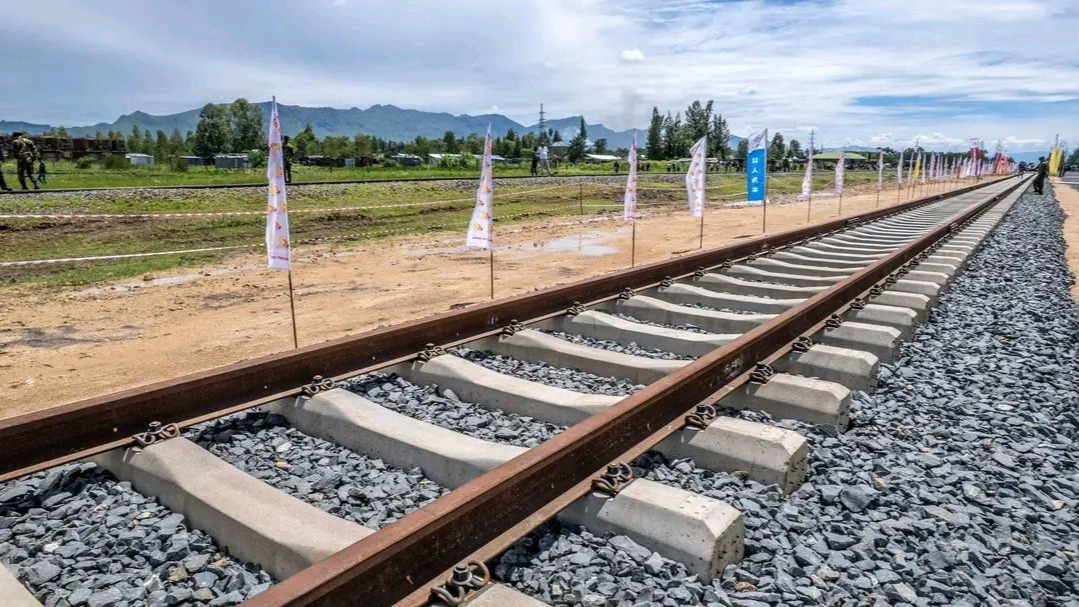
Construction crews began work on Kenya’s Ksh 700 billion Naivasha to Kisumu to Malaba railway extension in Narok County on 1 July 2026, marking the physical start of a project that spent more than six years stalled for lack of financing.
Kenya Railways awarded the contract to a pairing of Chinese state firms, China Communications Construction Company and China Road and Bridge Corporation. Narok County carries roughly 100 kilometres of the route, making it the entry point for a corridor that will eventually stretch across nine counties to the Ugandan border.
Today is truly a great day for Kenya Railways and for Kenya.
Today marks a historic milestone as the official construction works for the Naivasha–Kisumu–Malaba Standard Gauge Railway (SGR) Project have commenced in Narok County. pic.twitter.com/VAklBV9yUl— Kenya Railways (@KenyaRailways_) July 1, 2026
Land Deals Move Ahead In Kisumu
While earthworks get underway in Narok, planners in Kisumu face a different task: clearing land for the Kibos Terminus, one of the project’s key freight facilities. The National Land Commission has started ground verification on parcels gazetted for compulsory acquisition, a necessary step before construction can reach the terminus site. Kenya Railways held a public meeting with affected landowners in Kisumu Town East Sub-county on 24 June, walking property owners through a process triggered by Gazette Notice No. 4986, published back in April.
Land acquisition tends to be the slowest and most contentious part of any railway build in Kenya. Getting ahead of it in Kisumu suggests planners learned something from the delays that plagued earlier SGR phases.
A Six Year Wait Finally Ends
President Ruto broke ground for this extension at Suswa, Narok County, on 19 March 2026, more than half a decade after construction on the original SGR stalled near Naivasha. China cut back lending for large African infrastructure projects in 2019 over debt sustainability concerns, and the western leg sat frozen just over 350 kilometres short of the Ugandan border.
Financing this round looks different. Rather than raising a new sovereign loan from China, Kenya restarted the project using securitisation of its Railway Development Levy, a shift that tracks with a broader change agreed at a 2024 China Africa summit in Beijing, where the two sides moved away from loan heavy arrangements toward investment based ones. Kenya also renegotiated repayment terms on the original two SGR phases last year, easing its annual obligations.
Kenya’s existing line runs 472 kilometres from Mombasa to Naivasha, carrying both passengers and freight since 2017. The new extension adds significantly to that footprint and, for the first time, threads the network through to Uganda’s border at Malaba, opening a direct rail link to a country East Africa’s freight planners have wanted to reach for years.
Two Corridors Chase The Same Cargo
Kenya isn’t the only country building toward East Africa’s landlocked interior. Tanzania’s Central Corridor, the 722 kilometre standard gauge line running from Dar es Salaam to Dodoma, already carries paying customers. Phases three through seven remain under active construction, and in the first nine months of the 2025/26 financial year, the line moved 2,515,203 passengers and 102,452 tonnes of freight.
Uganda, meanwhile, has yet to break ground on its own SGR network, which remains stuck at the planning stage. The country’s more tangible infrastructure win right now is the East Africa Crude Oil Pipeline, which had reached 82.6% completion. Rwanda is chasing a different kind of connectivity: Bugesera International Airport’s first phase, targeting seven million passengers annually, is due to open in 2027.
Kenya’s Northern Corridor and Tanzania’s Central Corridor are, in effect, racing for the same prize. Rwanda, Burundi, Uganda, the Democratic Republic of Congo and Zambia all sit landlocked, and whichever route those countries choose to move their imports and exports through will determine port revenue, rail freight income and logistics employment for the winning side. Malawi factors into that calculation too, adding further weight to a competition that stretches well beyond Kenya’s borders.
Two railways are now rising toward the same markets from opposite coasts. Neither Kenya nor Tanzania will win this contest simply by being first to lay track. The corridor that finishes construction fastest, runs the most reliable service and prices freight most competitively is the one that will end up carrying the region’s cargo, and with it, the economic returns both countries are building toward.
