


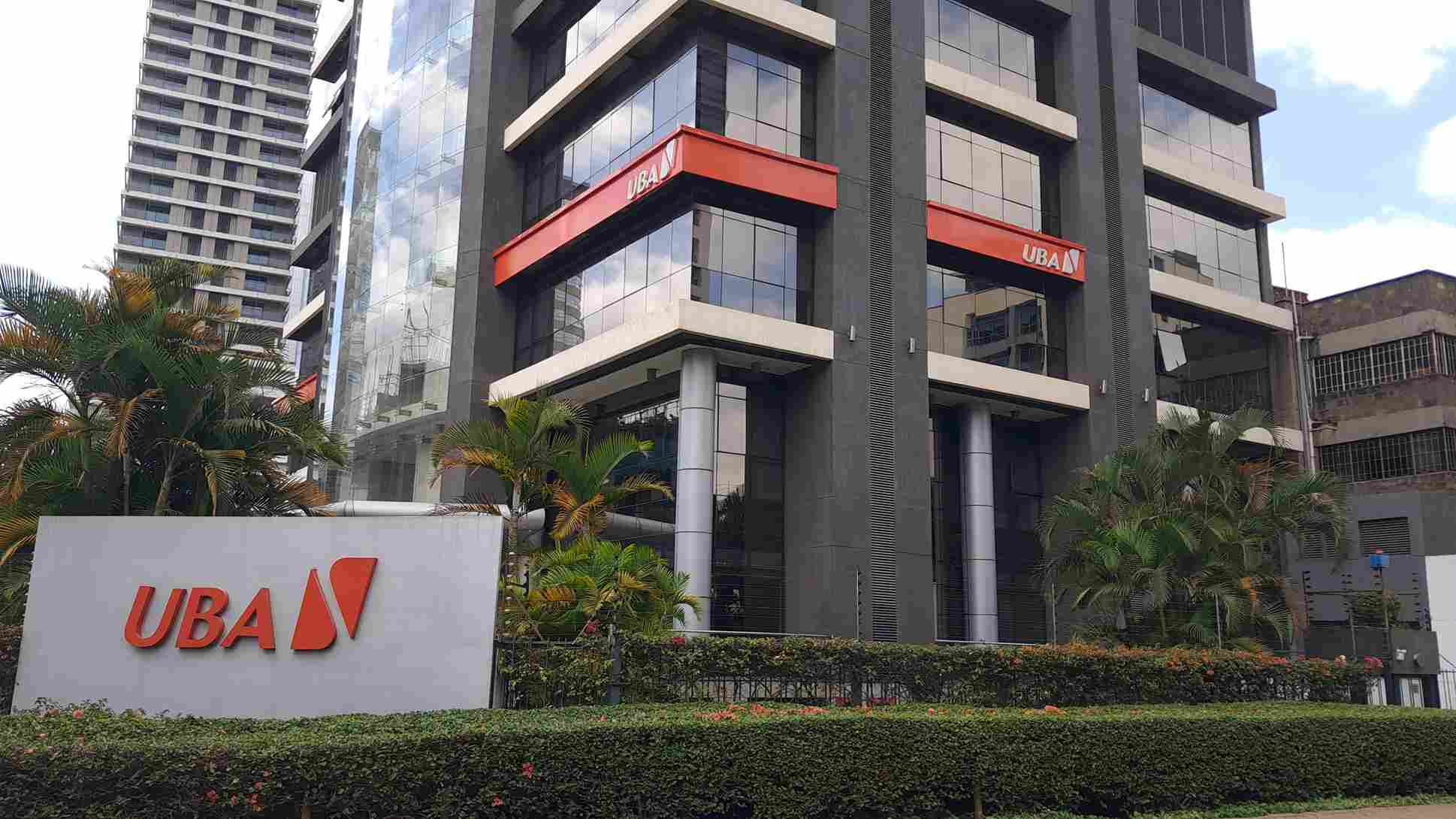
After five consecutive years of losses, UBA Kenya closed 2025 in the black.
The bank posted a profit after tax of KES 426.8 million for the year ended December 31, 2025, reversing a loss of KES 586.8 million recorded in 2024. The turnaround came on the back of income growth and a sharp reduction in operating costs.
| Metric | FY2024 | FY2025 | Change |
|---|---|---|---|
| Profit / (Loss) After Tax (KES m) | (586.8) | 426.8 | Turnaround |
| Net Interest Income (KES m) | 469.3 | 487.1 | +3.8% |
| Non-Funded Income (KES m) | 712.4 | 1,100.0 | +54.4% |
| Operating Expenses (KES m) | 1,800.0 | 1,100.0 | -35.3% |
| Total Assets (KES b) | 13.7 | 21.8 | +59.1% |
| Net Loans and Advances (KES b) | 2.1 | 4.8 | +130.9% |
| Customer Deposits (KES b) | 9.1 | 16.1 | +76.5% |
| Core Capital (KES b) | 1.5 | 1.9 | +27.6% |
Net interest income grew 3.8% to KES 487.1 million. Non-funded income climbed 54.4% to KES 1.1 billion. Operating expenses fell 35.3% to KES 1.1 billion, down from KES 1.8 billion the year before. The bank did not cut its way to profit on paper alone, its balance sheet expanded in parallel.
Total assets grew 59.1% to KES 21.8 billion. Net loans and advances more than doubled, rising 130.9% to KES 4.8 billion. Customer deposits crossed the KES 10 billion mark, reaching KES 16.1 billion, up 76.5% from KES 9.1 billion in 2024.
A Capital Gap and How the Bank Closed It
The results carried one unresolved issue. UBA Kenya ended 2025 with core capital of KES 1.9 billion, up 27.6% from KES 1.5 billion in the prior year, but still short of the Central Bank of Kenya’s minimum statutory requirement of KES 3 billion.
That requirement did not always stand at that level. The Business Laws (Amendment) Act 2024 set a schedule that raises the minimum core capital in stages:
| Deadline | Minimum Core Capital Requirement |
|---|---|
| December 2025 | KES 3 billion |
| December 2026 | KES 5 billion |
| December 2027 | KES 6 billion |
| December 2028 | KES 8 billion |
| December 2029 | KES 10 billion |
The revision was designed to strengthen the resilience of the sector over time. UBA Kenya ended 2025 below the first threshold.
In March 2026, parent company United Bank for Africa Plc injected KES 1.097 billion into UBA Kenya, lifting core capital above the CBK threshold and resolving the shortfall.
George O. Otieno, Chairman of the Board, framed the injection as a statement of intent from the group: “As a strategic subsidiary of UBA Plc, this reflects the Group’s strong confidence in Kenya, demonstrated through additional capital injection to ensure compliance with the minimum core capital requirement of KES 3 billion. This positions UBA Kenya on a solid foundation and enables us to play a greater role in supporting Kenya’s economic growth.”
Beyond the Balance Sheet
The numbers tell part of the story. The other part sits in where the bank deployed its capital.
During 2025, UBA Kenya participated in the USD 150 million Road Securitisation Programme, an infrastructure financing arrangement designed to release liquidity for road contractors, speed up construction timelines, and support the completion of projects that had stalled. The programme connects structured finance to public infrastructure, roads that move goods, reduce costs, and expand access to markets.
That participation reflects a deliberate positioning. UBA Kenya operates with a focus on manufacturing, trade, agriculture, mining, and construction. It targets value chains and small and medium enterprises with financing built around how those businesses actually function. It also draws on the pan-African network of UBA Group to support cross-border trade, including through PAPSS, the Pan-African Payment and Settlement System.
Managing Director and CEO Mary Mulili put the trajectory plainly: “Our return to profitability is a clear signal that UBA Kenya is on the right path. We have strengthened our foundation and are now focused on growth. With the continued support of UBA Group, we are confident in our ability to deliver value to our customers, support businesses, and play a meaningful role in Kenya’s economic transformation.”
What Comes Next
UBA Kenya enters 2026 better capitalised, profitable, and with a deposit base that has nearly doubled in a year. The bank plans to scale lending across sectors it considers priorities, expand its digital payments infrastructure, and develop financing products in clean energy and environmentally responsible investment.
| Strategic Focus | What It Means in Practice |
|---|---|
| Cross-Border Trade | Using UBA’s pan-African network and PAPSS to move money across borders |
| Sector Lending | Targeting manufacturing, trade, agriculture, mining, and construction |
| SME Financing | Supporting value chains with financing built around how businesses operate |
| Digital Payments | Expanding payment infrastructure and online banking access |
| Green Finance | Funding clean energy and environmentally responsible projects |
Five years of losses do not reverse overnight. But the trajectory is clear, the capital base meets the regulatory threshold, and the parent company has put money behind its confidence in the Kenyan market.
