



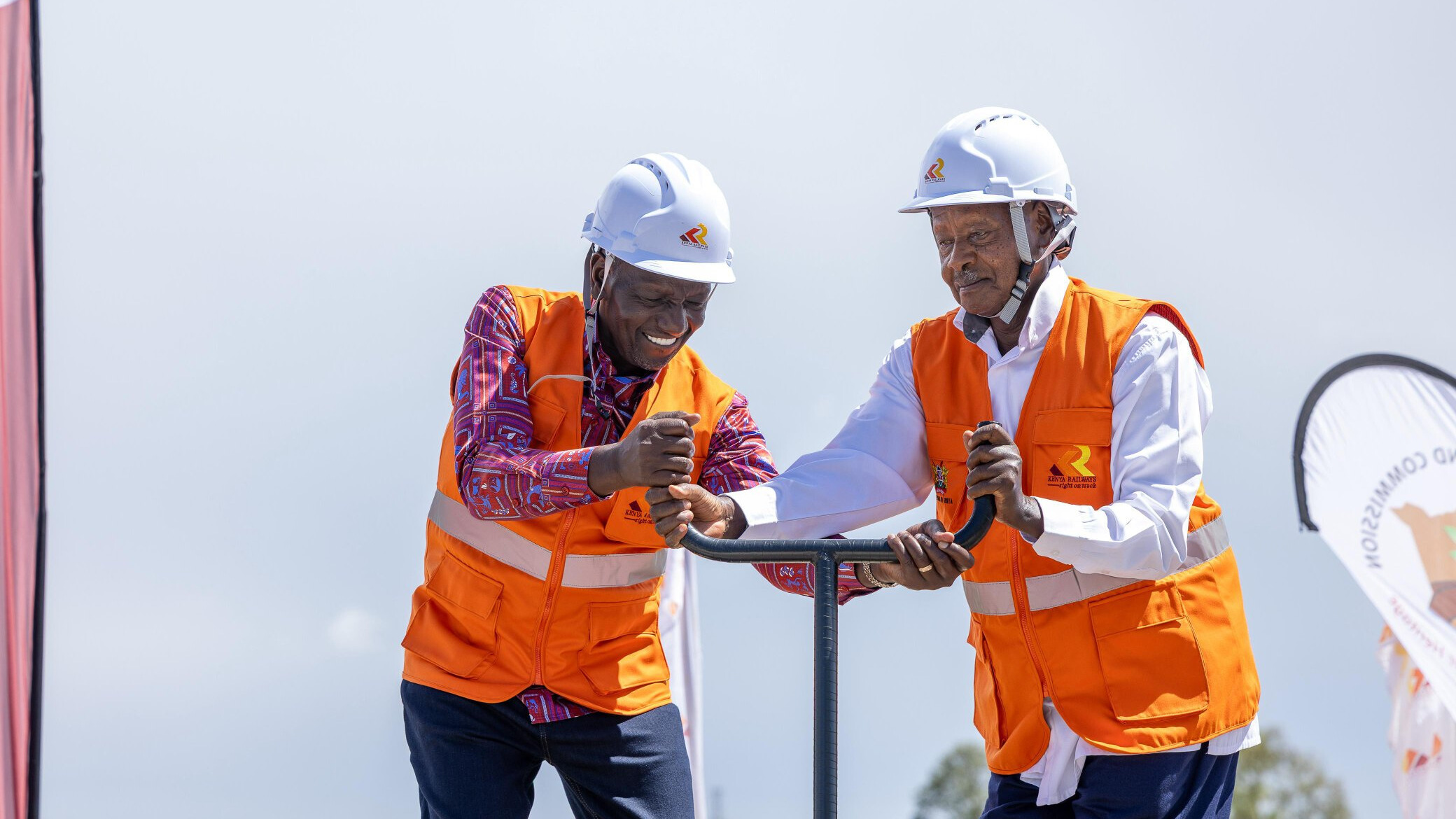
Presidents William Ruto and Yoweri Museveni on Saturday flagged off construction of the 107 kilometre Kisumu–Malaba Standard Gauge Railway section, completing a rail corridor from Mombasa to the Kenya–Uganda border.
The section completes a nearly 1,000-kilometre rail link from the port of Mombasa to Malaba. The line is planned to extend to Kampala and eventually to Rwanda, Burundi, South Sudan, and the Democratic Republic of Congo.
Museveni: Road Freight Is “Suicide”
Museveni said continued reliance on roads for heavy cargo and petroleum transport was unsustainable. “The transport system, as it currently stands, is chaotic and wasteful,” he said. “Mixing passengers, light cargo, and heavy cargo on roads is dangerous.”
He called for heavy freight to move to rail and petroleum products to pipelines, arguing this would reduce accidents, lower logistics costs, and protect road infrastructure.
“If we continue depending on road transport for cargo, we are effectively undermining our own competitiveness,” Museveni said.
He added that affordable transport, electricity, and access to credit were the foundations of any competitive economy, and urged African governments to prioritise infrastructure investment to reduce production costs.
Museveni: “We’re going to push our section from Malaba to Kampala, then to Kasese and Mpondwe linking to the DRC. We are also working on the railway from Tororo to Gulu, then Nimule to Juba, as well as the line from Bihanga to Kigali.” pic.twitter.com/sr60xU2TCm
— UBC UGANDA (@ubctvuganda) March 21, 2026
Kenya Selects Southern Corridor for SGR Extension to Kisumu, Eyes Uganda Link
Ruto: Logistics Costs Are Strangling Trade
Ruto said transport costs currently account for between 30 and 40 per cent of the final value of goods moving through the corridor, a figure he described as a direct drag on regional competitiveness.
Cargo from Mombasa to Malaba currently takes about 80 hours by road, and more than 100 hours to reach Kampala. The SGR is projected to cut freight costs by at least 40 per cent per tonne per kilometre and reduce transit times by nearly 30 per cent.
“Our economies are not generating sufficient opportunities to match the pace of our rapidly growing populations,” Ruto said. “At the same time, our businesses continue to grapple with high logistics costs that undermine competitiveness.”
The planned extension of the SGR from Uganda to DR Congo, South Sudan, Rwanda, Burundi and beyond will further unlock regional opportunities, stimulating fresh waves of economic activity and deepening integration in our region. pic.twitter.com/VBN6hSNXmZ
— William Samoei Ruto, PhD (@WilliamsRuto) March 21, 2026
Special Economic Zones Along the Corridor
The project includes special economic zones at Kisumu’s Kibos area and in Busia, both linked directly to the railway, to attract investment in manufacturing, logistics, and trade.
Ruto said the railway would also serve agriculture — moving tea from Kericho, dairy from Bomet and Narok, and farm produce from the interior to Nairobi and Mombasa for export.
“This railway will connect farmers to markets,” he said. “It is a commercial lifeline and a regional investment that will transform the fortunes of our farmers, producers, industrialists, and businesses.”
Historical Context
Ruto traced the expansion to the colonial-era Uganda Railway, built roughly 130 years ago to link Mombasa to the East African interior. That meter-gauge line shaped settlement patterns and trade routes across the region before eventually falling into disrepair.
“The railway reinforced Mombasa as the gateway of trade, while Nairobi rose from a rail depot into a logistical hub and eventually the capital,” Ruto said. “It opened the Rift Valley and the lake region to commerce and transformed Kisumu into a vital inland port.”
The Kenya-Uganda Railway, a colonial infrastructure traversing Kenya from the Coast to the Western region and into Uganda, profoundly shaped the geography and economic trajectory of our region. pic.twitter.com/idV8R8LpjW
— William Samoei Ruto, PhD (@WilliamsRuto) March 21, 2026
The SGR expansion is intended to restore and extend that regional connectivity under a modern rail standard.
Kenya Restarts SGR Extension Using Revenue Securitisation After Six-Year Halt
