



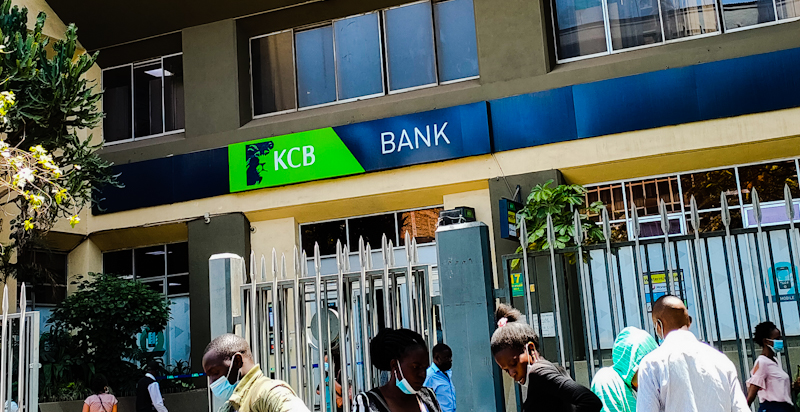
KCB Group on Wednesday reported an 11% rise in full year 2025 pre-tax profit to Ksh 90.9 billion, up from Ksh 82 billion the previous year, driven by growth in interest income across its seven East African markets.
Profit after tax closed at a record Ksh 68.4 billion. Total assets grew 9% to Ksh 2.15 trillion. The board declared a dividend of Ksh 22.5 billion, the largest in the Group’s history, with the share price up 58% during the year.
Group Chairman Dr. Joseph Kinyua said the results reflected a business holding steady through a testing environment.
“The performance remained resilient with improved profitability, a strong balance sheet and stable capital levels. Regional diversification continues to anchor growth, with subsidiaries contributing 30.7% of Group profit before tax and 30.2% of total assets.”
Interest Income Carries the Top Line
Net interest income rose 8% to Ksh 148 billion from Ksh 137.3 billion in 2024, with the loan book expanding 16.2% to Ksh 1.25 trillion. Growth came from new customers across key sectors including personal and household lending at 29.6% of the book, manufacturing and real estate each at 14.8%, construction at 8.4% and agriculture at 6.0%.
Mobile loan disbursements grew 30% to Ksh 544 billion, equivalent to Ksh 1.1 billion per day. By year end, 99% of all transactions ran outside branch channels.
Loan impairments rose slightly to Ksh 32.4 billion from Ksh 30 billion a year earlier, Group Finance Director Lawrence Kimathi told an investor briefing. Kimathi noted that total assets grew 9% to Ksh 2.15 trillion, anchored by deposit growth of 15% to Ksh 1.59 trillion across all markets.
Disciplined Execution Behind the Numbers
KCB Group CEO Paul Russo connected the results to how the bank ran its business through the year.
“Our 2025 performance reflects the strength of the KCB franchise, the resilience of our regional footprint, and the continued trust that customers place in us. Despite a challenging operating environment, we delivered solid growth driven by disciplined execution, continued investment in digital innovation, and our unwavering commitment to supporting sector-focused lending that catalyzes economic transformation across the region. We remained focused on sustainable growth, supporting customers and delivering long-term value for shareholders.”
Russo also addressed lending to the private sector directly, pushing back against any suggestion the bank was pulling back. “The only one of the biggest ways for banks to contribute to employment is to support private sector through lending. We must really increase lending to private sector.”
On digital access and financial inclusion, he was equally direct. “There are constituencies in Kenya that have never had a bank today. When you talk about inclusion, people just think digital. I come from Laisamis constituency. There is no branch, there is no bank.” The new mobile app, he said, changes that equation for customers who previously had to travel hours to open an account.

Subsidiaries Drive Regional Growth
Subsidiaries outside KCB Bank Kenya contributed 30.7% of group profit before tax and 30.5% of the total balance sheet. The non-banking businesses posted strong numbers: KCB Bancassurance grew profit before tax 29% to Ksh 1.14 billion, KCB Investment Bank grew 31% to Ksh 348 million and KCB Asset Management grew 54% to Ksh 160 million.
Among the banking subsidiaries, BPR Bank Rwanda grew profit after tax 23%. KCB Bank Tanzania grew 25%. KCB Bank Uganda was up 58%. KCB Bank South Sudan more than doubled its profit after tax.
Trust Merchant Bank in DRC, the second largest contributor to group assets at Ksh 298 billion, saw profit after tax fall 18% after armed conflict forced branch closures in the east of the country. Russo acknowledged the situation plainly. “We’ve had close to 15 or so branches in DRC closed in eastern DRC. Around 140 of those staff we’ve had to deploy into other assignments for now.” The bank still returned 21% on equity.
NPLs Decline, Coverage Holds
The NPL ratio improved to 16.9% from 19.2% at the start of 2025. The stock of gross NPLs fell to Ksh 211.8 billion from Ksh 225.7 billion. Regulatory coverage, provisions plus collateral, reached 122.4%.
Kimathi told investors the direction was clear. “This is probably the only slide where I’ll say when things go south, we are happy. The work we are doing to get our NPL to the right level is bearing fruit.”
The Group worked the book through rehabilitation, recovery efforts, full and final settlements and write offs. The sale and hive out of National Bank of Kenya also contributed to the reduction.
| Metric | FY 2025 | YoY Change |
|---|---|---|
| Pre-tax Profit | Ksh 90.9 billion | +11% |
| Profit After Tax | Ksh 68.4 billion | +11% |
| Total Assets | Ksh 2.15 trillion | +9% |
| Net Interest Income | Ksh 148 billion | +8% |
| Gross Loans | Ksh 1.25 trillion | +16% |
| Customer Deposits | Ksh 1.59 trillion | +15% |
| NPL Ratio | 16.9% | from 19.2% |
| Cost to Income Ratio | 42.5% | from 45.4% |
| Return on Equity | 22.5% | — |
| Total Dividend | Ksh 22.5 billion | +133% |
Costs Down, Capital Strong
The cost to income ratio fell to 42.5% from 45.4%, with operating expenses declining 2.5% year on year. Core capital as a proportion of total risk weighted assets closed at 18.4%, against a statutory minimum of 10.5%. Total capital to risk weighted assets stood at 22.1% against a regulatory minimum of 14.5%. The liquidity ratio was 50.8%, well above the regulatory floor of 20%.
Return on equity came in at 22.5% and return on assets at 3.3%. Shareholder funds closed at Ksh 331 billion.
On the dividend, Kimathi addressed shareholders who had been pressing for higher payouts. “We’ve heard. We’ve listened. We were waiting for all our stars to be aligned so that we do not put the bank at risk. That has come full circle and we are now ready to give back some of your investment to you. You are the owners of the bank.”
Outlook
Loan growth is guided at 10% to 11% for 2026. Deposit growth at 9% to 11%. Net interest margins are targeted at 7.2% to 7.8%. The NPL ratio is expected to fall further to 14% to 16%.
Chairman Kinyua pointed to the risks ahead while holding the line on the Group’s direction. “Looking ahead, we are optimistic about sustained business activity and economic growth prospects this year across the markets we operate in. We are closely watching the increased global uncertainties attributed to heightened geopolitical tensions and higher tariffs. The Board remains committed to providing strong governance and strategic oversight to ensure that KCB continues to deliver long-term value while supporting economic transformation across East Africa.”
For 34 million customers across seven countries, the work continues.
