



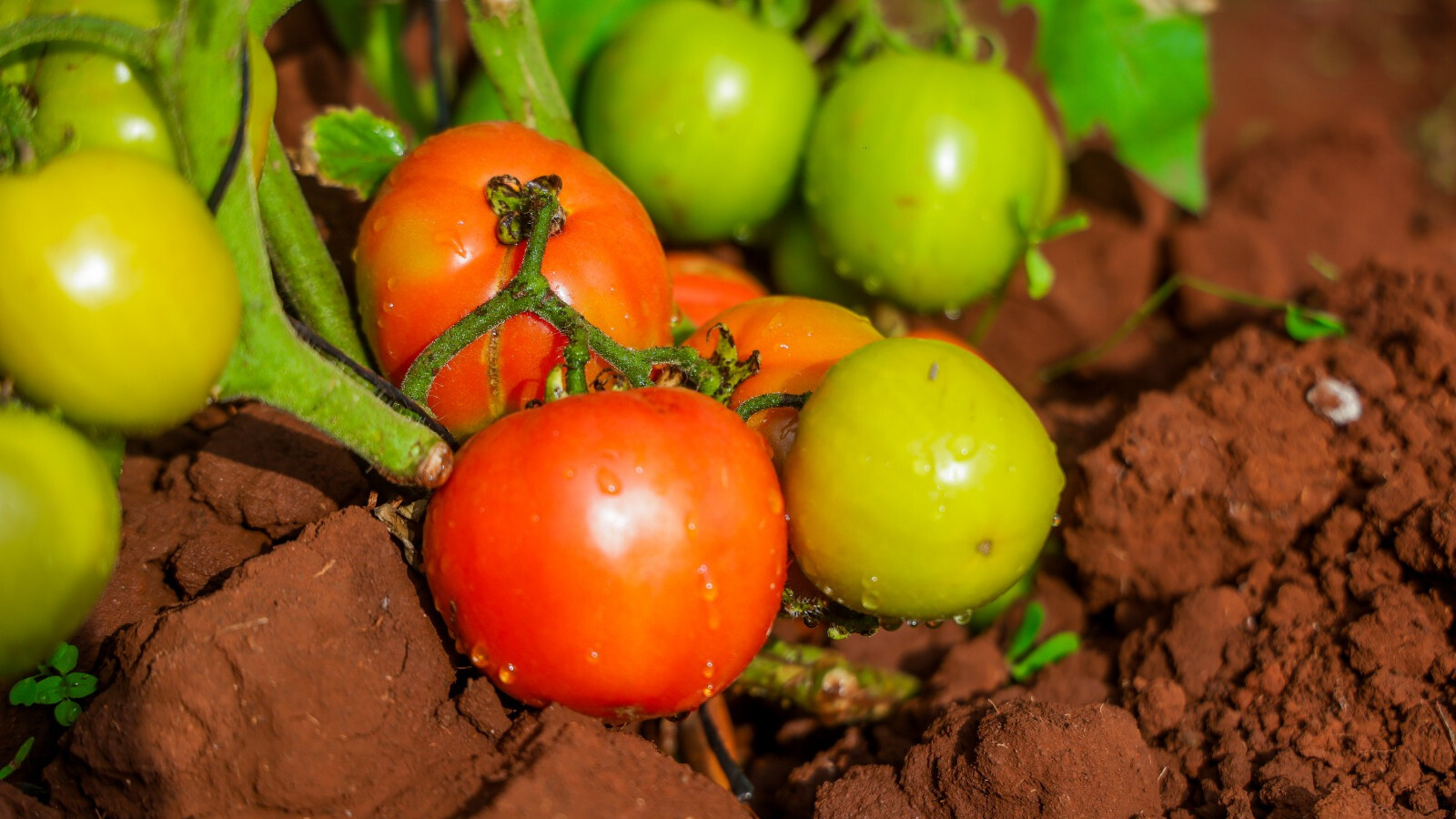
Kenyan tomato farmers are used to making trade-offs. A variety that yields well may struggle with disease. One that survives transport may yield less than expected. In many regions, growers have learned to accept these compromises as part of tomato farming.
But recent variety introductions suggest those trade-offs are narrowing.
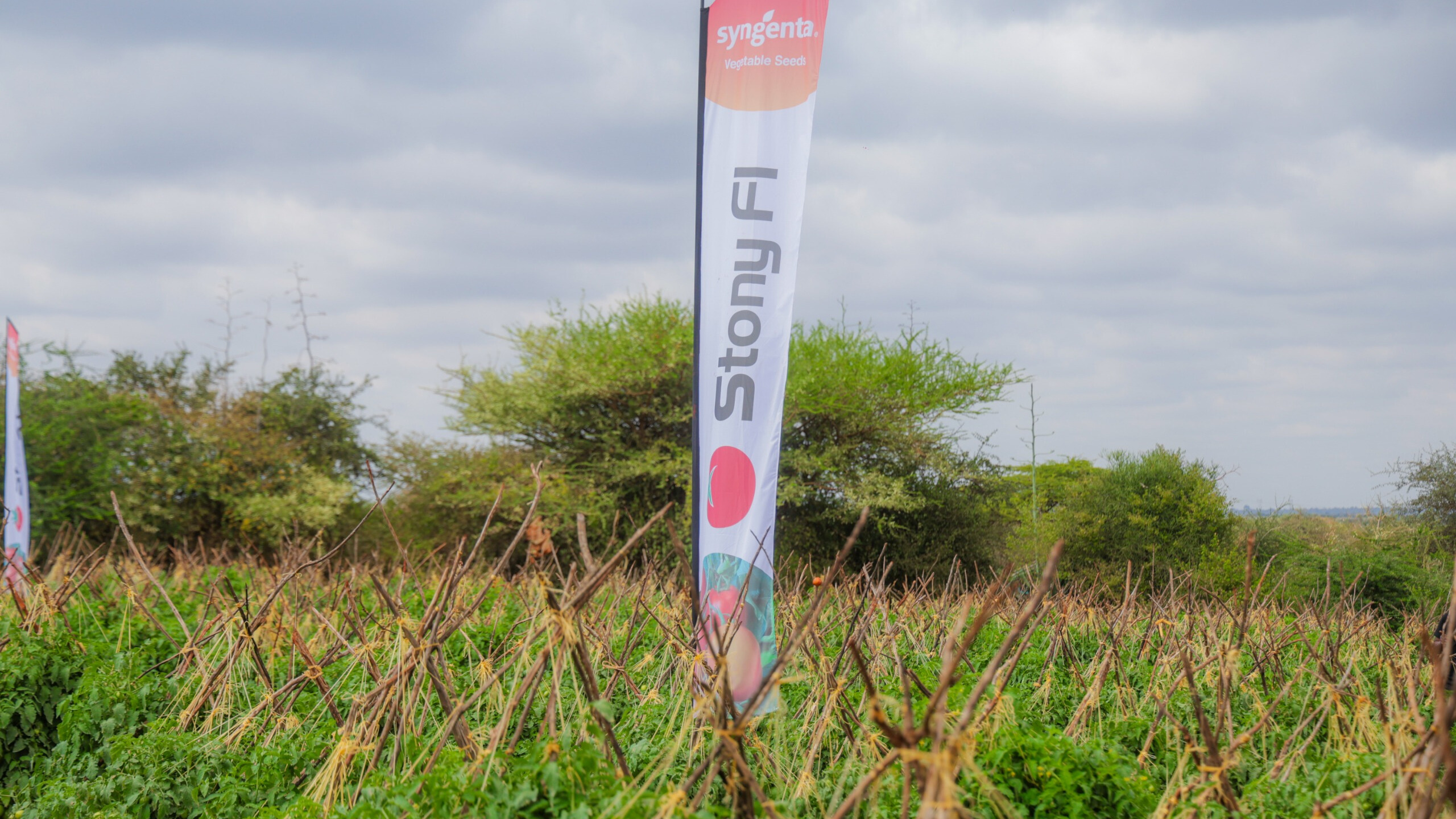
In July 2025, Syngenta Vegetable Seeds Kenya officially introduced Stony F1 at a field event in Kimana, Oloitoktok, a tomato-growing area where disease pressure, heat, and market access all shape planting decisions. The launch attracted farmers, agro-dealers, and extension staff not because it promised something revolutionary, but because it responded to familiar problems: bacterial wilt, Tomato Yellow Leaf Curl Virus (TYLCV), fruit softness, and inconsistent market prices.
Stony F1 joins a group of Syngenta Vegetable Seeds Kenya tomato hybrids already in use across the different counties. Together, these varieties reflect how tomato breeding is increasingly shaped by field realities rather than headline yield figures.
Why variety choice has become central to tomato farming
Across counties, tomato production in Kenya spans a wide range of environments, from cooler highlands to hot, irrigated lowlands. Disease pressure varies sharply by region, and markets are unforgiving when fruit quality drops.
In practical terms, variety choice now determines:
● How long a field stays productive
● Whether the disease wipes out a crop mid-season
● How much fruit survives transport
● Whether traders accept or reject a consignment
Hybrid varieties with targeted tolerance packages and firm fruit types reduce risk between harvest and sale. This is why Syngenta Vegetable Seeds Kenya’s catalogue places strong emphasis on disease tolerance, fruit firmness, and shelf life, rather than yield alone.
About Stony F1
Stony F1 is a hybrid tomato developed primarily for open-field production, with a vigorous plant and compact internodes. The variety combines early maturity with a strong, compact plant structure.
Several traits explain why farmers in wilt-affected areas would love it.
- Disease tolerance
Stony F1 is tolerant to bacterial wilt and TYLCV, two of the most damaging tomato diseases in open-field farming. While tolerance does not replace good crop hygiene or pest management, it can slow disease progression and allow crops to reach harvest.
In areas where bacterial wilt has forced farmers to abandon tomatoes altogether, varieties with partial tolerance are often the difference between planting and not planting at all.
- Fruit quality and handling
Fruit characteristics are where Stony F1 draws most attention. The variety produces large, firm fruits, typically 150–180 grams, with a square to high-round shape and uniform sizing.
And given how tomatoes may change hands several times between the farm and the final consumer, firmness matters, and Stony F1 proudly carries this trait. Varieties that soften quickly lose value before they reach the market.
This variety comes with a 14–21 day shelf life under appropriate handling, a window that aligns with the realities of Kenyan supply chains rather than idealised cold storage systems.
- Yield structure
Stony F1 comes as a vigorous and early variety, with short internodes and five to seven fruits per cluster. Under good management, Syngenta Vegetable Seeds Kenya field observations indicate yield potential of up to 7–10 kilograms per plant and 30 – 35 tonnes per acre.
What matters here is not the headline number, but consistency. Early and uniform fruiting helps farmers recover costs sooner and reduces exposure to late-season disease pressure.
Where Stony F1 fits and where it may not
Stony F1 is best suited to:
● Open-field growers in low- to mid-altitude regions
● Farms with a history of bacterial wilt or TYLCV
● Market systems where firmness and size determine price
It may be less suitable for growers seeking extended harvest cycles from indeterminate plants, or those targeting specialty saladette markets. This is where other Syngenta tomato varieties come in.
Other Syngenta tomato varieties in use in Kenya
Syngenta Vegetable Seeds Kenya’s tomato portfolio reflects the diversity of farming systems in the country. Four varieties commonly referenced by farmers and agronomists illustrate this range.
-
- Tylka F1: extended harvest and shelf life
Tylka F1 is an indeterminate hybrid designed for continuous harvesting. It produces elongated, very firm fruits averaging 120–130 grams, with reported shelf life exceeding 21 days.
Its disease tolerance package includes TYLCV, ToMV, Verticillium, and Fusarium, making it suitable for intensive systems where long harvest windows justify higher management input.
Tylka F1 is often favoured where staking and regular harvesting are feasible and where traders value long shelf life above fruit size.
-
- Kilele F1: determinate and predictable
Kilele F1 offers a determinate growth habit, producing firm oval fruits of similar size to Tylka but within a more compact production cycle.
With maturity around 75 days after transplanting and yields in the range of 30–35 tonnes per acre under good practice, Kilele F1 fits farmers who prefer defined harvest windows and simpler field management.
-
- Rafano F1: coping with heat
In warmer tomato belts, Rafano F1 stands out for its hot-setting ability, maintaining fruit set and size when temperatures rise.
The variety combines tolerance to bacterial wilt and TYLCV with firm, oval fruits and good shelf life. It is often considered for late plantings or consistently hot regions where many varieties struggle to set fruit.
-
- Alston F1: saladette flexibility
Alston F1 is an indeterminate saladette-type tomato, suited to both open-field and greenhouse production. Noted for bacterial wilt tolerance and fruits averaging 130–150 grams, it serves markets that prefer a Roma-style shape.
Its flexibility makes it useful in mixed systems, particularly where growers are transitioning into protected cultivation.
Agronomy still determines outcomes
Across all varieties, one message is consistent: genetics do not replace management. Put some emphasis on the following:
- Raising seedlings in a clean nursery (seed trays or fine-tilth beds). Sow shallow (2–3 cm), keep moisture even, and transplant after 3–4 weeks when seedlings have 4–6 true leaves.
- For open-field production, maintain a 60 × 60 cm spacing. Under protected cultivation, spacing can be adjusted to 60 × 45 cm, depending on training system and variety.
- Staking is recommended to keep fruits off the soil, improve airflow, reduce disease pressure, and ease spraying and harvesting—even for determinate and semi-determinate varieties.
- Apply a basal fertiliser at transplanting and maintain balanced feeding through the season. For good fruit firmness and colour, keep an approximate N:K ratio of 1:1.5 during flowering and fruiting. Where 4–8 t/acre of well-decomposed manure is used, inorganic fertiliser rates can be adjusted.
- Pre-irrigate fields 1–2 days before transplanting and maintain consistent soil moisture. Avoid stress–flush cycles, which increase fruit cracking and uneven sizing.
- Control cutworms early after transplanting and monitor whiteflies, the main TYLCV vector. Variety tolerance helps, but integrated pest management and field hygiene remain essential.
Variety tolerance reduces risk, but agronomic discipline determines whether yield and quality are realised.
A quieter shift in tomato breeding
What Stony F1 and similar varieties represent is not a dramatic break from the past, but a steady refinement of priorities. Breeding is increasingly focused on durability, handling quality, and realistic yield, rather than maximum output under ideal conditions.
For Kenyan farmers, this matters. Markets reward reliability more than extremes, and seasons are too unpredictable to gamble on fragile varieties. The early adoption of Stony F1 reflects a broader trend in farming, that tomato varieties are now judged by how well they survive the journey from soil to sale.
And for many growers, that journey is where the real battle is fought.
