



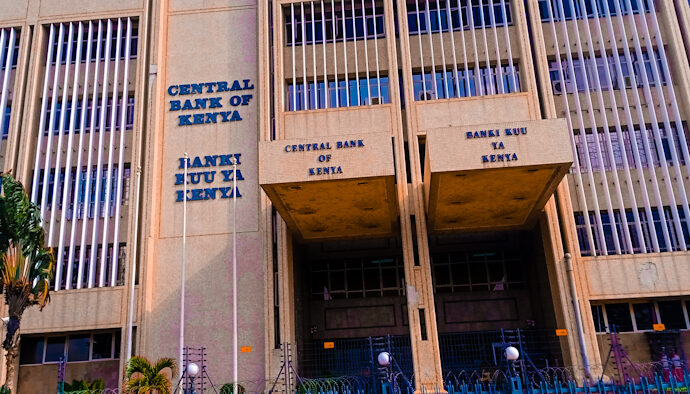
The Central Bank of Kenya’s Monetary Policy Committee (MPC) meets on February 10, 2026, with market analysts widely expecting a hold on the benchmark rate at 9%.
This follows nine consecutive cuts in 2025 that anchored inflation below the 5% midpoint of the CBK’s target band.
However, NCBA Market Research has shifted its initial position, arguing that “room still [exists] for further policy easing.”
Headline inflation eased slightly to 4.4% in January, down from 4.49% in December, though food inflation rose to 7.3%due to dry conditions. Analysts argue that while inflation remains contained, weak aggregate demand and modest credit uptake limit the case for further easing.
Kenya Bankers Association: Call for Policy Stability
The Kenya Bankers Association (KBA) has urged the CBK to retain the benchmark rate at its current level. In a research note released ahead of the meeting, KBA stated:
“Holding the rate steady will help banks complete the shift to the new risk‑based lending framework while supporting economic growth.”
The bankers warn that a policy shift now would force fresh repricing of loans, increase uncertainty for customers, and slow credit uptake. Lending rates are still adjusting following earlier policy easing, with private‑sector credit showing fragile recovery. Non‑performing loans remain high in key sectors, limiting banks’ appetite for aggressive lending.
KBA also points to Kenya’s improving external position as a reason for stability. Strong diaspora remittances—over USD 5 billion in 2025—and robust export earnings have supported the shilling, while foreign exchange reserves stood at USD 12.4 billion in early February 2026, equivalent to 5.3 months of import cover.
Banks argue that these buffers reduce pressure on the CBK to adjust rates, noting: “With external risks contained and inflation within target, there is no urgent need for a policy shift.”
Ahead of the CBK MPC meeting tomorrow, the KBA Centre for Research on Financial Markets and Policy proposes maintaining the current monetary policy stance to allow full transmission of previous CBR cuts, support declining interest rates, and ensure a smooth transition to the… pic.twitter.com/TNT4EOEM6P
— Kenya Bankers Association (KBA) (@KenyaBankers) February 9, 2026
NCBA Market Research: Growth Hinges on Weather and Public Sector Activity
According to NCBA Market Research, “Kenya’s economic performance this year will remain hinged on weather conditions and the pace of public sector activity. Seasonally, horticulture is expected to perform well, especially cut flower exports in the first and second quarter. This is likely to see annual growth touch 5.1%.”
NCBA’s consumer activity index (NCBA‑CAI) rose 0.95% month‑on‑month and 8.9% year‑on‑year in January, signaling improved activity levels compared to December. The uptick was largely driven by seasonal education expenditure.
Despite food price pressures, maize price declines are expected to offset vegetable and fruit costs, keeping overall inflation within the 4.3%–4.7% range in February and March.
An updated note, issued Monday highlights weak aggregate demand and plateauing credit growth as justification for additional easing. “Since then, credit growth has plateaued around the November level of 6.3%. There is thus a policy need to stimulate this further by lowering interest rates,” the report states.
Global conditions also support easing. The IMF has revised global growth upward to 3.3%, driven by AI‑related investment in the U.S. and Asia, policy reforms, and lower trade barriers. Sub‑Saharan Africa is projected to grow 4.6%, reinforcing Kenya’s external sector strength.
NCBA concludes: “We recommend policy easing by the committee in its February meeting to stimulate further private sector credit growth and economic activity.”
Cytonn Investments: Supportive Environment, But Headwinds Ahead
Cytonn Investments paints a cautiously optimistic picture:
“Going forward, the business environment is expected to remain supportive in the short to medium term, underpinned by strengthening demand, improved supply chain performance, and a more accommodative monetary policy stance following the Central Bank of Kenya’s rate cut to 9.0% in December 2025 and the prospect of further easing.”
However, Cytonn warns that rising input costs from taxation and weak consumer purchasing power could constrain profitability.
In the fixed income market, high liquidity has driven rates downward, enabling the government to front‑load borrowing. The government is already 95.8% ahead of its prorated net domestic borrowing target of Kshs 388.9bn, with a net borrowing position of Kshs 761.2bn (inclusive of T‑bills).
Cytonn expects yield curve stabilization as external borrowing increases, noting: “Investors are expected to shift towards the long‑term papers to lock in the high returns.”
