



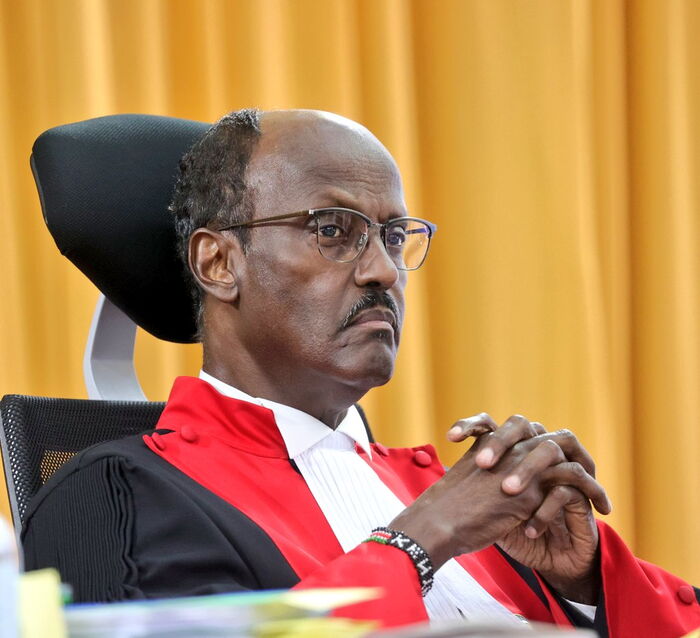
Supreme Court Judge Mohammed Khadhar Ibrahim has passed away at the age of 69 after a prolonged illness.
He died on Wednesday, December 17, at around 4:30 p.m. while receiving treatment at the Aga Khan Hospital in Nairobi. His passing marks a profound loss to the judiciary, the legal fraternity, and the nation.
Illness and Treatment
Justice Ibrahim had recently returned from India, where he was admitted to an intensive care unit for specialised treatment. Doctors later recommended that he return home to Kenya to spend his final days surrounded by family. The Judiciary and his family maintained privacy regarding the exact nature of his illness, referring to it only as a “long illness.”
Official Tributes
Chief Justice Martha Koome confirmed the news, stating:
“On behalf of the Judiciary, the Supreme Court of Kenya, the Judicial Service Commission, and on my own behalf, I convey, with profound sorrow, the passing of Hon. Justice Mohammed Khadhar Ibrahim.”
She added that the judiciary extends its deepest condolences to his colleagues and the Judicial Service Commission during this moment of immense loss.
Law Society of Kenya President Faith Odhiambo described him as “A towering source of inspiration to all who dared to dream,” praising his calmness, intellect, and dedication to justice.
The International Commission of Jurists (ICJ Kenya) honoured him as “He fought for the law, lived by the law, and served the law with honour.”
Judicial Career
Justice Ibrahim was appointed a judge of the inaugural Supreme Court of Kenya on 16th June 2011 after an open and competitive interview. He served with distinction, sitting on panels that heard the 2013 and 2022 presidential election petitions.
- Judicial Service Commission (JSC): Elected on 17th May 2022 as the Supreme Court representative.
- Judiciary Committee on Elections: Appointed Chairperson on 16th August 2021 by the Chief Justice.
- High Court Service: Appointed Judge of the High Court on 22nd May 2003, serving in the Civil Division, later transferred to the Commercial Division, and subsequently to the Judicial Review and Constitutional Division.
- Regional Service: Resident Judge in Eldoret (2007–2009), covering the North Rift Valley, and later Resident Judge in Mombasa (2009–2011) before elevation to the Supreme Court.
He was due to retire on January 1, 2026, upon reaching the constitutional retirement age of 70.
Early Life and Legal Practice
Born on January 1, 1956, Justice Ibrahim studied law at the University of Nairobi before entering private practice.
- He joined Waruhiu & Muite Advocates in November 1982 and was admitted to the Roll of Advocates on 11th January 1983, becoming the first Kenyan Somali admitted to the Bar.
- He rose to salaried partner in 1985 and full partner in 1987.
- In 1994, he founded Mohammed Ibrahim & Associates, which later expanded into Ibrahim & Isaack Advocates, specialising in civil and constitutional litigation, banking law, company law, bankruptcy, commercial law, property law, conveyancing, and insurance law.
Commitment to Social Justice
Justice Ibrahim invested heavily in securing rights for minority groups, particularly the Somali community. He opposed the discriminatory “pink cards” policy that relegated Kenyan Somalis to second‑class citizenship.
His dedication to justice extended to pro bono work and community service. In July 1990, he was detained without trial and spent a month in solitary confinement at Kamiti Prison for offering legal advice and supporting pro‑democracy champions during the one‑party regime.
He was active in the Law Society of Kenya, elected to its Council in 1994, and worked with Kituo Cha Sheria and the Legal Education and Aid Programme (LEAD). A founding trustee of the Mwangaza Trust, a human rights organisation, and contributed to the Lawyers Committee for Human Rights. He remained a member of the Kenya Magistrates and Judges Association.
Legacy
Justice Ibrahim is remembered as a trailblazer, a calm and distinguished jurist, and a defender of judicial integrity. His judgments were marked by deep legal scholarship, fairness, and an unyielding protection of constitutional values.
He was a pillar of the judiciary, respected for his intellectual rigour and quiet strength. His passing marks a significant loss to the Supreme Court, the legal fraternity, and the administration of justice in Kenya.
As ICJ Kenya eloquently stated, “He fought for the law, lived by the law, and served the law with honour.”
