



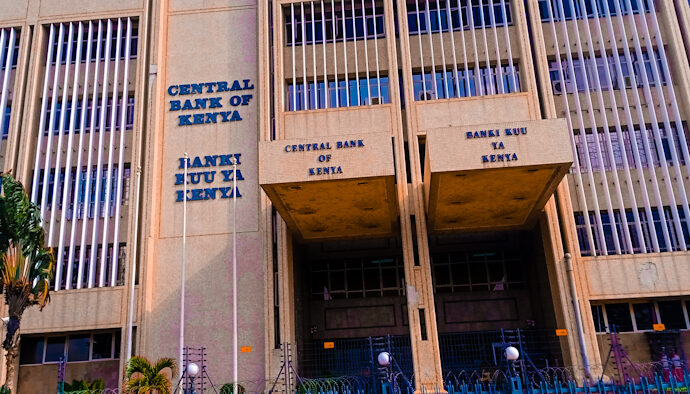
Kenya’s central bank lowered its benchmark lending rate by 25 basis points to 9.50% on August 12, marking the seventh consecutive cut.
The Monetary Policy Committee (MPC) said it saw room to ease monetary policy further, citing stable inflation and the need to boost private sector lending.
“The Committee concluded that there was scope for a further easing of the monetary policy stance to augment the previous policy actions aimed at stimulating lending by banks to the private sector,” said the Central Bank of Kenya (CBK) in its statement.
Inflation Remains Within Target Range
Consumer inflation rose to 4.1% in July from 3.8% in June, staying well within the CBK’s preferred band of 2.5% to 7.5%. Core inflation edged up to 3.1%, driven by higher prices of processed foods such as sugar and maize flour. Non-core inflation climbed to 7.2%, reflecting increased energy costs.
The CBK expects overall inflation to remain below the midpoint of its target range in the near term, supported by lower food prices, stable energy costs, and a steady exchange rate.
Global Outlook Improves, Risks Persist
The MPC revised the global growth outlook for 2025 upward to 3.0%, citing stronger performance in the United States and China. Lower effective tariffs and improved financial conditions contributed to the revision. However, the Committee flagged risks from weak global demand and geopolitical tensions in the Middle East and Eastern Europe.
Kenya’s Growth Forecast Holds Steady
The CBK maintained its GDP growth projections at 5.2% for 2025 and 5.4% for 2026. First-quarter data showed the economy grew by 4.9%, driven by strong agricultural output and a rebound in construction. Leading indicators point to improved performance in the second quarter.
Surveys conducted in July revealed optimism among CEOs and market participants, who cited favourable weather, low inflation, stable exchange rates, and growth in the digital economy. However, some respondents expressed concern over subdued consumer demand and high operating costs.
External Position Strengthens
Kenya’s current account deficit narrowed to 1.6% of GDP in the 12 months to June 2025, down from 1.8% a year earlier. The CBK projects the deficit will stabilise at 1.5% this year, fully financed by financial inflows. This will result in a balance of payments surplus and a USD 673 million increase in gross reserves.
Foreign exchange reserves stand at USD 10.96 billion, equivalent to 4.8 months of import cover, providing a buffer against external shocks.
Banking Sector Shows Resilience
The banking sector remains stable, with strong liquidity and capital adequacy. The ratio of non-performing loans (NPLs) held steady at 17.6% in April and June. NPLs declined in construction, manufacturing, and household lending but rose in trade, tourism, and hospitality.
Commercial banks continued to make adequate provisions for NPLs. The CBK also reviewed a proposed revision to the Risk-Based Credit Pricing model, which aims to improve monetary policy transmission to lending rates.
Credit Growth Accelerates
Private sector credit grew by 3.3% in July, up from 2.2% in June and -2.9% in January. Lending to manufacturing, trade, construction, and consumer durables increased, reflecting stronger demand and falling interest rates. Average lending rates dropped to 15.2% in July, down from 17.2% in November 2024.
The MPC noted that the government’s fiscal consolidation strategy, reflected in the FY2024/25 and FY2025/26 budgets, supports debt sustainability and macroeconomic stability.
“The Committee will closely monitor the impact of this policy decision as well as developments in the global and domestic economy and stands ready to take further action as necessary,” said Dr. Kamau Thugge, Chairman of the Monetary Policy Committee.
The MPC will meet again in October 2025.
